Return to Paris Day 22

Monday April 22

My last morning in Paris, I walked to Rue Berthollet the first place Mayotte Capecia lived in Paris.  It’s Easter Monday, so the streets were empty.  The walk from Rue Irelandais goes along Rue L’Homond, passes a small garden, turns down Rue Retaud adjacent to yet another garden.  Paris is like that, places of unexpected green and rest.

IMG_6311-4
Rue Retaud
Yet, where Claude Bernard intersects with Rue Berthollet, there is little greenery.
IMG_6300
15 Rue Berthollet, Mayotte Capecia’s first home in Paris

What was it like for Capecia to land here coming from a small island surrounded by the sea, alive with verdure?  In Je Suis Martiniquaise, her first person narrator, also named Mayotte, describes an idyllic childhood:

Why did I decide to write?  I had just arrived in Paris….. It was cold and snowing and the gentle whiteness falling from the sky that I was seeing for the first time both fascinated me and caused me pangs of homesickness.  That is when I wrote down some of the childhood memories about my country.

Each day for me was different, each day brought it’s own revelation, each day was like a net that brought strange fish to the shores.  But I think that my favorite moment was the evening when all the village children gathered on the endless beach.  We rolled in the sand, still lukewarm, flecked with tiny stones, clear as glass in which the last rays danced, and which I thought, were like dead stars fallen from the sky the night before.  On our half naked bodies we felt the voluptuous caress of a fresh breeze.  The sun set slowly and, minute by minute, the colors changed.  The ocean horizon became yellow, then orange- I do not remember ever in my life having seen a more beautiful spectacle.

In 1905, my grandmother faced the same contradictions coming from the small town of Soufriere, Saint Lucia to Hoboken, New Jersey, then, onto Washington Heights in Manhattan.  Perhaps she was not so disconcerted.  Her father had sent her and a few of her sisters to school in England, so she knew a different “lieu” or place.  Perhaps, she looked forward to leaving the confines of a small island where there were few surprises.

Unknown-1
Hoboken Ferry to Manhattan, Early 1900’s

Soon after arriving in Paris, Capecia became a cook for a family in order to make ends meet.  She was alone, her children left behind in Martinique in the care of her twin sister, Reine, who later joined her.  My grandmother was eventually brought to New York by a sister, her older sister Yia.  What greeted her?  Aunt Yia lived above a store front.  Even in the 1960’s, she had to be called from the street in order to enter her apartment.  In the early 1900’s, she had access to the cellar where she put up boarders, each bed separated only by a sheet.  One of those boarders was my Greek grandfather.  Was this a shock to both grandparents, one from Saint Lucia, one from the small village of Kastellia in Greece?

d085f3f247e15a60abd2fa89f9e21b6e
Women Playing Cricket, Saint Lucia 1905
kastellia_prosp2
Kastellia, Fokida, Greece
apo_tous_protous_metanastes_stnv_Ameriki_thumb
My Greek grandfather, Efstadiou Zinis, (middle, top row), early 1900’s shortly before he left for America

Capecia had to work most of her adult life.  She wasn’t a stranger to supporting herself.  And my grandmother?  She certainly had it better in Saint Lucia than Capecia in Martinique.  She had been abroad to school, she and her sisters played instruments, traveled first class to America, and like good Victorian women, they knew how to sew.  After her sister Yia threw out her husband, she earned her living as a dressmaker or as Yia, always aiming high, described on her card, a dress designer, not merely a seamstress.

Another commonality between Capecia’s protagonist and my grandmother, Germaine, was a preference for white men.  When the local priest in Je Suis Martiniquaise offers to help her learn her catechism lessons, she writes:

He looked at me with his bright blue eyes.  Oh, how I have loved to be blond like him!

Later when the character learns that she had a white grandmother, she wonders if her mixed race mother had married a white man instead of her black father, would her life have been easier.  She ends the chapter with this declaration.

I, who was still thinking about the Father (the priest), decided that I could love only a white man, a blond with blue eyes, a Frenchman.

Although in the early 1900’s when my grandmother married my Greek grandfather, he wasn’t exactly considered “white.”  This possibility was pointed out to me at a coffee I was required to give as a Marine Corps officer’s wife.  The women were discussing the marriage of Jackie Kennedy to Onassis. “How could she marry that dirty Greek?” one woman decried.  The others clucked in sympathy.  After a few minutes of decision making, I told them, “My grandfather is Greek.” That was the end of the coffee.  Unlike my grandmother, I didn’t hide my heritage, at least, not what I knew of it.  But I wasn’t in danger of being lynched for the color of my skin.  Between 1882 and 1968, almost 4000 African Americans were lynched.  And it only took “one drop” of Africa heritage to fall into that category.

IMG_6598
My great grandmother’s death certificate.  She is described as colored

Years later, while visiting  my grandfather’s Greek village, a cousin said to me, “Oh your grandmother’s name was Mary.” No, I told him that was my grandfather’s second wife after my grandmother Germaine died.  His disdainful response, “Oh, yours is the black grandmother.”  Did my grandfather have the same contempt for his wife.  It seems he did: he told his Greek family Germaine’s secret with his white Irish wife on his arm.

And this prejudice or preference runs deep.  My daughter’s  Greek professor when meeting me said with pleasure, “Ah you have the blue eyes of the north.”

What is it this desire to be white, to be blue-eyed?  Was my father pleased I had blue eyes even if my skin didn’t quit meet his standards?  Not always.  Too dark.

I planned to uncover the experience of being a mixed race French West Indian living in Paris trying to get closer to my family’s experience of passing.  I’ve only scratched the surface.  I will come back, come home as my family and I seem to view Paris.

IMG_6319
View from my room, my last night

As Jean Rhys, that other creole, says to a companion at the end of her novel Good Morning, Midnight

Well, there you are, Paris, and this is a good-bye drink….

Return to Paris Day 20-21

Saturday April 20

On my way to buy gifts at Bon Marché, still trying to trace Mayotte Capecia’s life in Paris, I strolled along Rue Mayet where she had lived with her sister in 1947.  The small street runs between Rue de Sevres where Bon Marché is located and Rue du Cherche-Midi, I didn’t know the number so I used my imagination to guess where she might have hung her hat.  Could one of these have been her building?

IMG_6205

I’m anxious to buy an important birthday gift for an interesting four year old.  Last year, I discovered that Bon Marché replaced their extraordinary notions department on the top floor with an equally extraordinary children’s department.  Another disappointment.  The department pour les enfants has been drastically reduced.  As I told a salesperson, “C’est dommage,” that’s a shame.  Nevertheless, I manage to spend over 50 Euros.  After dropping more money at Zara’s located across the street, it was time to make my way home.  Back on Rue du Cherche-Midi, I passed Le Nemrod and stop for lunch.  I should have done more of this: sit outside with a delicious salad, a glass of rose, and watch the French go by.

IMG_6224

On my back through the Jardin du Luxembourg, a young man approached me and said in French how beautiful “it” is.  Assuming he was referring to the espaliered apple trees we were next to, I readily agreed.  He realized that I was an American and continued in English, making niceties as we strolled together.

IMG_6228

He suggested we exchange phone numbers.  I declined, graciously, I hope, and he wandered away unsuccessful at snagging  what he may of thought was a woman of a certain age with a comfortable income.  Is this a Jean Rhys moment from the pages of her novel, Good Morning Midnight?  In the evening, her protagonist, having returned to Paris after years away, wanders up the Boulevard Saint Michel confronting her age, her older status.  And like me this is a location where she has walked often.  Two men approach her and one asks, “Pourquoi etes-vous si triste?”  Why are you so sad?  She tells them she’s not sad although she admits to herself she is:

”Yes, I am sad, sad as a circus-lioness, sad as an eagle without wings, sad as a violin with only one string and that one broken, sad as a woman who is growing old.”

Because she discovers they are Russian, she accepts their offer for a drink.  Is she braver than me, sadder than me, less cynical?

I arrive back at the Centre Culturel Irlandais by late afternoon.  It’s cooled off and the courtyard is almost empty.  A good time to write, to consider answers to those questions.

IMG_6230


Sunday April 21

It’s Easter Sunday and Jean Rhys is still with me.  Parallel walks, parallel observations.  In the novel, she describes an earlier time in Paris when the protagonist worked in a dress shop, and got off the metro at Rond Point at 8:30 every morning just as I had years ago hawking newspapers.  Her character Sophie must face the dilemma of Sunday in Paris.  “…Sunday – a difficult day anywhere.  Sombre dimanche….”

I feel compelled to go to La Brasserie de L’Isle Saint-Louis for lunch.  I’ve sent people here for supposedly the best sauerkraut in Paris.  In order to get there, I had to negotiate every inch of Pont de Tournelle as hundreds crowded the bridge to photo the blackened Notre Dame.  Hot and sweaty, it was seventy-six degrees, I managed to get a seat on the terrace overlooking the Seine.  When I ordered choucroute garni, the waiter asked if I was sure that is what I wanted, a dish piled high with different cuts of ham, sauerkraut, and potatoes.  I wondered myself.  An odd choice for a hot April day,  But I stubbornly proceeded.  I like it but ate only half.

Unknown

After a stroll around the L’Isle Saint Louis and some ice cream I noticed crowds forming by the Pont L’Archeveche and watched an enchanting escape from the charred remains of Notre Dame fully in view.  A group of professional skaters lifted spirits as they graciously danced along the bridge.


Looking For Rachel Day 4

Wednesday, September 5

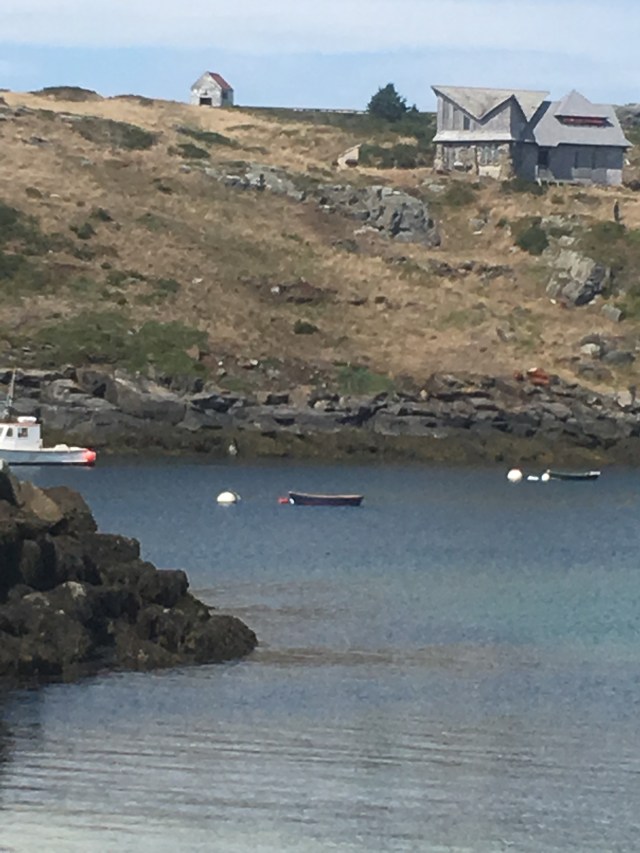
Today, we took the ferry from Boothbay Harbor to Monhegan Island, over sixteen miles away.  A whale was sighted but I managed to miss it.

In her book, The Edge of the Sea, Carson writes of Monhegan Island, “…which in ancient times must have stood above the coastal plain as a bold monadnock.”  According to Britannica.com, a monadnock is, “an isolated hill of bedrock standing conspicuously above the general level of the surrounding area.”

img_4700

Our first stop was the Fish House noted for it’s lobster rolls.  I remember driving to Wood’s Hole decades ago and stopping at roadside stands.  Two dollars would get a hot dog bun filled with lobster salad; then, small pieces of lobster pieces fit the roll.  Now everything is super sized and doesn’t appeal.  I opted for fish tacos.

The restaurant, a short walk from the Ferry to Dead Man’s Cove, faces Manana Island where the Manana Island Sound Signal Station is located, sending out fog signals since 1855.

img_4689

From there, we walked to Lobster Cove.  The path reminded me of the difficulty getting to the beach at Rachel’s house.  Narrow trails towards challenging rocks.  I had hoped to see some birds of note but none appeared.  Like Rachel Carson, I’m fond of sighting birds.  Unlike her, I’m inconsistent in my attempts.  My friends ventured further.  I remained cautious.

img_4698

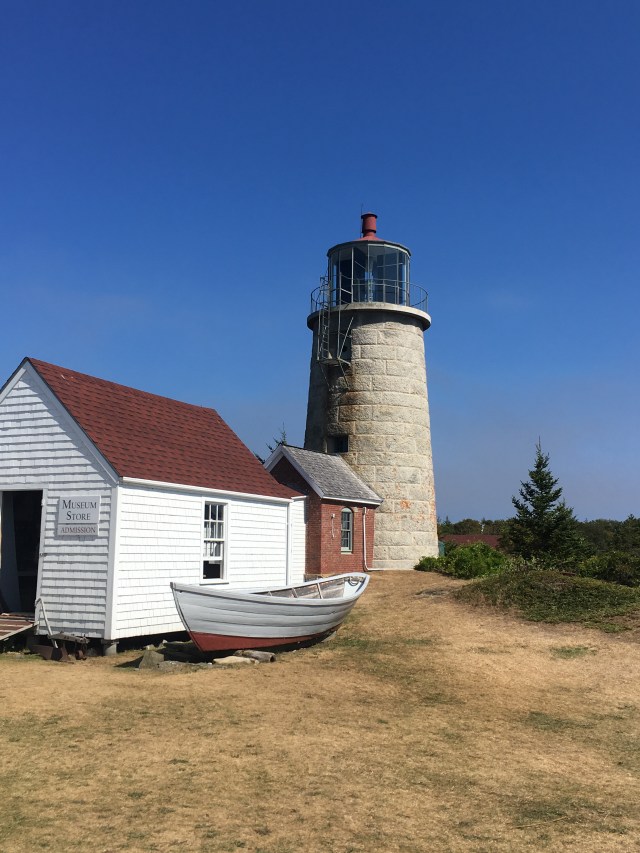
Next the Monhegan Museum of Art and History,  part of the keeper’s house on the Lighthouse grounds.  A real treasure like the museum on Ile Aux Marins across from Miqulon, the French outpost off the coast of Nova Scotia. We stepped back into the past with views that stopped my breath.

img_4734

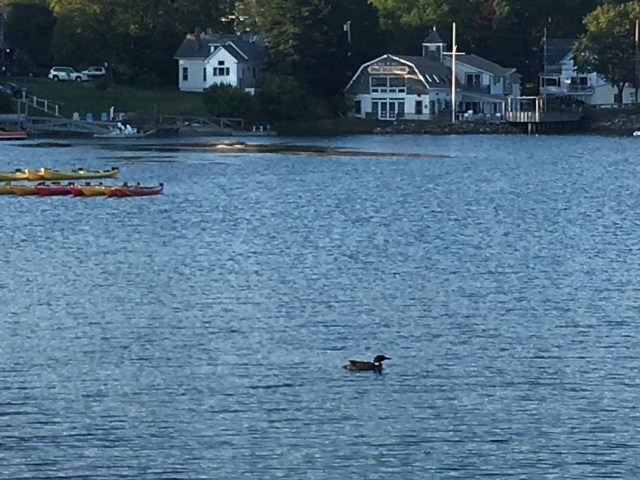
We had to do a quick tour in order to reach the ferry on time.  Once back in Boothbay Harbor, we crossed the Boothbay Harbor Footbridge to the other side and did see a bird of note: a loon.

img_4740

We ended the day with a dinner of beans on toast.  Then a look at the stars while reading aloud James Harpur’s poem, “The Perseids.”  And we were moved.

And in the freckled darkness

the stars looked down on us

and on the gathering of silent animals,

as if they’d willed us there, the ones

they had been waiting for,

ensouling the universe

with our thoughts for sick and absent friends

and wishes for uncertain futures –

the stars saw the meaning of life –

if only for the time it took

to see and lose a prayer

in our evaporating trails of love.

From  The White Silhouette, Carcanet, 2018 

img_4641


Looking for Rachel Day 3

Tuesday September 4

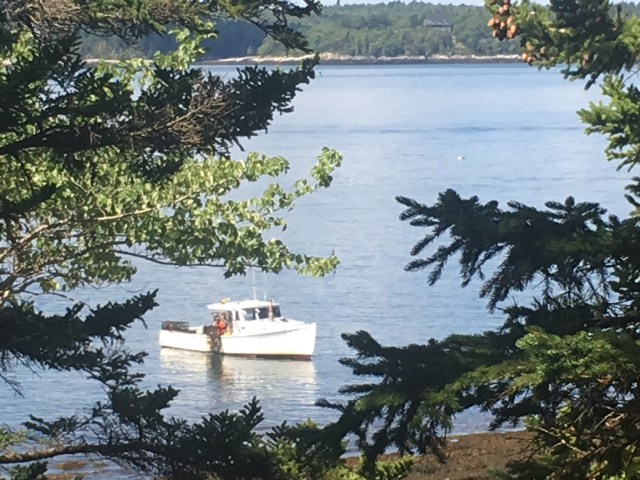
I began the day walking to the town beach.  I can imagine a routine that would include this morning stroll.  When I returned, we had breakfast on the porch and watched a fishing boat make it’s way up the Sheepscot River.

img_4656

On the itinerary for today was Boothbay Harbor.  This visit disappoints.  Having read a biography of Rachel Carson and articles about her time in Maine, I imagined a small understated New England town.  Instead most stores fill their shelves with tourists’ merchandise.  One of my friends commented on their playlist, 60’s pop to appeal to baby boomers.

Just like New Hope Pennsylvania, Boothbay Harbor sits along the water: New Hope along the Delaware, Boothbay Harbor on the Atlantic.   Henry Miller, when he returned to the states from Europe as WWII took hold, wrote The Air Conditioned Nightmare, an account of his drive cross country east to west.  He stopped in New Hope which he described in scathing terms.  The town often described as a refuge for artists, seemed to him the home of non-artists.  He recognized the beginnings of the tourist trap it would become.

After some grocery shopping, we returned home and once again, I walked to the beach. I watched cormorants perch along the rocks and talked to several people.  As I looked into one of the tidal pools,

img_4650

I imagined a perfect routine: a walk to the beach every morning, coffee on the deck, writing, chores in town, writing in the afternoon, another walk to the beach, then, back to the deck for drinks, dinner, and to bed with a book.  Heaven.

Dinner was a group effort.  We played music, drank gin and tonics, talked, laughed for hours, and watched the sun set on the Sheepscot.

img_4681

Regardless of the amount of alcohol consumed, I was able to do some writing before hitting the sack.

img_4665

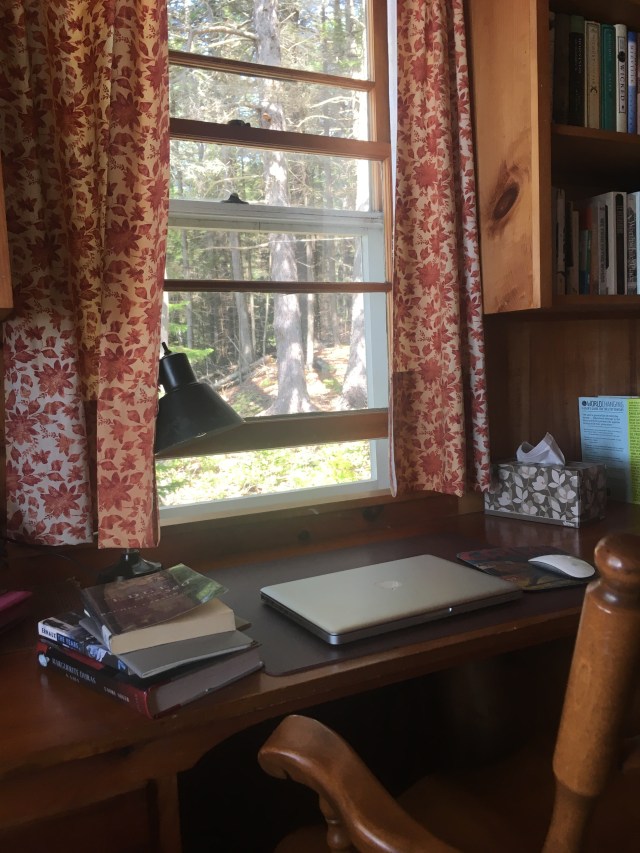
Another bit of heaven, writing where she wrote.

Looking for Rachel Day 1

Sunday  September 2 2018

“Going down into the low tide world,”

Always Rachel, The Letters of Rachel Carson and Dorothy Freeman

I am in her house, but not in her world.  I can see the body of water, the Sheepscot River that eventually reaches the sea, but I can not touch it.  This morning, my first morning, I walked along the path that leads to the shore but could go no further than the long ledge of rocks that line the coast, slippery and dangerous.

IMG_4901

When Carson first moved to Southport, Maine, she had a note from a neighbor, Dorothy Freeman, welcoming her.  She invited Dorothy and her husband to a Sunday exploration of the very coastline that challenges me.

After a friendship developed between the two women, Carson wrote to Dorothy that she wanted to preserve the forest off Dogfish Head Road which extends north to the tip of a peninsula of the same name.  It’s the site of an early settlement as well as the port where steam boats carried summer guests to Southport.  Dorothy was one of those early visitors, traveling by steamer from Boston to Southport when she was just an infant.

The act of preserving was imperative to Carson.  But as Linda Lear (a Carson biographer) explains, ”She also wanted to preserve the paths these two friends had lovingly tread.”  Carson called them the “Lost Woods.”  I walked along the path that seems to lead to those woodlands, but it went nowhere; instead, I saw only houses.  So the woods are lost.  I’m saddened.   A contradiction as I’m sharing her very house with my two loving friends, Karen and Iris.

images
 The Lost Woods

Karen and I rose early.  She is reading the Sea Around Us, Carson’s poetic and scientific portrait of the sea, and I’m reading Always Rachel, a present from Karen. I began to peruse the book, looking for links to my stay and read aloud those first few entries hoping to inspire our outings.  Karen also explored the grounds and, like me, reached only the top of the rocky shelf.  But she feels confident we can make our way if we do it together, much like Rachel and Dorothy did on that first meeting.

Unknown

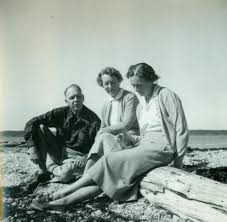
Stanly Freeman, Dorothy Freeman, Rachel Carson

We have a hard time getting out of the house, so much to share, to review.  I worry that I won’t be looking for Rachel.

Today, we visited monarchs at the Costal Maine Botantical Gardens in Boothbay.  A guide in the Butterfly House told us that the staff knows when the Monarchs will migrate: then, they lift the screened roof and the monarchs make their journey to Mexico. This guide was particularly fond of the Mourning Cloak butterfly: it doesn’t migrate but toughs out the winter in Maine, making its home in an oak tree, then, in the Spring, climbs down the trunk to drink it’s sap.

Unknown-3

Mourning Cloak

Tomorrow is Labor Day and we will look for Rachel at the Newagen Inn which she visited for the last time on another Labor Day watching Monarchs fill the air.  My worries were unfounded- a serendipitous link to Rachel.