Day One and Two

Friday March 13 -Saturday March 14

This journal attempts to record observations during an extraordinary time.  Although the title for this entry says “Day One,” it is actually 207 days since my first interaction with the virus.  That day my doctor urged me to cancel my trip to Paris afraid I would be one of the now 5.7 million Americans stricken with the disease.  I didn’t listen: on February 15th, I landed at Charles De Gaulle airport.  My return flight was booked for March 20th.  I didn’t make it.  On March 13th, I raced home like thousands of other Americans after President Trump announced the closing of borders at midnight to anyone traveling from Europe.

Once home, I ran around the supermarket loading up on beans and toilet paper in a frenzy of ignorance.

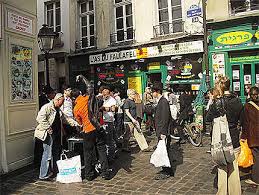
The next day, March 14th, I faced my first day of reckoning.  Like many humans, my thoughts turned to vanity.  Who would cut and color my hair?  It was due.  My hairdresser had already closed her store but said she might consider seeing a few regulars.  I jumped at the offer, ignoring the risks .  These were early days.  Maybe I felt invincible.  I had been in France during fashion week when some Italians had been allowed to enter the country as Italy reeled from the voracious spread of the virus.  I had walked down the narrow streets of the Marais past fashion show venues bumping into people, perusing stores for hours.

UnknownMarais, Paris

 In London, I had been to the movies, to the British Library, the National Archives, spending whole days researching family history.

images-1Curzon Cinema, Bloomsbury, London

I was in Ireland just as Dublin shut down.

imagesO’Connell Bridge, Dublin

I had flown on a crowded plane for more than 6 hours and then taken an hour train ride home.  But I wasn’t sick.  So couldn’t I get my hair cut?  No, I finally decided, I couldn’t and so began five months of isolation and negotiations with family, friends, neighbors, fellow citizens, with myself on what to do and how to manage.

Dublin Day 5

Wednesday, March 11

The plan- research my Irish ancestors at the National Archives of Ireland on Bishop Street,  a 2 mile walk across the Liffey into a gritty part of Dublin.
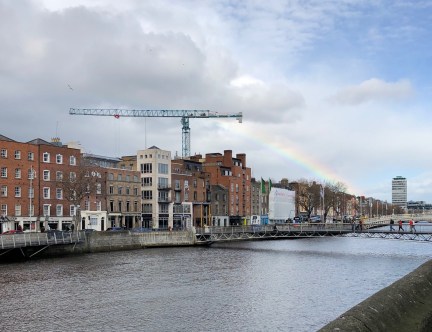
IMG_7655-2Millennium Bridge, River Liffey, Dublin

However, the Archives were closed due to the corona virus.  The day was just about shot, so I made my way to Dunne’s Department Store on Henry Street just blocks from my flat.  They stocked faux bone cutlery I had admired at my friend’s house and had unsuccessfully searched for in the Paris “marchés.”  Once I located my prize, I realized 8 forks, 8 knives, 8 soup spoons, and 8 teaspoons were too heavy to fly home.  The clerk recommended sending them through the postal service.  This required a trip to the General Post Office (GPO) on O’Connell Street, the republican’s headquarters during the 1916 Easter Rising when they attempted to end 800 years of British occupation.  Beginning Easter Monday, April 24th, the leaders of the rebellion took control of the building.  By Saturday, April 29th, shelling of the GPO made it uninhabitable.  They escaped by breaking through walls of surrounding buildings only to surrender hours later from their new headquarters at 16 Moore Street.

The_shell_of_the_G.P.O._on_Sackville_Street_after_the_Easter_Rising_(6937669789)General Post Office, Dublin, 1916 Easter Rising

Although it was almost closing, the postal workers were most helpful, the cost was reasonable, my problem was solved.

A downpour forced me home where I lit a fire, took up Angelica Grant’s, Deceived With Kindness: A Bloomsbury Childhood. and had leftovers for dinner.  I was about to watch TV when I got a text from my cat sitter.  “Because of the Corona Virus, Trump is closing the airports on Friday to international travel.  Will you be okay?”  No.  I wasn’t scheduled to leave for another 10 days.

Unknown

I’m obsessed with how some Jews knew it was time to leave Germany and other parts of Europe during Hitler’s reign.  Would I have had the courage, the sense to get out?  Here I was in a somewhat similar dilemma but I hadn’t paid attention.  My doctor had asked me to cancel this trip because of the virus.  I had had inklings of it’s problems in Paris when France barred Italian trains.  But I hadn’t changed my plans.  Now I had to get out of Ireland by Friday or be trapped in a foreign country,  or so I thought.  Immediately, I got on the phone to change my reservation.  By midnight I managed to get two flights: one with a stop over in London leaving in 6 hours, another leaving Dublin on Friday getting in at noon.  By 3 A.M, I had made a decision.  Worried I might get stuck in London, I chose to leave on Friday even though the flight might be delayed: the time difference between Ireland and the states gave me a 5 hour advantage.

Thursday created it’s own problems.  When I tried to confirm my flight, United Airlines had an expired passport number.  I tried to make the changes on line but to no avail.  When I called the airline, I got disconnected after being on hold for three hours.  Around midnight, I gave up and checked in using the wrong passport number.  I would make the correction at the airport.  But if I couldn’t, would I be kept in Ireland indefinitely?  This was the second time I wondered if I could get home from Europe.  I had been in France on 9/11 and for the few days when the US airports were closed, I imagined never getting home or being shot down mid air.

A cab picked me up at 5 A. M. Friday and for about a half hour provided some distraction.  After the driver uncovered I was doing research on my Irish grandmother’s education, he gave me a brief history of hedge schools.  During the 18th and part of the 19th century, only those of the Anglican faith were allowed to attend school in Ireland.  Hedge schools, usually held in barns, homes and fields were organized to give Catholic children (who were in the majority) an education.  Something to mull over in terms of my great- grandmother.  On the Irish 1901 census, it indicated she could read and write.
Rathvilly-Hedge-SchoolsRathvilly Hedge School Around 1827

Once at the airport, I went to the print out my ticket.  I dug in my handbag for my wallet.  Nothing.  I ran from person to person looking for help.  Finally an airport employee used her phone to call the cab company and yes, they had it and, yes, they would drop it off.  Relief.  But once I went through security, would I be prevented from leaving?  My passport indicated I had been in France just 10 days ago, a restriction for entering the United States.  I got through.  Momentary relief.  As I wandered around the airport, I learned that I had to go through United States Preclearance.  Now I was really worried.  This was US security.  What would they do when they realized that I had recently been in France?  And the line was exceedingly long.  Would I miss my flight?

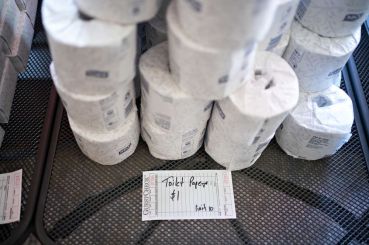
My worst fears came to nothing.  I was back in Princeton by 2 P.M. –  enough time to rush to the grocery story and stock up on toilet paper.
1000x-1

Dublin Day 1-2

Saturday March 7

These days were spent at a friend’s house without much writing, just a brief adjustment to a new country.  Getting there was not easy.  My mode of transportation was a shuttle that stopped within a few blocks of her house.  When I arrived at Dublin Airport, there were no signs directing me to the bus line.  An airport employee led me outside to a bank of bus quays.  But which one?  A man seeing my distress helped me navigate my luggage in what he thought was the right direction; eventually, he became confused and walked off shaking his head.  I chose one whose sign had the same color as the advertised shuttle, red, and settled in for a long, cold wait.  Eventually, I made it to Lucan.  A few glasses of wine, dinner, then bed.

Sunday March 8

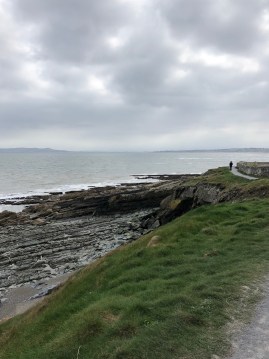
A full day.  As we often do when I visit, we took her dog on a long walk along the cliffs of Donabate which face the Irish Sea. Exquisite as ever.

IMG_5876Donbate

Then a film at the Lighthouse Cinema, more a cultural meeting place with it’s lounges and bars.

imagesLighthouse Cinema Dublin

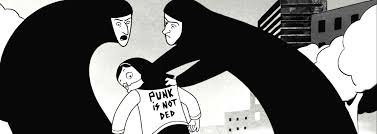
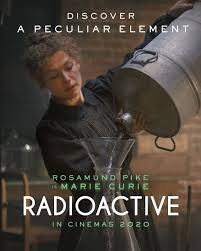
The showing of Marjane Satrapi’s Radioactive, a biopic on Madame Curie, was of particular interest: an interview with Satrapi followed the film.  Several connections.  First, in Paris, at the Irish Cultural Center, I lived across the street from the Curie Institute.  Second, I have taught Satrapi’s animated film Persepolis many times as well as the two graphic memoirs on which it is based.  I found the film Persepolis disappointing compared to the memoirs which gave a more informed view of life in Iran during and after the 1980 cultural revolution.   However, the superb quality of the animation brought the graphics alive as if they were jumping off the page.

images-2Persepolis

Radioactive’s conventionality surprised me.  Satrapi is anything but conventional.

images-1

It could have been a Hollywood biopic complete with out of focus love scenes cutting to romantic water views.  Entertaining but not so interesting.   However, the interview did better.  Satrapi did better emerging as the outspoken unguarded woman of Persepolis.

In the restroom, for the first time, I took into account the threat of the Corona Virus:  I washed my hands for 20 seconds.


London Day 1 and 2

Monday March 2

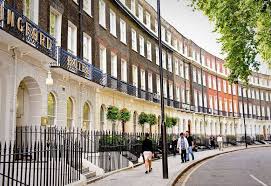
I flew from Charles de Gaulle to Gatewick without a hitch.  I had read that the black cabs of London cost the same as Uber.  Not true.  100 Euros later, I arrived at my hotel, the Crescent, located on Cartwright Gardens in Bloomsbury.   Since the Georgian building has no elevator, once the woman at registration saw my luggage, she opted to change my room to the ground floor overlooking a small courtyard.

Unknown-2Cartwright Gardens

By now it was almost 7: time for dinner.  Luckily Marchmont Street around the corner is home to a number of restaurants.  I settled on the most crowded: the Marquis Cornwallis, named after an 18th century merchantman ship dating back to the 1800’s.   Customers seat themselves, then, place their order at the bar.  When a waiter picked up the remains of my dinner, I asked if I had to return to the bar to order dessert.  “No, love. I’ll get it for you.”  Nothing like being addressed as “love” to feel less alone.

Unknown-3Marquis Cornwallis, Marchmont Street, Bloomsbury, London

Tuesday March 3

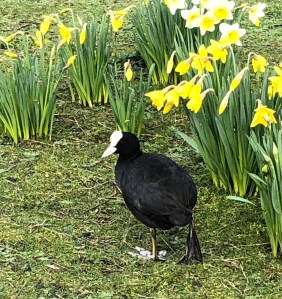
As my son Larry was in England on business, we planned to spend the day together.  And a lovely day it was.  We managed to have a full English breakfast at the Crescent and set off under a blue sky for the 1.5 mile walk to Regents Park which can be a paradise for bird watchers.  We were able to sight common coots and grey herons.

IMG_7488Common Coot

We spent an hour or more meandering through the park, crossing the bridge to the Japanese Garden Island, then on to Queen Mary’s Rose Garden, landing at the Regents Bar and Kitchen where we rested with a cup of coffee.

IMG_7498Weeping Willow at the ornamental lake of Queen Mary’s Garden

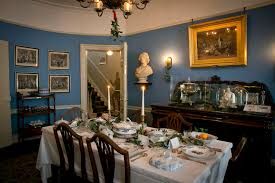
We used the Euston Road to return to Bloomsbury and made arrangements to meet at the Charles Dickens Museum later in the afternoon.  He remembered when he was eight that I was member of the Dickens Society in Philadelphia, so a visit seemed especially cogent.

Unknown-4Dining Room, Charles Dickens Museum

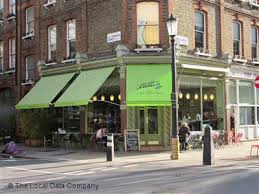
We like to be flaneurs, walking and looking, without much planning.   After leaving the Dickens Museum, we set out in search for a coffee shop.  Somehow we ended up at Great James Street a few blocks away and came across Dorothy Sayers’ house (author of the Lord Peter Wimsey novels).  Eventually we made our way to Tutti’s Cafe, a small convivial coffee bar on the charming Lamb Conduit Street.

images-2Tutti’s Cafe, Lamb Conduit Street, London

Dinner was forgettable but the building was charming.  We did have an interesting conversation about writing and about this blog.  Larry calls the urge to create, the beautiful struggle.  He doesn’t think I’m revealing enough of that struggle.  Certainly, you won’t see it on this page.


Paris Day 15 and 16

Saturday, February 29

This morning I woke up exhausted after a good night’s sleep.  Do I have the corona virus or is it the ennui I seem to carry around?  Usually it dissipates after breakfast with the residents.  Today, overwhelmed by fatigue, I spent the day in bed and didn’t join the three women for dinner.

I tell myself there will be days of isolation and loneliness.  But why is it’s happening now?  I have stimulating conversations every morning, gatherings with artists in the evenings.  Although I have dinner alone each night, I’ve been very engaged.

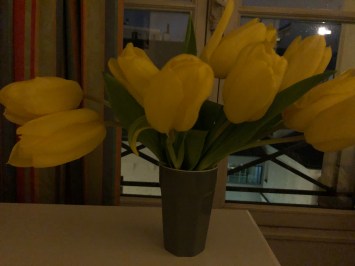
IMG_7479                                                                 The last bouquet

I read my blog on Greece, written five years ago on the verge of a Fulbright.  I describe two days of staying in my Athen’s hotel room emerging only for a meeting one day and and a souvlaki the next.  Ennui is no stranger to me.   My expectations set me up for self-doubt.  I romanticize those that seem to have found their place especially the Bloomsbury group whose work I devoured many years ago, in particular,  Virginia Woolf.   Her country home with her writing shed surrounded by beautiful gardens, long walks along the downs, afternoons with writer’s and painters reading, discussing.  But like Samuel Beckett, she endured days of doubt, of mental anguish and, then, a swing to elation.  Her solution was suicide.  Perhaps, my urge to live on an island is a strategy to force me back on myself, to find my place.

Sunday, March 1

Today I feel alert, confidant, at home in Paris.  God, these extremes are exhausting.  

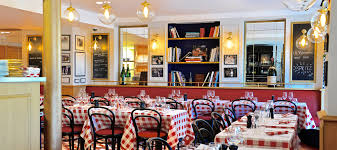
For my last full day in Paris (I leave for London tomorrow) I plan to have Sunday lunch at La Rotessirie d’Argent.  It faces the Seine two doors away from the famous Tour d’Argent, and next door to it’s bakery, Le Boulanger de la Tour.  I pass by frequently crossing the Pont de la Tournelle over to the right bank.  One day, I stopped to buy mini croissants.  Ils etaient parfaits.  The idea of eating roast chicken on a Sunday afternoon is part of a long tradition of Sunday dinner with Maman in which I long to participate.

UnknownLa Rotisserie d’Argent

On my way to breakfast one of the administrators of the Centre Culturel Irlandais caught up with me and asked if I still planned to attend the book club she had mentioned when I first arrived.  I thought I could  fit it in with my roast chicken.  But this was no intimate group meeting for an hour, this was a formal meeting known as Cercle Litteraire Irlandais (Irish Literary Circle) lasting three hours with drinks, food, a program and over 100 attendees.  There were speakers including Deirdre Farrell, Deputy Head of Mission at the Irish Embassy in Paris, and Lara Marlow, France correspondent for The Irish Times, as well as mediatations, readings, and even a group writing exercise.  It was a celebration of International Women’s Day.

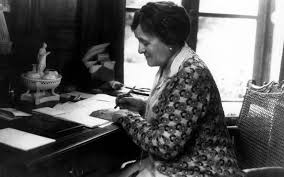
Lara Marlowe in her keynote address discussed three women who inspired her: Iranian Nasrin Sotudeh, French Berthe Morisot, and American Edith Wharton.  All three defied their respective roles: Sotudeh, a lawyer, represented women who refused to wear the hijab, Morisot became a well-respected painter, the only women to exhibit in the first impressionist show in 1874, and Edith Wharton wrote novels becoming the first woman to win the Pultizer Prize for Literature in 1921 instead of being a doyenne in her privileged social circle.  My question to Ms. Marlowe was where are the Irish women of the 19th century without upper class privileges who fought against stereotypes to become artists in their own right.  She and the audience were stumped.

images   Nasrin SotudehUnknown-1Berthe Morisotimages-1Edith Wharton

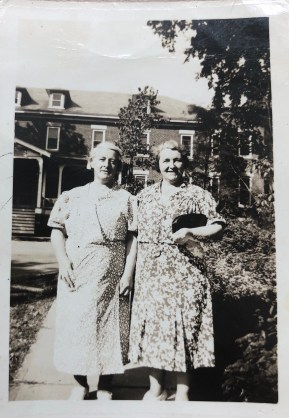
 Then we were asked to write about a woman we admired.  I chose Molly Daly, my grandmother.  She lived in Ireland for 13 years without her mother.  She returned to the United States only to be teased relentlessly about her brogue.  She married an alcoholic whose family thought she was “shanty Irish.”  When he died leaving her with two children to raise, she often brought in family members who had no where else to go.  When her children married, she moved in with them usually with no room of her own, sleeping on a daybed in the dining room.  And she never complained.  Her solace, reading her prayer book and saying her rosary.

IMG_7779

Molly Daly on the right