Day 32 Paris

Wednesday May 2

Today, I followed my previously upended plan of visiting the Jeu de Paume, now a museum of photography, by walking through the Tuileries, and, afterwards, searching for signs of Duras.  I will look for Rue Dupin, her husband’s family home where a resistance cell often met.  It was there that her husband, Robert Antelme, was arrested and, then, sent to Buchenwald and, finally, Dachau.  His arrest, imprisonment, and rescue figure largely in her memoir, La Douleur (The War).

“There’s no room for me here anywhere, I’m not here, I’m there with him in that region, no one else can reach, no one else can know, where there’s burning and killing.  I’m hanging by a thread, by the last of all probabilities….”

Another quiet breakfast without my pals.  I did nod hello to a younger resident who sometimes joined us.  But he was surrounded by a bevy of laughing young women, completely engaged.  I never saw him again.
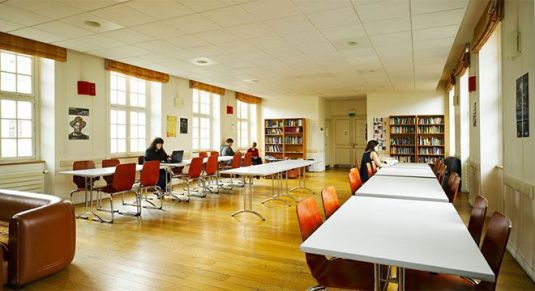
staying_gallery_07_660_360_80_c1
Residence Hall, Irish College, Paris

On my way  to the Tuileries in a gallery on Rue Bonaparte, I saw a photo depicting the riots in 1968- the revolution that sent De Gaulle running.  This is the first recognition I’ve seen of the momentous event that took place 50 years ago.  Why?  I’m thrilled I will be here on it’s anniversary.  Am I the only one?
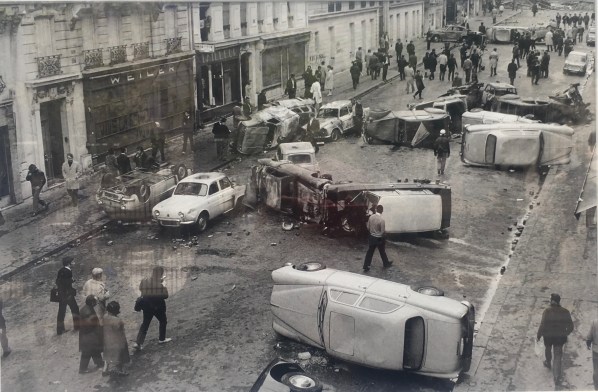
IMG_3886 2
Cars used as a barrier by students, Rue Gay-Lussac, May-June 1968

Duras must have celebrated De Gaulle’s cowardice.  She wasn’t a fan as can be seen in La Douleur,

“De Gaulle doesn’t talk about the concentration camps, it’s blatant the way he doesn’t talk about them, the way he’s clearly reluctant to credit the people’s suffering with a share in the victory for fear of lessening his own role and the influence that derives from it.”

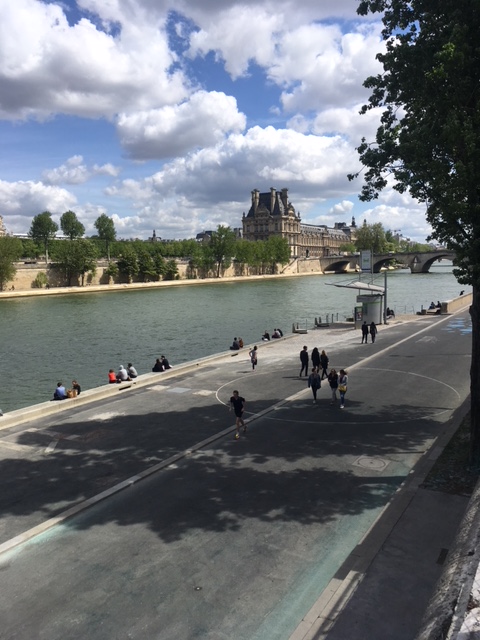
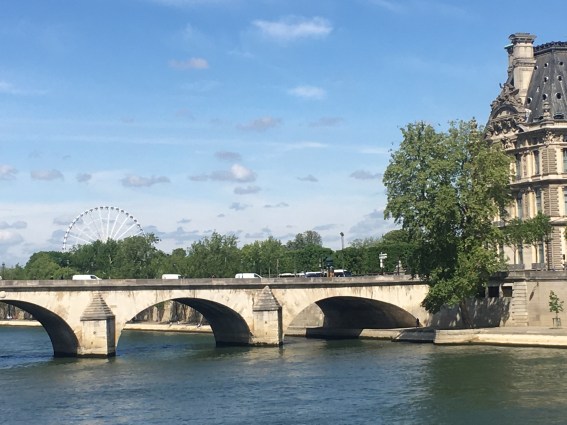
I walked to the Seine and over Pont Royal, crossing Quai Francois Mitterrand.
IMG_3890
Pont Royal, Paris

Mitterrand, a member of that very cell at Rue Dupin, narrowly escaped arrest the night Antelme did not, according to Laure Adler in Marguerite Duras, A Life:

“Mitterand called again from a public phonebook in Boulevard Saint-Germain.  This time Marie-Louise (Robert Antelme’s sister who was also arrested and later died in Ravensbruck) was curt, ‘Monsieur, I have already told you, you are mistaken.’ Then Mitterand understood.”
IMG_3903
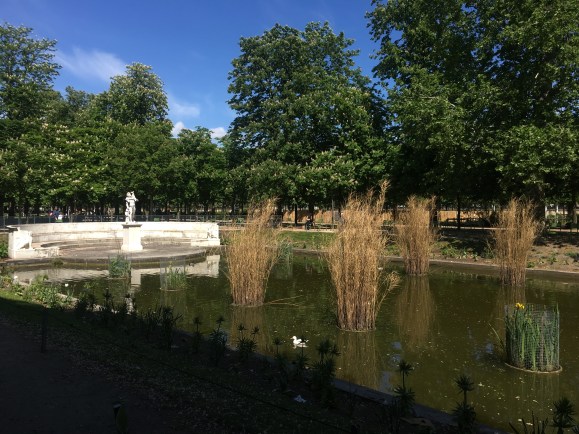
North Exedra Pond, Jardin des Tuileries

Dark thoughts as I wandered through the gardens on a cloudless spring day.

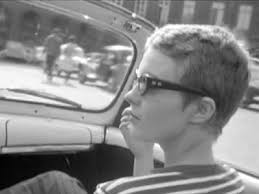
I reached the Jeu de Paume at the end of the Tuileries where it faces La Place de la Concorde.  In Breathless, Jean-Luc Godard used the same location to film Jean Seberg and Jean-Paul Belmondo taking a spin in a stolen car just 15 years after the liberation of France. Although he used jump cuts to shorten the film, his editing created visual energy and excitement mirroring the relationship between Seberg and Belmondo.
Unknown-3
Jean Seberg, A Bout de Souffle, Breathless, 1960

There are two exhibits at le musée: an Austrian photographer, Raoul Hausmann and an American, Susan Meiselas.  I began downstairs with Hausmann who was part of Berlin Dada, the images taken from 1927-1936.  At the entrance, the show’s curator introduced Hausmann’s work via a looped video.  Several minutes passed before I realized she was speaking in French. I understood it all.  Quelle surprise!
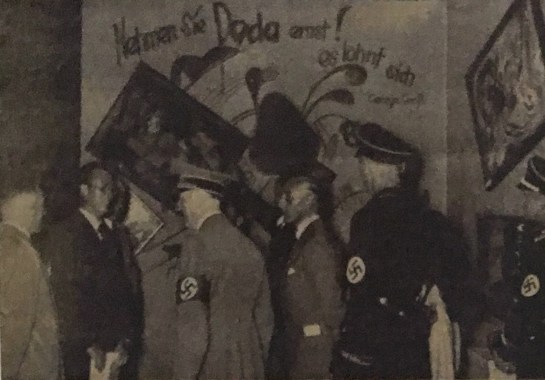
IMG_3927-1     A Nazi exhibition denouncing “degenerative art” which included Housmann’s work.

The Meiselas exhibit took up the entire second floor: it’s depth and humanity startled me.  I began photographing each note and image.  The Prince Street Girls reminded me of Little Italy in the winter- the smells of Italian pastries, small cups of espresso, steamed windows.
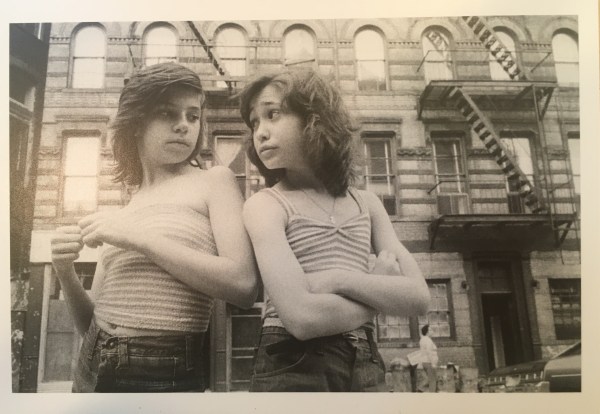
IMG_4413Dee and Lisa on Mott Street, Little Italy, New York, 1976

In the next room, the work on Nicaragua distressed me.  I wanted to leave: too much pain.  But I couldn’t pull myself away.  Her work makes me hopeful.  A humanist artist.  She, like the Iranian filmmaker Abbas Kiarostami, considers what it means to capture an image, a life, not just the shot.
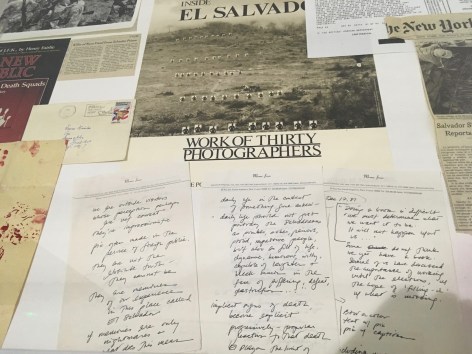
IMG_3986

In the bookstore, I find Duras and another American, Diane Arbus.  A celebration of both my histories, France and America.
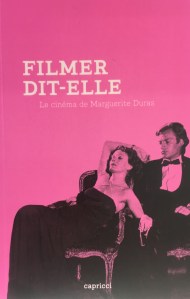
IMG_4005-2IMG_4007

I sat outside on the terrace of the museum’s salon de thé et café, La Boîte à Images, had a coffee, and gazed across the gardens.  Now, the photo I put up on Instagram of Agnes Varda as she entered her home haunts me.  I was so excited- I had caught her.  I didn’t consider her right to privacy, her right to go through her day unassaulted.  As a mea culpa, I took the image down, replacing it with a closed notebook and the comment, “Instead of Agnes Varda who deserves her privacy.”

IMG_4008

I left the cafe in search of Duras.  It took me a long time to get to Rue Dupin.  I kept getting turned around, finding myself going up and down Rue du Cherche-Midi or ending up on Rue de Sèvres.  One detour reaped a reward, the offices of Les Éditions de Minuit where Duras published many of her works.  In his book, A Walk Through Paris, Eric Hazan laments the loss of publishing houses in the 6th arrondissement to what he calls the “capitalist concentration of publishing”  and comments on those that stayed:

“A few major publishers have remained in the quarter, Gallimard, Minuit, Fayard, and Bourgois among others, but they are like vestiges of a past splendour.”
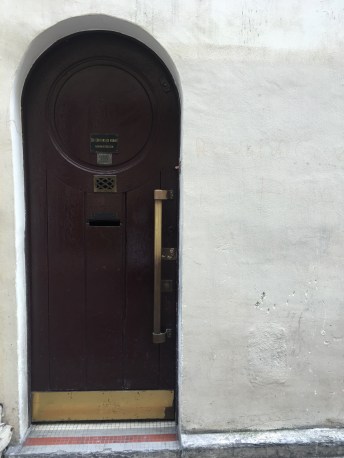
IMG_4028
Les Éditions de Minuit, 7 Rue Benard Palissy

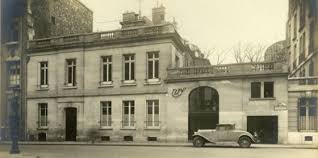
Finally, I found 3 Rue Dupin where the Antelme apartment was located on the floor above the post office.

09afa8f54adcb6d.12890
3 Rue Dupin, Paris where Robert and Marie-Louise Antelme were arrested.

Then, I noticed L’Epi Dupin, a restaurant whose card I’ve been saving for years.  I don’t know why: I don’t remember eating there. How did I get it?  How easily I get waylaid by the minutiae of my own life even when faced with the tragedy and loss that took place on the same street almost 74 years ago.

IMG_3168

After ten miles of walking, cheese, radishes, and a baguette in my room became dinner.
 

Paris Day 26

Thursday April 26

Only twelve days left before I return to the United States.  I don’t have enough time to explore Sophie Calle or even my own family at the National Archives.  Many shoulds.  I feel pressured to squeeze it all in.  An impossibility.  I must remember to take a photo of the charming street I pass every day on the way to the Alliance Française.   I have only today and two more classes.

IMG_3696

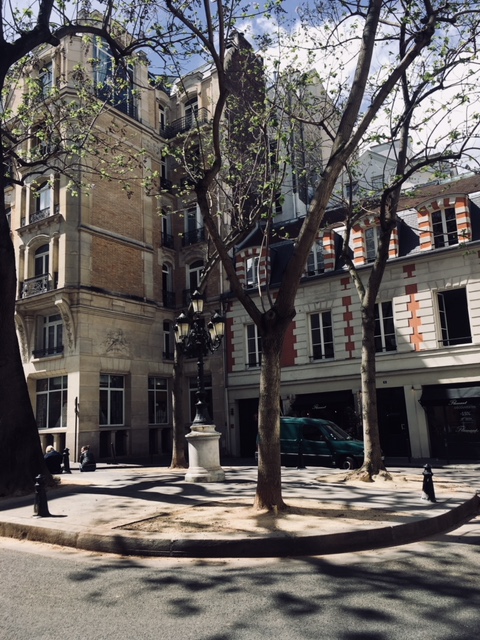
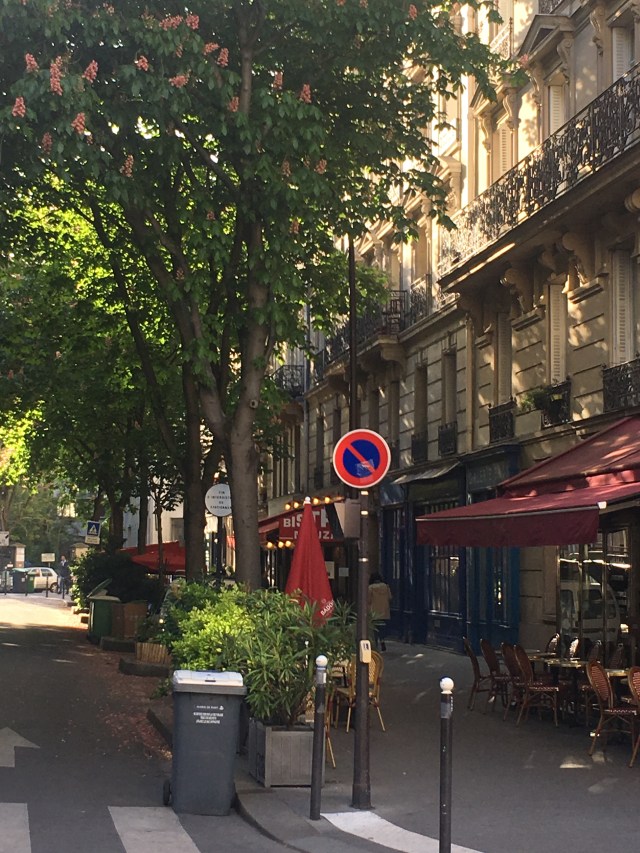
Rue de l’Abbé de l’Epée

Given yesterday’s debacle, I decided to approach Duras by visiting Musée D’Orsay.  As part of The Resistance, she often visited Gare D’Orsay working with the BCRA, Bureau Central de Reseignement et d’Action (Central Office for Intelligence and Action) which coordinated intelligence supplied by French networks.  In her memoir The War, she describes her days at the Gare:

 “…I set myself up there by stealth with forged papers and permits. We managed to collect a lot of information…about movements of prisoners and transfers from one camp to another. Also a good many personal messages.”

and after the arrival of French political deportees,

“Orsay.  Outside the center, wives of prisoners of war congeal in a solid mass.  White barriers separate them from the prisoners.  ‘Do you have any news of so-and-so?’ they shout.  Some stay till three in the morning and, then, come back again at seven.  But there are some who stay right through the night.”

6d822e44ff03aefcbec98716e13e6f17                              Returning Prisoners Arriving at Gare de l’Est 1945
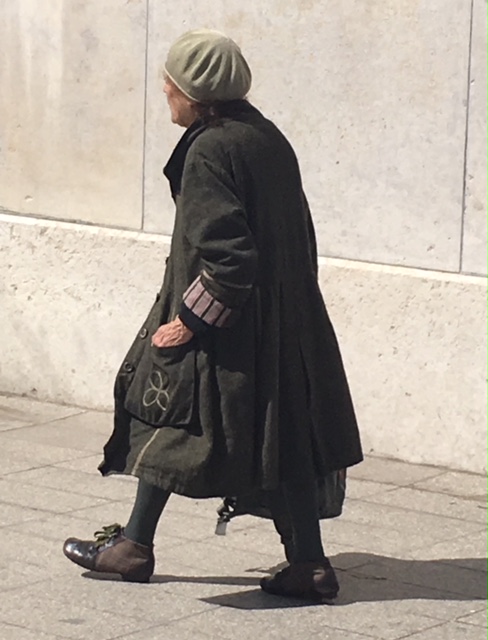
On my way, I passed several sandwich shops: all smelled delicious. I don’t have time for breakfast on the days I go to class, so I was particularly hungry.  While trying to decide which shop to patronize, I passed a woman from a fashion time warp, a thirties coat, 1900’s shoes. Up and down the street she strode.  Maybe this was my Sophie Calle moment.  Sophie Calle, a French multimedia artist, that is, writer, photographer, installation and conceptual artist, followed a man on the streets of Paris and all the way to Venice photographing him without his knowledge.  Later, she had her mother hire a detective to follow and photograph her as she went through her day.

IMG_3709

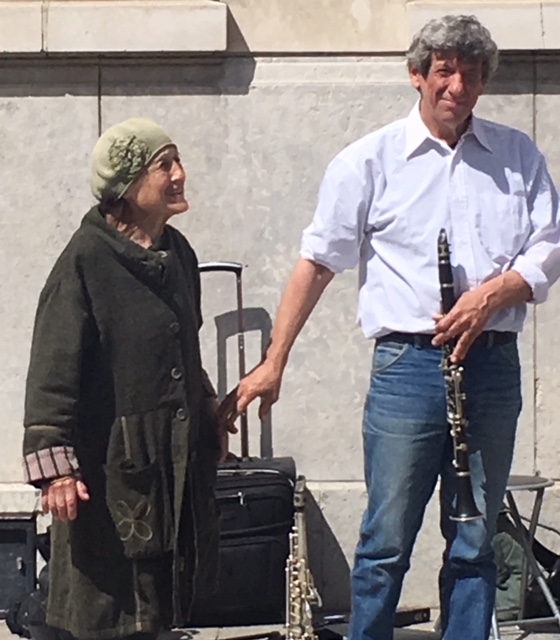
I walked a few hundred feet behind the woman until she entered a drug store.  When she emerged, I couldn’t maintain the stalking.  I’m not made for artistic ruthlessness where another person unknowingly becomes a source of creative endeavor.  Instead, I got in line at a sandwich shop, which would have been at home in Brooklyn: locally sourced ingredients, minimalist design, lots of grains and vegetables.  I took my lunch to the steps of the Musée d’Orsay.  There she was, my thirties’ prey, standing next to a trio busking in front of the museum.  I can’t seem to escape my country: the group played American blues music.  Then, she came alive, dancing in all her magnificence from one song to the next.  When they took a break, the clarinet player raised the dancer’s hand and said to the audience “Merci, Madeline”

IMG_3725                                                                  Madeline

If I wanted to write, I had to get going.  After a long day, Duras describes her walks home from Gare d’Orsay.

“As soon as I leave the embankment (along the seine) and turn into Rue du Bac, the city is far away and the Orsay center vanishes.”

I would do the same.  The sun was shining just as it was for Duras.  The Seine winked blue-green at passers by.  How privileged we are sitting on the steps of the museum, walking along the Seine, having tea in Restaurant du Musée d’Orsay.  In 1945- hunger, fear, despair, loved ones tortured, killed.  But I walk along the Seine undisturbed, unmolested, unafraid.  And just last year, miles away in Calais, a makeshift refugee camp was destroyed.  Even here, the homeless don’t always find shelter.

IMG_3742

Quai Anatole Franc

I enjoyed meandering back to the Irish College and decided to forgo writing.  I made one more Duras stop, the office of her publishers for many years, Gallimard, who collaborated with Vichy in order to publish resistant writers, Jean-Paul Sartre and Camus.  When Patti Smith visited Gallimard, her French publisher, she writes:

“My editor Aurélien opens the door to Albert Camus’s former office.”

Did she know it’s history?  Does it matter?  Can we compromise and be ethical?

Unknown

Gallimard Office, Rue Gaston Gallimard

Gallimard is off Rue de l’Université which becomes Rue Jacob and ends at Rue de Seine.  Towards the end of Rue Jacob, I looked right and discovered an empty Place de Furstemberg.  Was I in Paris or Aix-en-Provence where such retreats abound?

IMG_3784                                                    Place du Furstemberg

On Rue Monsieur le Prince, I passed Les 3 Luxembourg Cinema.  I spotted a connection to Agnes Varda. A film entitled Peau d’Ame sur les traces du film de Jacques Demy (Varda’s husband) was playing that night followed by a discussion with the filmmaker, Pierre Oscar Levy.

Two hours later I was seated.  The film is a tongue in check archaeological exploration of the setting of Jacques Demy’s film Peau d’Ame, a musical based on the Charles Perrault fairy tale of the same name, that is, Donkey Skin, about a King who wants to marry his daughter.  Demy used Michel Legrand for the music and Catherine Deneuve as the lead just as he had in The Umbrellas of Cherbourg.

In the film, made over four years, students brushed dirt from artifacts such as pieces of costumes and colored glass as they would on any archealogical dig.  Demy and Varda’s daughter, Rosalie, was interviewed when a ring worn by Deneuve was discovered. The audience occasionally laughed but I couldn’t get the jokes.  Afterwards, the filmmaker and an archaeology professor from the Sorbonne discussed the authenticity of such an endeavor for well over an hour.  Mon Dieu.  I dozed a bit; then the need to get some dinner overroad politeness.  I departed just in time to get a Lebanese sandwich at Au Vieux Cedre near Place de la Contrescarpe.  While I waited, the owner offered me a glass of mint tea. A graceful gesture to the other who, now, doesn’t feel like the other.

Unknown-1                                                                Au Vieux Cadre


Paris Days 22-23

Sunday April 22

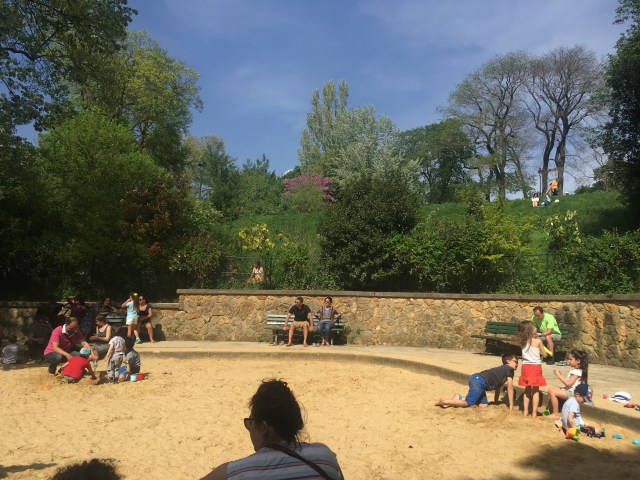
Sunday, we went to the country, that is, Parc des Buttes-Chaumont, in northern Paris to meet with two of her friends, one with a toddler.  As my daughter hadn’t had breakfast, we stopped in a cafe that offered brunch, Le Ju’ on Rue des Archives  There was a line waiting to get in which we thought bode well.  Not so. The brunch was fixed, no choices: a plate of tired croissants, scrambled eggs, not so bad, a hamburger, why, and a fruit bowl.

We took lines 5 and 7 on the metro, found her friends, and strolled the few blocks to a park entrances. Given we had a toddler in tow, we made our way to a sandbox.  I walked with one of the  women and managed to converse in French for almost 15 minutes ranging from what I was doing in Paris, the difficulty of working from home, and the challenge of selling art- she curates and sells paintings. Being a generous soul who speaks beautiful French,  she practiced great patience with my tense difficulties, lack of proper articles, and general mispronunciations.

IMG_3581.JPG

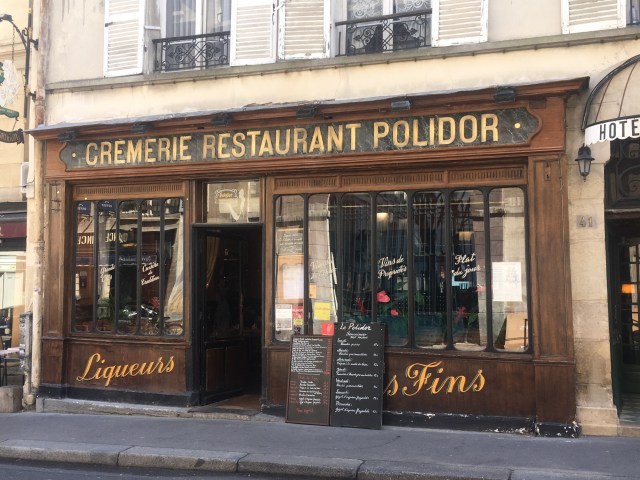
After several pleasant hours watching children play and battle in the sandbox, we went back to Odeon.  We thought we would try Polidor for dinner.  But the restaurant was hot and smelled of roasting meat.  Although seated, we left before ordering much to the disgust of the waitress who let us know that she found our behavior intolerable.

IMG_4134.JPG

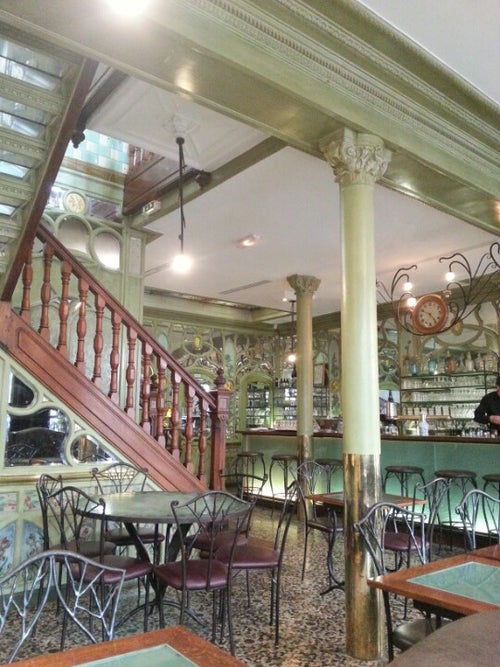
On to Le Pre Verre near the Sorbonne- closed.  We had passed a pretty art deco restaurant on Rue Racine, a bit formal, but since we were starving, it didn’t matter where we eat as long as it was soon.

An hour and a half later, we were still hungry.  The food was inedible: a first course of cold pumpkin soup with a dollop of creme fraiche had no flavor and an unpleasant texture.  My daughter warned me that the soup would predict the quality of what was to follow.  So true.  The steak described on the menu as selected by Monsieur So and So, nominated as the best butcher in France, was so tough and dry, I could barely cut it much less eat it.  The waiter seeing full plates each time he whisked them away didn’t insult us by asking if we wanted dessert.  Later we discovered that Bouillon Racine is a well-known, respected, and historic restaurant. Incroyable.

Le Bouillon Racine_24

To make sure we ended the evening on a good note, we returned to the familiar Les Editors for cafe gourmand and Armagnac.

Monday, April 23

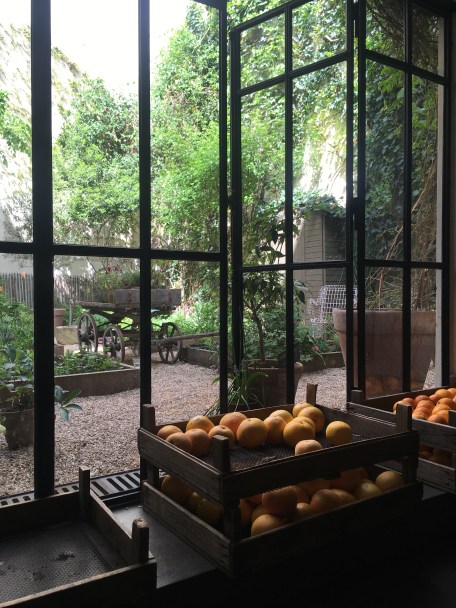
Monday found us walking on the right bank.  On our way to one of her favorite stores, Merci, we walked through Les Halles.  The last time I visited was during the early morning hours, the area crowded with crates of fruit and vegetables.  I finished the night by having onion soup in a small restaurant on the edge of the market.  Au Pied du Cochon is still there, but instead of a market, there are benches and greenery.  Finally, we reached Merci and managed to covet something in each department.  Downstairs, a restaurant faces a courtyard, and Mon Dieu, finally, good food: excellent soup and salad, accompanied by a tart rose.

IMG_3628.JPG

Next, Place des Vosges for apero (aperitif) with two more of her friends, a woman and man she had worked with when she taught English to business clients.  Her American friend is married to a French man and is now a French citizen; the fellow is married to a French woman and is a novelist.  We had lots of laughs and a discussion about which bank is in, right or left.  I opted for the left.  In the past, I only spent time on the right bank when I sold newspapers on the Champs Elysees.  My daughter and her friends all hail from the right and insisted that the left bank is over, passe.  As her American friend put it, “I never cross the river.”

IMG_3650

We parted in time, we thought, to get to the restaurant, Poulette, where we had dinner reservations.  We soon realized we weren’t going to make it on foot, so we took a bus.  Another altercation between French citizens.  The bus got stuck behind a garbage truck; consequently, the ride was stop and go.  The passengers began asking the bus driver to let them off.  My daughter said that the French can get very cranky if they are late getting home for dinner.  But the French have rules and one is that bus drivers can only stop at bus stops.  Otherwise, the driver gets a hefty fine.  One young man was undeterred, demanding again and again that the driver let him off.  Finally the driver stopped the bus, stood up, faced the fellow, and told him to stop the harassment.  The passenger made faces and rude remarks- it seemed they might come to blows, but an older man stepped in and defused the situation.

Poulette turned out to be a fine choice.  Beautiful tiled walls, delicious fish, and mashed potatoes so rich in butter, they were yellow.

IMG_3659

After walking 10 miles over 12 hours, we called it a night and had a tearful good-bye in the lobby of Grand Hotel des Balcons.

IMG_3593


ANOTHER ATHENS HOTEL

I’m having a Chelsea Hotel moment even though I am at an upscale hotel in the “quartier” of those who have swimming pools on their roof, Kolonaki. I have left the hotel only twice in the last twenty-four hours: to go to a meeting about my Fulbright grant after which I returned and slept and, then, three hours later, to walk three blocks for souvlaki and a beer. Within an hour, I was in my pajamas and back in bed. Soon, it will be 8:00 P.M. and I could go out and find a taverena, but I’ve decided to skip dinner, have a drink and some potato chips from the minibar. Did Faulkner and other writers at the Chelsea succumb to “ennui” so easily?

I didn’t surface for very long today, but it was long enough to notice that many pedestrians carried shopping bags with the labels of expensive stores. I did see other signs of change besides graffiti new to Kolonaki.  An old women in widow’s black surrounded by plastic bags holding her belongings had strategically placed herself on the pavement next to an ATM machine. Nevertheless, she didn’t seem to be profiting by her location. Several older men and some children moved up and down the steep streets with outstretched hands, and a young women sat in a doorway breastfeeding her child, completely exposed, her hand extended.

In today’s International Herald Tribune, Paul Krugman in an article about the European economic crisis wrote, “Forget about Greece, which is pretty much a lost cause; Spain is where the fate of Europe will be decided.” For some, he seems to be speaking the truth; others may be “fiddling while Rome burns.”

20120626-202751.jpg