Return to Paris Day 15

Monday April 15

I met with Christiane Makward to discuss Mayotte Capecia at Le Brelan, a cafe on Rue Beaubourg.  On my way, I passed the Pompidou Center: it’s exterior fits this streetscape quite differently than the celebratory atmosphere exuded on the Rue Saint-Martin entrance.

Unknown-2

I arrived early and scanned the passersby but realized I had no idea how to recognize her.  Then, I noticed a woman standing to my right, smiling wryly, and carrying a book.

IMG_6342

When we found a table away from the noise in the cafe, she asked “How did you find Mayotte Capecia?”  The question surprised me since I had been “living’ with Capecia for the last two months.  It seemed obvious.  I unwound my story of exploring the black experience in Paris, in particular, those immigrants from the French West Indies.

I asked about Capecia’s life in Paris.  Professor Makward explained that Capecia worked as a cook when she first arrived.  Somehow, she met a publisher who became her lover and who encouraged her to write of her life in Martinique.  Then, Madame Makward dropped a bomb, “You know, she didn’t really write those novels?”  I said no and asked who did.  She believes the most likely culprits were her publisher and his assistants.  Moreover, much of the second novel, La Negresse Blanche was plagiarized from a diary written by a French Naval officer who had had an affair with Capecia while stationed in Martinique.  Before we parted, she gave me a copy of Mayote Capecia ou l’Alienation selon Fanon.

Her book about Capecia revealed this subterfuge: she had had access to Capecia’s sister and children as well as primary sources including the diary.  What to do?  I thought Je Suis Martiniquaise had given me a window into my grandmother’s early life in the Caribbean.

Unknown-4
Church of the Aussumption, Soufriere Saint Lucia where grandmother Germaine de Jorna was baptized.

Although I’d read other portraits of Saint Lucia and Martinique, this was the first that described coming of age from a woman’s perspective.  Of course, these were the same comments made by critics supporting Capecia after Frantz Fanon’s dismissal of the novels.  Was I on a fool’s errand as I had feared?

I walked home in a daze unsure how to proceed.  Each attempt seemed a dead end.  I crossed in front of Notre Dame just as the many of the tourist buses were pulling away.  Earlier thousands had waited in line in hopes of entering.

Tired and discouraged, I took refuge at La Method, a cafe close to my home, and ordered a Ricard.  A minute later, I heard a loud boom; then, green clouds filled the sky.  Other patrons and servers came out to watch as more and more clouds emerged.   Soon, helicopters circled above us.

IMG_6163

My phone had died, so I had no idea what had happened.  I malingered for an hour or so attempting to read Makward’s book in French.

When I got back to the Irish Cultural Center, I discovered the reason for the billowing green clouds: Notre Dame was on fire.  The first time I left for France at age 21, Notre Dame had been my go to for mass.

The day before I left for France that first time, I made sure I went to confession.  After some pointed questioning by the priest, I admitted indulging in “heavy petting” with my boyfriend.  He said I had committed a sin: I disagreed as I was in love.   How to get absolution?  Without it, I would go straight to hell should my plane go down over the Atlantic.  We compromised.  I didn’t have to agree to sinning as long as I went to mass every Sunday while living in Paris.  And each Sunday found me at Notre Dame or Sacre Coeur.

The last time I visited Notre Dame, my husband cried at its grandeur and beauty.  At the main alter a book lay open for visitors to name a loved one who had died.  I wrote my father’s name: he would have liked being remembered in the family’s “country of origin” even though our de Jorna’s left France in the late 1600’s.  Then, the cathedral would have been 400 years old and most likely known to that earlier ancestor.

My father did visit Paris once.  My mother told me he used French to get around.  His mother’s tongue came back to him.  I returned him to Paris in words, his name.

Return to Paris Day 9

Tuesday April 9

B5D82E2F-AEDD-4C85-8274-74C6E6B0CF4A.jpeg

I been thinking of Jean Rhys.  She was a beke, that is, an Antillean creole descended from early European colonists in Dominica, like my relatives in Martinique before the African pot got stirred.  In her novel, Good Morning Midnight, the protagonist has returned to Paris after more than 15 years, a Paris she recognizes but doesn’t seems to fit. She’s older, she’s alone.  It resonates.

B0CC2C46-6CF4-4C2A-88CC-11E9ECB20743

From Good Morning Midnight, page 1

“I have been here five days. I have decided on a place to eat in at midday, a place to eat in at night, a place to have my drink in after dinner.  I have arranged my little life.”

I’m into my second week but can’t say that I’ve made much of an adjustment. Would it be enough to take every meal in the same place?

Paris has always been home for me.  The first place I could own, that fit me, that did away with shyness, with not belonging and trying to belong.  At the other home, I monitored my speech, my friends’ reactions, my family’s approval, disapproval.  Like my father, I didn’t want to be discovered.  In Paris, I only adhered to the, then, strict rules of tutoyer, hand shakes, meal time punctuality, and the language I used with “adults’ versus my friends, mostly students.  Don’t use the shortened “formid,” only use the correct, “formidable.”  And never use “fric,” the slang for police.  These requirements weren’t personally attached to me. 

In Paris, that first time, I talked to strange men on motorcycles while walking along a road in Sottteville sur Mer.  But it was daylight and there were passerby’s.  I was safe.  My French family didn’t agree: I understood their concern but wasn’t deterred.  I broke it off with a boyfriend after a week when I learned he was smuggling cigarettes.  I created my own group of friends from other newspaper sellers of The New York Herald Tribune and The New York Times.  My last liaison took me to meet his friends, to his favourite cous cous restaurant, and to a studio belonging to an artist friend.  As we approached the elevator, the concierge made her presence known.  He explained that I was his fiancé.  The only way to make it past her.  Under the eaves on a small bed, we kissed, tumbled, and that was all.  He didn’t get his way but he didn’t drop me.  We spent my last day in Paris saying good-bye at the Select where we met almost every night.  And, il a plura, it rained.

Like Jean Rhys’ character, I’ve returned to a Paris that doesn’t quite fit.  Or I don’t fit.  And like her character, some of it is age but also the blinders of narcissism and youth are off.  As they were in Au Bout de Souffle where in the end, the lovers don’t recognize each other, a free spirited thief and a conventional American.

After Tuesday’s class at the Alliance, students clustered together complaining.  One student said she dreaded coming each morning.  I feel the same and have decided to quit at the end of this week.  I’ll have more time to explore Mayotte Capecia’s experience as a woman of color living between two cultures, Martinique and Paris.   Her characters, Isaures and Mayotte, both leave Martinique for Paris, hoping for a better life.  Did she get it?  Do colonized people of color get that better life?  My grandmother and her sisters lied and said they were from France because surely France was better than Saint Lucia.

A long day, a difficult day saved by an aperitif at Bistrot L’Estrapade located at the end of my street.  I thought only dinner was served  but when I passed by,  the owner was enjoying a cigar at one of the four outside tables.  I asked if I could have just a drink.  Yes, yes, he agreed but could only find vermouth rouge.

3ED2C97F-63B3-4EC2-A412-3A9860994A65

Ca suffit as I look down the street towards the Pantheon.

38F96636-11F0-4630-9BF9-D5430F164EA0


Return to Paris Day 5

Friday, April 5

I went in search of La Colonie, described as a meeting place for the exploration of decolonization through discussion, art, music, dance.  I haven’t been successful at finding or contacting any French West Indies groups: I hoped to talk to someone who’s might connect me.

Most of this long walk was spent on Rue Saint-Martin, originally an old Roman road, which passes by the Pompidou Center alive with pedestrians, cafes, art galleries, and entrepreneurs.

35EAB743-D1C7-4C6B-9D8C-26FDF3BA8E1D.jpeg

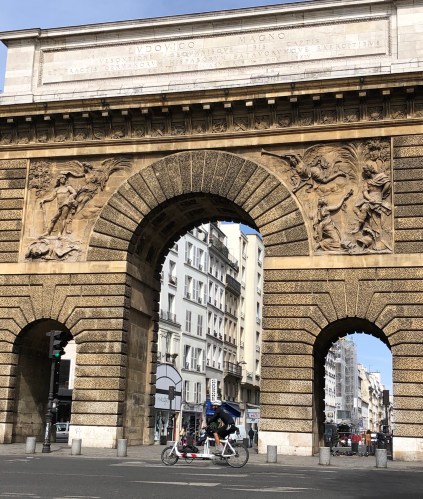
Eventually, I reached Porte Saint-Martin, where Rue Saint-Martin crosses Boulevard Saint-Denis.  Built in 1674 under the orders of Louis XIV, the monument commemorates his victories in the Rhine and France- Comte.  It replaced the medieval gate from the 1300’s, part of the fortified city of Charles V.

86A6DFBB-274D-4A3E-B081-1555BCB09F00.jpeg

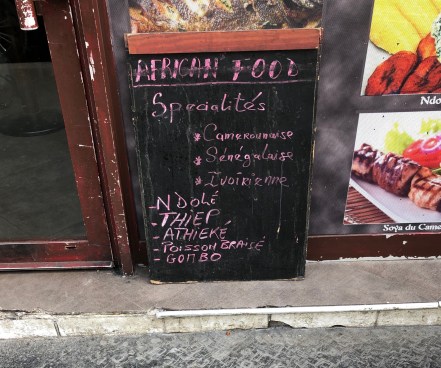
Once through the arch,  the atmosphere changes: more run down, more faces of color, more African restaurants. 

0F0D1F45-3171-4469-8639-14E0146035C2.jpeg

After almost four miles, I arrived.  Nothing outside indicated what I would find inside: a large two story room lit by skylights, filled with couches, tables, plants, and a bar.  Each table held a list of events for the month.

16A7AA1A-6B64-4152-8DEA-AC561D74FEF2

Stacks of flyers from various groups lined one long wall.   A few people sat together on couches while I put myself at one of the small tables in the middle of the room.  The bartender brought me a coffee.  I lingered.  Later, when I went to pay, in French, not good French, I explained I was researching the Caribbean experience of living in Paris, then, asked if he could direct me to someone who might know.   He gave me the email of the Cultural Director for La Colonie.  Finally, success!

Later, disappointment.  No matter how I formatted the address, il ne marche pas, it  didn’t work.  As an alternative, I used the cafe’s website to request an event space, hoping he’ll respond.  Fingers crossed.  I wonder.  Is this search of mine star-crossed?

Yet, Paris rarely disappoints.

0726C797-8051-446E-89BF-90C790331549

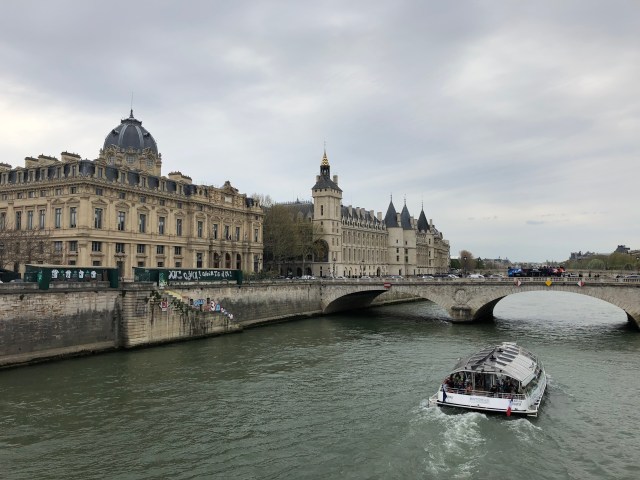
View from Pont Notre-Dame