Return to Paris Day 20-21

Saturday April 20

On my way to buy gifts at Bon Marché, still trying to trace Mayotte Capecia’s life in Paris, I strolled along Rue Mayet where she had lived with her sister in 1947.  The small street runs between Rue de Sevres where Bon Marché is located and Rue du Cherche-Midi, I didn’t know the number so I used my imagination to guess where she might have hung her hat.  Could one of these have been her building?

IMG_6205

I’m anxious to buy an important birthday gift for an interesting four year old.  Last year, I discovered that Bon Marché replaced their extraordinary notions department on the top floor with an equally extraordinary children’s department.  Another disappointment.  The department pour les enfants has been drastically reduced.  As I told a salesperson, “C’est dommage,” that’s a shame.  Nevertheless, I manage to spend over 50 Euros.  After dropping more money at Zara’s located across the street, it was time to make my way home.  Back on Rue du Cherche-Midi, I passed Le Nemrod and stop for lunch.  I should have done more of this: sit outside with a delicious salad, a glass of rose, and watch the French go by.

IMG_6224

On my back through the Jardin du Luxembourg, a young man approached me and said in French how beautiful “it” is.  Assuming he was referring to the espaliered apple trees we were next to, I readily agreed.  He realized that I was an American and continued in English, making niceties as we strolled together.

IMG_6228

He suggested we exchange phone numbers.  I declined, graciously, I hope, and he wandered away unsuccessful at snagging  what he may of thought was a woman of a certain age with a comfortable income.  Is this a Jean Rhys moment from the pages of her novel, Good Morning Midnight?  In the evening, her protagonist, having returned to Paris after years away, wanders up the Boulevard Saint Michel confronting her age, her older status.  And like me this is a location where she has walked often.  Two men approach her and one asks, “Pourquoi etes-vous si triste?”  Why are you so sad?  She tells them she’s not sad although she admits to herself she is:

”Yes, I am sad, sad as a circus-lioness, sad as an eagle without wings, sad as a violin with only one string and that one broken, sad as a woman who is growing old.”

Because she discovers they are Russian, she accepts their offer for a drink.  Is she braver than me, sadder than me, less cynical?

I arrive back at the Centre Culturel Irlandais by late afternoon.  It’s cooled off and the courtyard is almost empty.  A good time to write, to consider answers to those questions.

IMG_6230


Sunday April 21

It’s Easter Sunday and Jean Rhys is still with me.  Parallel walks, parallel observations.  In the novel, she describes an earlier time in Paris when the protagonist worked in a dress shop, and got off the metro at Rond Point at 8:30 every morning just as I had years ago hawking newspapers.  Her character Sophie must face the dilemma of Sunday in Paris.  “…Sunday – a difficult day anywhere.  Sombre dimanche….”

I feel compelled to go to La Brasserie de L’Isle Saint-Louis for lunch.  I’ve sent people here for supposedly the best sauerkraut in Paris.  In order to get there, I had to negotiate every inch of Pont de Tournelle as hundreds crowded the bridge to photo the blackened Notre Dame.  Hot and sweaty, it was seventy-six degrees, I managed to get a seat on the terrace overlooking the Seine.  When I ordered choucroute garni, the waiter asked if I was sure that is what I wanted, a dish piled high with different cuts of ham, sauerkraut, and potatoes.  I wondered myself.  An odd choice for a hot April day,  But I stubbornly proceeded.  I like it but ate only half.

Unknown

After a stroll around the L’Isle Saint Louis and some ice cream I noticed crowds forming by the Pont L’Archeveche and watched an enchanting escape from the charred remains of Notre Dame fully in view.  A group of professional skaters lifted spirits as they graciously danced along the bridge.



Return to Paris Day 18-19

April 18 Thursday

Sampurna Chatterji, a writer in residence at the American University in Paris, lives at the Cultural Centre Irlandais.  We’ve had some interesting conversations over breakfast, about how long it takes to settle into Paris in order to begin writing, about the difficulty of writing fiction while the world moves towards nationalism and fascism.  She invited me to hear her read at the American University’s new digs overlooking the Seine.  The weather was perfect for a long walk.  I carefully chartered my journey but managed to get tangled up in the streets around Les Invalides, making me quite late.

Unknown

When I finally arrived and entered the elevator to the second floor, another hurried woman entered.  She, too, had gotten lost and like me was going to Sampurna’s reading. We arrived  in time to hear her students read from their work before Sampurna began. She included something she was working on, an entry from her Encyclopedia of Everyday.

“Is writing like walking?

I would put in it a spoon. The sound of a spoon

moving in a thick glass beer mug

from which an old person is drinking

her unsugared milk for the day.”

An excerpt published in Paris/Atlantic, AUP’s (American University in Paris) Creative Arts Outlet

A vivid dream we were invited to enter.  Mesmerizing.

The woman who accompanied me in the elevator was a friend of Sampurna’s and had been raised in Africa.  She encouraged me to contact her: she would like to discuss her experience as a person of color living in France.  Interesting that as I’m about to leave, I meet someone who could speak directly about the very problem I’ve been trying to explore.

To avoid further street entanglements, I walked home along the Seine.  It was a clear night, the temperature in the upper sixties, quite perfect.  Pedestrians walked arm in arm, leaning over walls as they gazed into the moonlit river.  Restaurants and small canteens like impromptu beer gardens lined its banks.   This long, almost six mile walk, reminded me of my first summer in Paris when my rag tag friends and I walked along the Seine stopping to play guitar, to read poetry at the Square du Vert-Galant, underneath the Pont Neuf.

Unknown-3

“Ian took me to walk the banks of the Seine with Mike I, Mike II, and Martin.  At the end of the Ile de la Cite- a French guitarist, Martin on the banjo, a juggler and a man in tails. Formid!” Journal Entry

April 19 Friday

As I did last year when I was about to leave, I treated myself to dinner at Bistro L’Estrapade, the small restaurant at the end of my street.  A delicious meal- an amuse bouch of whipped pike, a salad with warm goat cheese and a strand of carrots, dorado with a butter sauce, quinoa and cruciferous vegetables, ending in tarte tatin and ice cream decorated with ground cherries reminding me of the cloudberries on St.Pierre and Miquelon.

Unknown

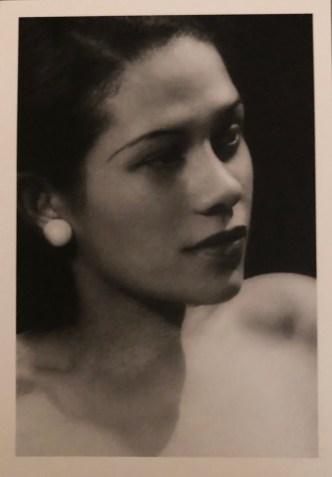
Towards the end of the meal, two black couples sat at a table across from me.  The women impressed me, full bodied, as big as their male companions, adorned with big jewelry and clothes that hugged their bodies.  Yet, they sat demurely, their hands clasped in their laps while the men spread their elbows across the table dominating the space.  A contradiction.  They didn’t conceal their magnificent physical presence but acquiesced territory.  Was the same true of the Les Modeles Noirs in the Musée D’Orsay’s exhibition? 

IMG_6558

Adrienne Fidelin, 1937 by Man Ray, her lover

As I lingered over coffee, I considered another contradiction, my leaving a week early.  What was my sudden need to get home?  Was it becoming too hard to be alone?  I almost always travel on my own for a month or more and had never felt a need to depart.  Was the frustration with this project too much?  Had I forgotten to enjoy the daily pleasures of living in Paris?  I wonder if I’ve become too focused on my work ignoring the joy of returning to my first home.

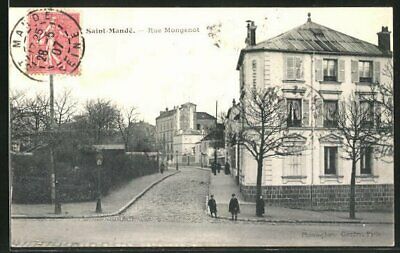
CPA-Saint-Mande-Rue-Mongenot-1907

My first home in Paris, Rue Mongenot, 1907 Postcard

Return to Paris Day 16-17

April 16 Tuesday

A day spent reviewing my options.  If Capecia didn’t write the novels, she did live that life, so the depiction of Martinique could represent some similarity to my grandmother Germaine de Jorna’s experience.  In Je Suis Martiniquaise, she describes a young girl free to wander, to explore a paradise of sorts:

“On arriving at our chosen destination, we undressed and bathed in the nude, boys and girls mixed, but with no thought of wrongdoing.  In the distance, we could still hear the washer women beating their clothes against the rocks.  Our spot was filled with moss, ferns and giant palms that rose like strange birds when the wind swirled them about.”

and later as the group decides to go on an “expedition,”

“Young bamboo shoots adorned the mountain with a soft green velvet; palm trees beckoned to us, bending and undulating with the suppleness of a serpent as they danced among the giant ferns.”

northern_forest_martinique_001

Northern Forest, Martinique

Perhaps, my grandmother had moments such as these, but maybe her life was closer to the character’s sister, Francette, sent to live with an aunt who restricted her freedom in order to be “proper.”   In Caribbean households that held themselves above the “fray,” young women often stayed indoors, sewing, reading, changing their clothes morning, afternoon, and evening to fit a social protocol.  According to my father, his mother also changed her children’s clothing three times a day.

Mckeon 3

Germaine’s daughters

Perhaps, Germaine was cocooned behind closed doors in Saint Lucia, imprisoned as was Francette.

Unknown-2

Morne Coubaril Estate, Soufriere, Saint Lucia

Her sister Yia, my great aunt, imposed similar restricitions on their niece Adria who lived with her in New York.  When guests came to the apartment to visit, to play cards, Adria was hidden behind the closed door of her bedroom,  lest she betray her colonial mixed race roots.

Photo- Adria2

Adria de Jorna

Late afternoon I visited the San Francisco Book Store on Rue Monsieur Le Prince looking for Jean Rhys that other creole.  I found two books, a collection of short stories and Quartet.  On my way home I walked past Librarie du Cinema du Pantheon Cinelitterature next to Cinema du Pantheon on Rue Victor Cousin.  A bookstore specializing in film, they had original copies of Cahiers du Cinema for 10 euros and less.  I bought one from February 1964 with reviews by Godard and Truffaut and another from June 1963 with a discussion of Jean Rouch, anthropologist, filmmaker, and a founder of cinema verite.

IMG_6169        IMG_6168

I finished my outing with a cafe alonge at Cafe du Nouvelle Marie.  This time I was greeted warmly and understood the necessity of an additional container of water.

image


April 17 Wednesday

The restaurant Mokonuts was on the agenda.  On my way, I crossed in front a small square which last year held a statue of Rimbaud, but he’s gone, replaced with greenery as at Bastille.  As I continued on Avenue Ledru-Rollin, I noticed several books on a building’s window sill, free for the taking, one by Annie Ernaux, considered France’s memoirist extraordinaire.  Relevance is fleeting.  How could Rimbaud and Ernaux be discarded?

Mokonuts fed me well: a delicious lamb stew with fresh peas served by the charming owner who runs the front of the house.  When I commented on her excellent English, she retorted that she had better be able to speak her native tongue.  She hails from one of the outer boroughs of New York.

My way home took me to Pont Sully from where I could view the back of Notre Dame: she’s not herself, reduced and darkened.

IMG_6183

Return to Paris Day 15

Monday April 15

I met with Christiane Makward to discuss Mayotte Capecia at Le Brelan, a cafe on Rue Beaubourg.  On my way, I passed the Pompidou Center: it’s exterior fits this streetscape quite differently than the celebratory atmosphere exuded on the Rue Saint-Martin entrance.

Unknown-2

I arrived early and scanned the passersby but realized I had no idea how to recognize her.  Then, I noticed a woman standing to my right, smiling wryly, and carrying a book.

IMG_6342

When we found a table away from the noise in the cafe, she asked “How did you find Mayotte Capecia?”  The question surprised me since I had been “living’ with Capecia for the last two months.  It seemed obvious.  I unwound my story of exploring the black experience in Paris, in particular, those immigrants from the French West Indies.

I asked about Capecia’s life in Paris.  Professor Makward explained that Capecia worked as a cook when she first arrived.  Somehow, she met a publisher who became her lover and who encouraged her to write of her life in Martinique.  Then, Madame Makward dropped a bomb, “You know, she didn’t really write those novels?”  I said no and asked who did.  She believes the most likely culprits were her publisher and his assistants.  Moreover, much of the second novel, La Negresse Blanche was plagiarized from a diary written by a French Naval officer who had had an affair with Capecia while stationed in Martinique.  Before we parted, she gave me a copy of Mayote Capecia ou l’Alienation selon Fanon.

Her book about Capecia revealed this subterfuge: she had had access to Capecia’s sister and children as well as primary sources including the diary.  What to do?  I thought Je Suis Martiniquaise had given me a window into my grandmother’s early life in the Caribbean.

Unknown-4
Church of the Aussumption, Soufriere Saint Lucia where grandmother Germaine de Jorna was baptized.

Although I’d read other portraits of Saint Lucia and Martinique, this was the first that described coming of age from a woman’s perspective.  Of course, these were the same comments made by critics supporting Capecia after Frantz Fanon’s dismissal of the novels.  Was I on a fool’s errand as I had feared?

I walked home in a daze unsure how to proceed.  Each attempt seemed a dead end.  I crossed in front of Notre Dame just as the many of the tourist buses were pulling away.  Earlier thousands had waited in line in hopes of entering.

Tired and discouraged, I took refuge at La Method, a cafe close to my home, and ordered a Ricard.  A minute later, I heard a loud boom; then, green clouds filled the sky.  Other patrons and servers came out to watch as more and more clouds emerged.   Soon, helicopters circled above us.

IMG_6163

My phone had died, so I had no idea what had happened.  I malingered for an hour or so attempting to read Makward’s book in French.

When I got back to the Irish Cultural Center, I discovered the reason for the billowing green clouds: Notre Dame was on fire.  The first time I left for France at age 21, Notre Dame had been my go to for mass.

The day before I left for France that first time, I made sure I went to confession.  After some pointed questioning by the priest, I admitted indulging in “heavy petting” with my boyfriend.  He said I had committed a sin: I disagreed as I was in love.   How to get absolution?  Without it, I would go straight to hell should my plane go down over the Atlantic.  We compromised.  I didn’t have to agree to sinning as long as I went to mass every Sunday while living in Paris.  And each Sunday found me at Notre Dame or Sacre Coeur.

The last time I visited Notre Dame, my husband cried at its grandeur and beauty.  At the main alter a book lay open for visitors to name a loved one who had died.  I wrote my father’s name: he would have liked being remembered in the family’s “country of origin” even though our de Jorna’s left France in the late 1600’s.  Then, the cathedral would have been 400 years old and most likely known to that earlier ancestor.

My father did visit Paris once.  My mother told me he used French to get around.  His mother’s tongue came back to him.  I returned him to Paris in words, his name.

Return to Paris Day 14

Sunday, April 14

Palm Sunday.  I peeked out my window to see how the day would be celebrated.  The church goers had gathered in the courtyard to receive fresh palms.   As a child, I made crosses from dried palms.

IMG_6075

Instead of mass, I went to the market to buy flowers for that very window.

IMG_6078

When I returned, I planned my route to the Musee d’Orsay to see “Le modele noir de Gericault a Matisse” (The Black Model from Gericault to Matisse) which I had first seen at Columbia University.

I liked the route as it took me through my old neighborhood of Odeon.  After crossing Blvd. Saint Germaine to Rue de l’Ancienne Comedie, I turned onto Rue de Buci, a virtually pedestrianized narrow street filled with restaurants, Parisians. and a group of blues buskers.

IMG_6079

I arrived at the museum early enough to avoid long lines. The exhibit had greatly expanded from what I had seen in New York.  At first I’m was in a frenzy: there was so much to see, so many wonders: films of Harlem projected on the walls high enough so everyone can see.

And a film of Katherine Dunham, the choreographer, anthropologist, and metissage (her mother was French Canadian, her father African America) dancing Les Ballets Caribes in Paris.


I tried to photograph much of the text displayed on the wall but had to maneuver around other visitors. At one point I backed into a display and fell on my backside.  It was worth it.  One section entitled “Metissages Litteraires,” Mixed Race in Literature, mentioned Alexandre Dumas.  The author of The Three Musketeers was the grandson of an emancipated slave (Slavery in the French colonies wasn’t abolished until 1832.)   

My grandmother, Germaine de Jorna, nicknamed her sons after the three musketeers.

De Jorna Family

Armand de Jorna married Noeline Noel

Children

Andreid (Yia)  Germaine  James (father of Adria and Everard)

Zinis Family

Germaine de Jorna Married Efstadiou Zinis

Children

Andrew  Germaine  Alma  Louis  Flora  Gabriel  Stella

Louis Zinis married Mary Daly (daughter of Mary McGann)

Children

Judith  Linda  Edward

My father was Porthos, the character who wanted to make a fortune.  Since he worked from an early age in order to have his own spending money, the choice seems apt.  Did she choose this book because she knew of Dumas’ heritage.  Because she knew that another de Jorna had actually been a “mousquetaire?’

dadandmom1930scar

Louis Zinis (Porthos) who liked nice cars

Also discussed was Jeanne Duval born in Haiti around 1827.  She became Baudelaire’s mistress and was an important part of the poems in Les Fleurs du mal.  One edition included Matisse’s drawing, Martiniquaise, A Martinique Woman.  An exciting coincidence, so similar to the title of Mayotte Capecia’s novel, Je Suis Martiniquaise, 

IMG_6102

My de Jorna relative arrived in Martinique in 1690, five years after the enactment of the Code Noir, an edict of Louis XIV that set forth the policy for the slave population and remained in effect until 1789.  In the 1700’s one of the Martinique de Jorna’s angered a King of France: he was demoted from a high level administrative position to head of the militia.  In either case, he had to be involved in controlling slaves and having slaves.  But years later, they mixed, the de Jorna’s and the slaves.  So like Dumas, I am also descended from a slave.  Nevertheless, my military writer friend is somewhat correct in assessing it’s limited effect on me.  My father didn’t wash my skin with lye in order to “whiten” me.  However, my great aunt Yia tried this method on her nieces.

Edouard Glissant, Martinique poet and philosopher,  wrote ”One of the assumptions of French culture is to assimilate people, to have them all become like a transcendent French model.”  The French Antilleans believed they were French and according to Glissant, emulated French values which meant being white forming what he called a “pseudo-elite,” that resulted in a “depersonalization” of their identity.  Consequently. being identified as African or black was an insult.  They, as my grande-tante did, wanted to get as close as possible to white, to French culture.  Every summer she sent her nieces to a relative’s farm on Long Island where they were scrubbed with a diluted lye solution to make sure their one drop wasn’t too evident.

4x6- The Girls

Germaine de Jorna’s daughters once washed with lye

When she brought her brother’s daughter and son from Saint Lucia to live with her, the nephew was banished from her household.  He couldn’t pass.  He was too dark.  He joined the Merchant Marines so the story went.  However, he spent most of his life in Manhattan never to be seen again, at least not by his family or even the sister with whom he had lived.  Her skin tone did pass.  She kept that secret all her life.

By chance, on my way home,  I passed where Richard Wright had once lived.  Fitting.

IMG_6158