Paris Day Three and Four

Monday  February 17

Attacked by delayed jet lag.  After writing a bit, I had to go to sleep.  Several hours later, I roused myself.  My plan was to sit in a cafe on île Saint Louis and read Paris Creole, but I couldn’t move.  Finally, I  decided on a chore for which my body might be capable- finding the illusive drinking glasses.

I asked one of the administrators to direct me to the housewares shop he had introduced me to last year.  An inexpensive shop.  Instead he sent me to one around the corner.  Tres cher, very expensive.  Since I had very little energy, I forked over 6 euros for 2 small glasses.  Even the clerk agreed they were “chers.”

Back in my room, I was tempted to return to bed, but I knew several  hours later, I’d be hungry and bored.  I went to the Médiathèque, the library of the Irish Cultural Center, to do a bit of research.  The “book” will include a discussion of my Irish grandmother’s immigration experience.  She lived in the center of Ireland from 1893 to 1906.  Uncovering primary sources about life in rural Ireland has proven difficult.  I found three books all written by men but at least they cover the right period.

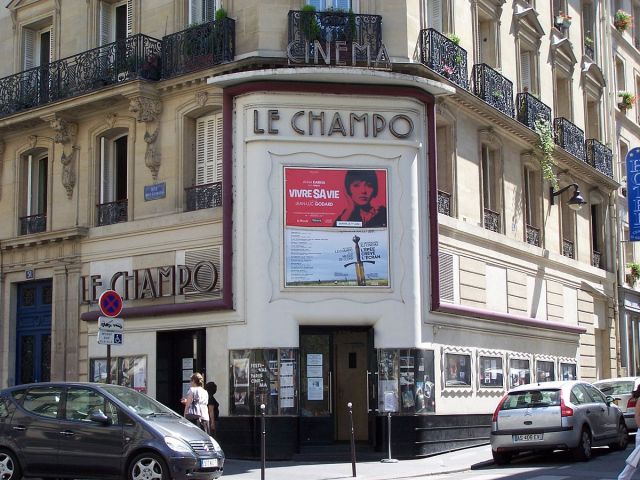
Then, I took myself off to the Champo cinema where I’ve been going since I was 21.
020B3718-0E20-4879-A469-74ED6B7DB0E3

Tonight was Jean Renoir’s The Southerner with Randolph Scott.  I needed an English speaking film.  I didn’t have the stamina to try understanding French for two hours.  In 1946, the film won the Oscar for best director and was shown at the Venice Biennale.  Why I asked myself.  The characters are stereotypes of poor farmers, almost caricatures, the acting is often wooden or over the top especially Beulah Bondi who plays the grandmother, and the cinematography is forgetful.  Some mise-en-scenes seemed directly copied from the film Grapes of Wrath.  And by God when I left the theatre, it was raining again.  This time, no umbrella.

 
2F96BD7A-5F9E-4494-A6B2-5B7725EAA06A

Like a bad penny, I returned to La Méthode for dinner.  I ordered dessert  realizing too late, it was unnecessary.  With my coffee came a small piece of cake, comme d’habitude.  In France, a small sweet often accompanies an order of coffee.  I returned home to some reading and the jet lag reversed on me.  I was up most of the night.  Not one bit tired until the next morning.

Tuesday  February 18

I continued to write about not writing as I‘ve been doing, then, spent the afternoon with yet another nap.  And like yesterday, I forced myself to get out.  This time to Luxembourg 3 off Boulevard Saint Michel for Tu Mourras a 20 Ans, You Will Be Dead When You Are 20.  Using my limited French, I bought a ticket and asked in which “salle” (room) the film was being shown.  Still no one attempts English with me.  Is it because there are so few tourists?

42DE9A10-6D35-4BB7-989C-15C2E43B716C

The film is Sudanese, so it was subtitled in French.  I understood most of what I read except when the sous-titres passed by too quickly.  The film follows a young man coming of age in a small Sudanese village while living alone with his mother.  It reminded me of Satyajit Ray’s 1956 film, Aparajito, in its pace, cinematography, it’s focus on a mother, even the emphasis on doors, physically and metaphorically.  Quite beautiful and moving.

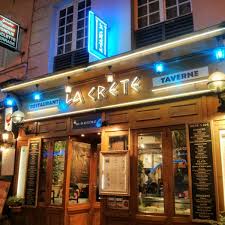
Where to have diner.  Should I continue my “residence” at La Méthode?   I could walk over to my old neighborhood, Odeon, and eat at the highly rated Le Comptoir.  Yet, for all it’s casualness, it seems full of itself.  Aux Délices du Liban, a Lebanese restaurant, around the corner from the Irish Cultural Center, seemed a good choice.  It was closed, so I walked down Rue Mouffetard to La Crete, a Greek restaurant, and enjoyed a lamb and pasta dish redolent with cinnamon.  I considered dessert.  The waiter and I discussed the absence of loukimades, so I settled on a coffee.
3CF75AED-954C-4700-A7C5-E771F7FC183F
What can distract me tomorrow or is it all grist for the mill?

Paris Day Two

Sunday February 16

At breakfast, one of the residents asked If I’d like to go to Mass held at the chapel every Sunday.  I considered going, having watched The Two Popes last night.  Although somewhat cliched in dialogue and structure, I liked it: the acting, the discussion between the characters, some of the cinematography especially the black and white scenes in Buenos Aires.  Mercy and forgiveness played a large part in the film.  To whom should I show mercy?  And, there was call to help the poor.  What can I do?  Perhaps the priest’s homily might have held some insight.
However, “the book” or writing here about “the book” won out.  I finished at one o’clock barely in time to meet Christiane Makward author of Mayotte Capecia which examines Capecia’s novels,  Je Suis Martiniquaise and The White Negresse. Professor Makward took me under her wing last year when I followed Capecia’s life in Paris as a transplanted creole.  The plan was to meet at Gare de L’Est (a 3 mile hike), then, walk to Canal Saint Martine for tea with her friend.
BF39D07B-97A9-4C3F-BCA3-3B82718A599F
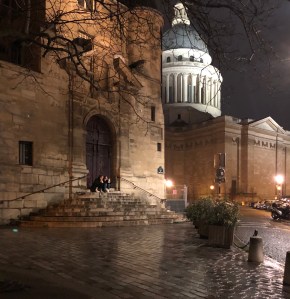
      Viewed from Place de Petit Pont on my way to Gare de L’Est
I arrived at the stroke of three and we made our way to her friend’s apartment which faces the canal.  After introductions, he invited me to look around.  As usual, I headed straight for the book case.  I sighted a biography of Derek Walcott which he had written.
Serendipitous.  A good sign.  Here I am trying to piece together my grandmother’s life in Saint Lucia while breaking bread with someone who spent ten years writing Walcott’s biography and visiting that very island.  I learned that my great grandfather, Armand de Jorna, may have left Martinique for Saint Lucia as it offered more opportunity.  The de Jorna’s had been in Martinique for 150 years before he was born.  Maybe he decided it was time to move on.  But he ended up being a doctor, so does that scenario fit?
CBFBA00E-5183-4302-ADF1-A88546A30587
Canal Saint Martine
After sharing an eclair, a tart citron and a tarte de pomme (my lunch and dinner), Christiane and I walked along the canal to her apartment to retrieve Paris Creole, a book she had purchased for me at Musee Branly.  It traces the lives of creoles born in the French West Indies and living in Paris from the 17th to the 20th century.
At her suggestion, I walked home using Rue Temple. The street has many charms and with a fine mist falling, Paris was particularly romantic.  Malheuresment, by the time I got to Notre Dame, the mist became a downpour.  When I took refuge at an oyster bar, the waiters encouraged me to join them under the heat lamps, but I was tired and wanted to get home.  Not my best idea.  Il pleut, il pleut!  My umbrella kept turning inside out: by the time I got to Rue des Irlandais (Irish Cultural Center),  I was soaked.
Once dry, I began reading Paris Creole, slowly: it’s in French.
4256E371-1279-4863-8E8A-A3698CE0076B
Some “creole” boys, ages 10 and 11, who were sent to France for an education, stayed to become lawyers and doctors, and, then, returned to the islands of their birth.  Could this have been Armand de Jorna’s journey?  Maybe I can find him in Paris, after all.
A good start, or so I thought until I tried to find the file I had begun on this infamous book of mine. Nowhere to be found.  I had written a rough draft of an introduction and hoped to work on it over the next few weeks.  But I’m empty handed and, it seems, empty headed.  I never attached the file to my email.  A Freudian slip of sorts?  Verlaine’s poem seems very apropros:
Il pleut dans mon cœur,
Comme, it pleut sur la ville.
It rains in my heart,
like it rains in the city.
Bien Sûr!

Paris, Day One

Saturday, February 15

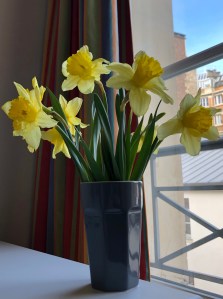
F5E21414-6138-4CFE-9891-3426E2E46EC4                                     My first flowers: Centre Culturel Irlandais
I’ve been busy proclaiming my intention to write a book.  Staying at the Irish Cultural Center in Paris often means people “want to know,” that is, what are you up to?   Not only does the Center have artists in residences, it attracts fellow travelers: writers and would be writers.  I explain to those who ask that I’m working on a “project.”  If more is required, I describe the book I aiming to create.  “It’s an exploration of my grandparent’s experience as immigrants, background history of the times, anthropological theory, and fiction.”  This idea sounds ridiculous to my ears let alone theirs.  But I say it none the less.  As I told one of the administrators who politely inquired, “I admit to what I’m doing as a way of keeping my feet to the fire.”   To another inquisitive writer, I lamented that since the book encompasses vast amounts of material, the notion of sorting through it overwhelms me.  She described her approach as plowing through and seeing where it leads.  I agree.  What choice do I have?

I managed to avoid my nemesis, the blank page, by searching for a set of glasses: one for flowers, one for drinking, one for toothbrush and toothpaste, one for pens and pencils.  But this is Paris where like stores often live side by side: book stores, furniture stores, plumbing stores, sock stores.  I thought I was up to locating the street of houseware “magasins”: this is not my first foray.  But after several turns around the neighborhood, no success.  What to do?   I knew the Monoprix on Boulevard Saint Michel didn’t have them.  Been there, done that.  Then, I remembered the outlet or overstock stores catty corner to the Luxembourg Gardens.   I purchased two which fit the bill and was able to buy L’Official, the weekly bible of goings on in Paris, at the kiosk.  Now I can avoid that blank page by perusing all that Paris has to offer.

Having walked five miles and been awake for 36 hours, I made it home, had a long nap, and, then, a very good dinner at my old stomping grounds, La Méthode.

CF3E1E7F-C12C-4686-829B-026D05B69378
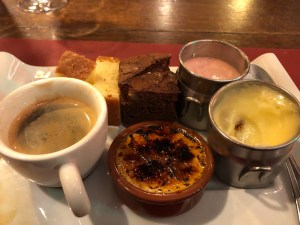
Finishing with an impressive cafe gourmand.
265E4CF3-1780-499F-A4AF-F9D00778A704
Then, a walk home.  Pas mal.
2F5EE645-EF40-4EA6-B77C-34280FE798A4

On My Way

February 14 Friday


Today, I’m starting on the long, tortured journey of writing a book that perhaps no one will read but may take years to complete.   I’m terrified, scared shitless.  To keep on target, I’m writing this blog, exposing to many or no one this quixotic enterprise.  Quixotic indeed, as it can’t be categorized: part memoir, part fiction, part exploration of sociology, history, anthropology. gender, race.  A sprinkling of French.   My grandmother and her sisters insisted they hailed from France.  Really they emigrated from Saint Lucia.  In their determination to hide all traces of African blood, they wiped out large swaths of their history and denied the rest in order to pass, in order to be taken as white.

Can I pull it off.  Who will care?  Is it of any value?

Ann Patchett in her memoir, Truth & Beauty, about her friendship with the writer, Lucy Grealy,  after waitressing all day, after being divorced, and living at home once again, reveals her own doubts about writing:

I was starting to wonder if I was ready to a be a writer, not someone who won prizes, got published, and was given the time and space to work, but someone who wrote as a course of life.  Maybe the salvation I would gain through work would only be emotional and intellectual.  Wouldn’t that be enough, to be a waitress who found an hour or two hidden in every day to write?  If Lucy was struggling to find her way under the burdens of surgery, surely I could find it in the comfort of my mother’s guest room.  I made my resolve to work for the love of the work, to write for myself, but it didn’t have to last for long.  She got a fellowship to the Fine Arts Work Center in Provincetown which gave her 7 months to write with some money and an apartment.

I’m hoping for this type of resolve as unlike Patchett, I won’t be rescued.

Return to Paris Day 22

Monday April 22

My last morning in Paris, I walked to Rue Berthollet the first place Mayotte Capecia lived in Paris.  It’s Easter Monday, so the streets were empty.  The walk from Rue Irelandais goes along Rue L’Homond, passes a small garden, turns down Rue Retaud adjacent to yet another garden.  Paris is like that, places of unexpected green and rest.

IMG_6311-4
Rue Retaud
Yet, where Claude Bernard intersects with Rue Berthollet, there is little greenery.
IMG_6300
15 Rue Berthollet, Mayotte Capecia’s first home in Paris

What was it like for Capecia to land here coming from a small island surrounded by the sea, alive with verdure?  In Je Suis Martiniquaise, her first person narrator, also named Mayotte, describes an idyllic childhood:

Why did I decide to write?  I had just arrived in Paris….. It was cold and snowing and the gentle whiteness falling from the sky that I was seeing for the first time both fascinated me and caused me pangs of homesickness.  That is when I wrote down some of the childhood memories about my country.

Each day for me was different, each day brought it’s own revelation, each day was like a net that brought strange fish to the shores.  But I think that my favorite moment was the evening when all the village children gathered on the endless beach.  We rolled in the sand, still lukewarm, flecked with tiny stones, clear as glass in which the last rays danced, and which I thought, were like dead stars fallen from the sky the night before.  On our half naked bodies we felt the voluptuous caress of a fresh breeze.  The sun set slowly and, minute by minute, the colors changed.  The ocean horizon became yellow, then orange- I do not remember ever in my life having seen a more beautiful spectacle.

In 1905, my grandmother faced the same contradictions coming from the small town of Soufriere, Saint Lucia to Hoboken, New Jersey, then, onto Washington Heights in Manhattan.  Perhaps she was not so disconcerted.  Her father had sent her and a few of her sisters to school in England, so she knew a different “lieu” or place.  Perhaps, she looked forward to leaving the confines of a small island where there were few surprises.

Unknown-1
Hoboken Ferry to Manhattan, Early 1900’s

Soon after arriving in Paris, Capecia became a cook for a family in order to make ends meet.  She was alone, her children left behind in Martinique in the care of her twin sister, Reine, who later joined her.  My grandmother was eventually brought to New York by a sister, her older sister Yia.  What greeted her?  Aunt Yia lived above a store front.  Even in the 1960’s, she had to be called from the street in order to enter her apartment.  In the early 1900’s, she had access to the cellar where she put up boarders, each bed separated only by a sheet.  One of those boarders was my Greek grandfather.  Was this a shock to both grandparents, one from Saint Lucia, one from the small village of Kastellia in Greece?

d085f3f247e15a60abd2fa89f9e21b6e
Women Playing Cricket, Saint Lucia 1905
kastellia_prosp2
Kastellia, Fokida, Greece
apo_tous_protous_metanastes_stnv_Ameriki_thumb
My Greek grandfather, Efstadiou Zinis, (middle, top row), early 1900’s shortly before he left for America

Capecia had to work most of her adult life.  She wasn’t a stranger to supporting herself.  And my grandmother?  She certainly had it better in Saint Lucia than Capecia in Martinique.  She had been abroad to school, she and her sisters played instruments, traveled first class to America, and like good Victorian women, they knew how to sew.  After her sister Yia threw out her husband, she earned her living as a dressmaker or as Yia, always aiming high, described on her card, a dress designer, not merely a seamstress.

Another commonality between Capecia’s protagonist and my grandmother, Germaine, was a preference for white men.  When the local priest in Je Suis Martiniquaise offers to help her learn her catechism lessons, she writes:

He looked at me with his bright blue eyes.  Oh, how I have loved to be blond like him!

Later when the character learns that she had a white grandmother, she wonders if her mixed race mother had married a white man instead of her black father, would her life have been easier.  She ends the chapter with this declaration.

I, who was still thinking about the Father (the priest), decided that I could love only a white man, a blond with blue eyes, a Frenchman.

Although in the early 1900’s when my grandmother married my Greek grandfather, he wasn’t exactly considered “white.”  This possibility was pointed out to me at a coffee I was required to give as a Marine Corps officer’s wife.  The women were discussing the marriage of Jackie Kennedy to Onassis. “How could she marry that dirty Greek?” one woman decried.  The others clucked in sympathy.  After a few minutes of decision making, I told them, “My grandfather is Greek.” That was the end of the coffee.  Unlike my grandmother, I didn’t hide my heritage, at least, not what I knew of it.  But I wasn’t in danger of being lynched for the color of my skin.  Between 1882 and 1968, almost 4000 African Americans were lynched.  And it only took “one drop” of Africa heritage to fall into that category.

IMG_6598
My great grandmother’s death certificate.  She is described as colored

Years later, while visiting  my grandfather’s Greek village, a cousin said to me, “Oh your grandmother’s name was Mary.” No, I told him that was my grandfather’s second wife after my grandmother Germaine died.  His disdainful response, “Oh, yours is the black grandmother.”  Did my grandfather have the same contempt for his wife.  It seems he did: he told his Greek family Germaine’s secret with his white Irish wife on his arm.

And this prejudice or preference runs deep.  My daughter’s  Greek professor when meeting me said with pleasure, “Ah you have the blue eyes of the north.”

What is it this desire to be white, to be blue-eyed?  Was my father pleased I had blue eyes even if my skin didn’t quit meet his standards?  Not always.  Too dark.

I planned to uncover the experience of being a mixed race French West Indian living in Paris trying to get closer to my family’s experience of passing.  I’ve only scratched the surface.  I will come back, come home as my family and I seem to view Paris.

IMG_6319
View from my room, my last night

As Jean Rhys, that other creole, says to a companion at the end of her novel Good Morning, Midnight

Well, there you are, Paris, and this is a good-bye drink….