Paris Day 26

Thursday April 26

Only twelve days left before I return to the United States.  I don’t have enough time to explore Sophie Calle or even my own family at the National Archives.  Many shoulds.  I feel pressured to squeeze it all in.  An impossibility.  I must remember to take a photo of the charming street I pass every day on the way to the Alliance Française.   I have only today and two more classes.
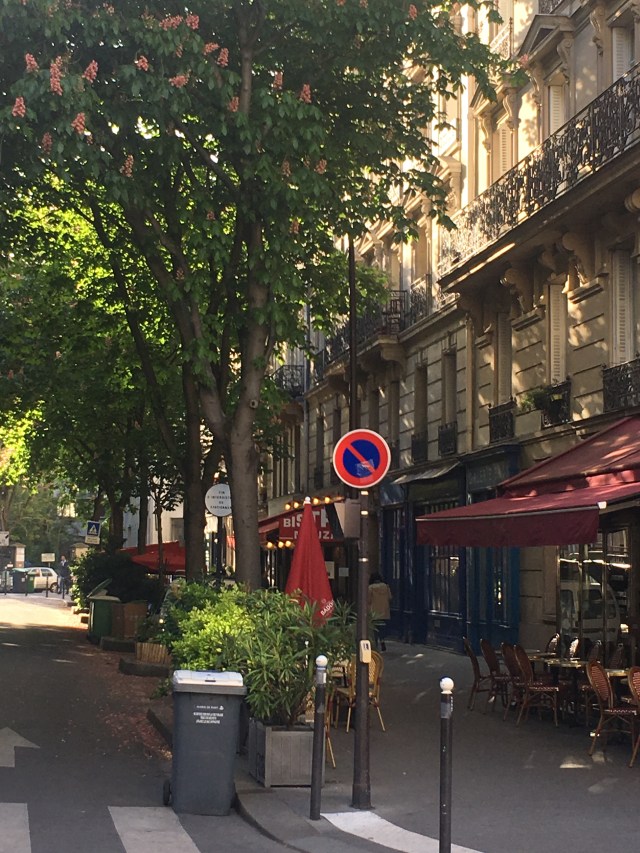
IMG_3696

Rue de l’Abbé de l’Epée

Given yesterday’s debacle, I decided to approach Duras by visiting Musée D’Orsay.  As part of The Resistance, she often visited Gare D’Orsay working with the BCRA, Bureau Central de Reseignement et d’Action (Central Office for Intelligence and Action) which coordinated intelligence supplied by French networks.  In her memoir The War, she describes her days at the Gare:

 “…I set myself up there by stealth with forged papers and permits. We managed to collect a lot of information…about movements of prisoners and transfers from one camp to another. Also a good many personal messages.”

and after the arrival of French political deportees,

“Orsay.  Outside the center, wives of prisoners of war congeal in a solid mass.  White barriers separate them from the prisoners.  ‘Do you have any news of so-and-so?’ they shout.  Some stay till three in the morning and, then, come back again at seven.  But there are some who stay right through the night.”

6d822e44ff03aefcbec98716e13e6f17                              Returning Prisoners Arriving at Gare de l’Est 1945

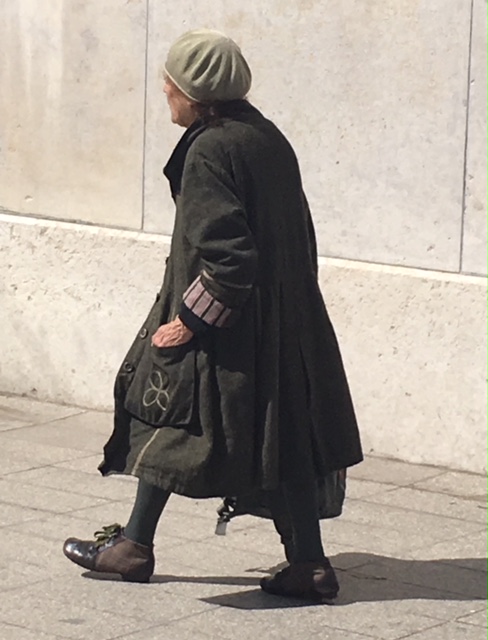
On my way, I passed several sandwich shops: all smelled delicious. I don’t have time for breakfast on the days I go to class, so I was particularly hungry.  While trying to decide which shop to patronize, I passed a woman from a fashion time warp, a thirties coat, 1900’s shoes. Up and down the street she strode.  Maybe this was my Sophie Calle moment.  Sophie Calle, a French multimedia artist, that is, writer, photographer, installation and conceptual artist, followed a man on the streets of Paris and all the way to Venice photographing him without his knowledge.  Later, she had her mother hire a detective to follow and photograph her as she went through her day.
IMG_3709

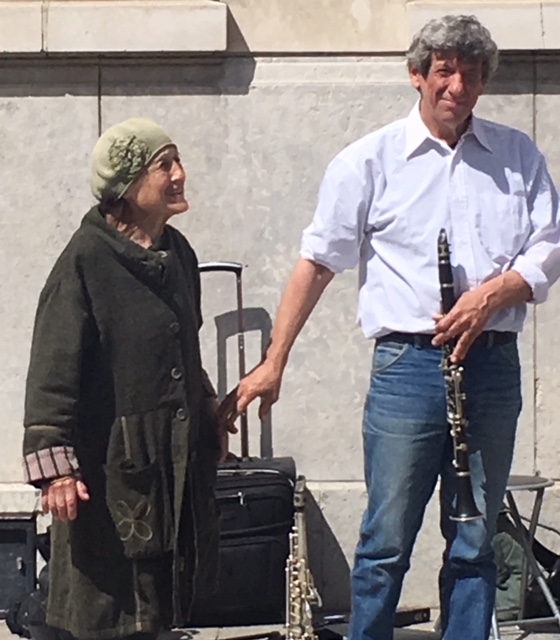
I walked a few hundred feet behind the woman until she entered a drug store.  When she emerged, I couldn’t maintain the stalking.  I’m not made for artistic ruthlessness where another person unknowingly becomes a source of creative endeavor.  Instead, I got in line at a sandwich shop, which would have been at home in Brooklyn: locally sourced ingredients, minimalist design, lots of grains and vegetables.  I took my lunch to the steps of the Musée d’Orsay.  There she was, my thirties’ prey, standing next to a trio busking in front of the museum.  I can’t seem to escape my country: the group played American blues music.  Then, she came alive, dancing in all her magnificence from one song to the next.  When they took a break, the clarinet player raised the dancer’s hand and said to the audience “Merci, Madeline”
IMG_3725                                                                  Madeline

If I wanted to write, I had to get going.  After a long day, Duras describes her walks home from Gare d’Orsay.

“As soon as I leave the embankment (along the seine) and turn into Rue du Bac, the city is far away and the Orsay center vanishes.”

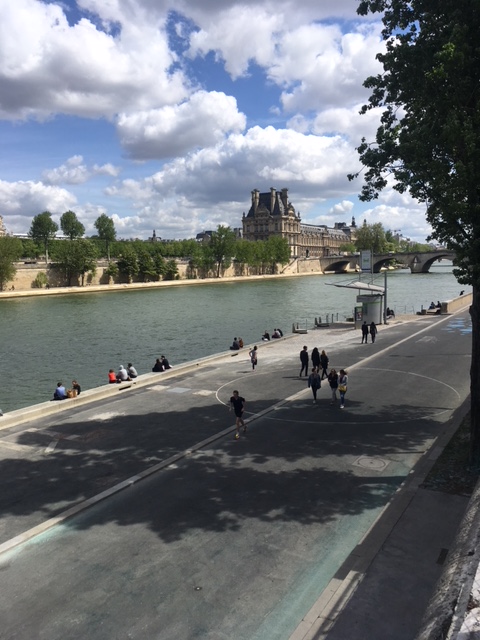
I would do the same.  The sun was shining just as it was for Duras.  The Seine winked blue-green at passers by.  How privileged we are sitting on the steps of the museum, walking along the Seine, having tea in Restaurant du Musée d’Orsay.  In 1945- hunger, fear, despair, loved ones tortured, killed.  But I walk along the Seine undisturbed, unmolested, unafraid.  And just last year, miles away in Calais, a makeshift refugee camp was destroyed.  Even here, the homeless don’t always find shelter.
IMG_3742

Quai Anatole Franc

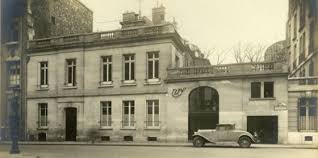
I enjoyed meandering back to the Irish College and decided to forgo writing.  I made one more Duras stop, the office of her publishers for many years, Gallimard, who collaborated with Vichy in order to publish resistant writers, Jean-Paul Sartre and Camus.  When Patti Smith visited Gallimard, her French publisher, she writes:

“My editor Aurélien opens the door to Albert Camus’s former office.”

Did she know it’s history?  Does it matter?  Can we compromise and be ethical?
Unknown

Gallimard Office, Rue Gaston Gallimard

Gallimard is off Rue de l’Université which becomes Rue Jacob and ends at Rue de Seine.  Towards the end of Rue Jacob, I looked right and discovered an empty Place de Furstemberg.  Was I in Paris or Aix-en-Provence where such retreats abound?
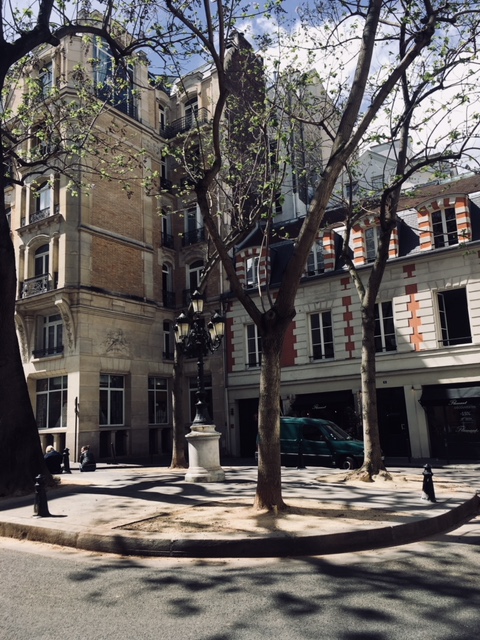
IMG_3784                                                    Place du Furstemberg

On Rue Monsieur le Prince, I passed Les 3 Luxembourg Cinema.  I spotted a connection to Agnes Varda. A film entitled Peau d’Ame sur les traces du film de Jacques Demy (Varda’s husband) was playing that night followed by a discussion with the filmmaker, Pierre Oscar Levy.

Two hours later I was seated.  The film is a tongue in check archaeological exploration of the setting of Jacques Demy’s film Peau d’Ame, a musical based on the Charles Perrault fairy tale of the same name, that is, Donkey Skin, about a King who wants to marry his daughter.  Demy used Michel Legrand for the music and Catherine Deneuve as the lead just as he had in The Umbrellas of Cherbourg.

In the film, made over four years, students brushed dirt from artifacts such as pieces of costumes and colored glass as they would on any archealogical dig.  Demy and Varda’s daughter, Rosalie, was interviewed when a ring worn by Deneuve was discovered. The audience occasionally laughed but I couldn’t get the jokes.  Afterwards, the filmmaker and an archaeology professor from the Sorbonne discussed the authenticity of such an endeavor for well over an hour.  Mon Dieu.  I dozed a bit; then the need to get some dinner overroad politeness.  I departed just in time to get a Lebanese sandwich at Au Vieux Cedre near Place de la Contrescarpe.  While I waited, the owner offered me a glass of mint tea. A graceful gesture to the other who, now, doesn’t feel like the other.
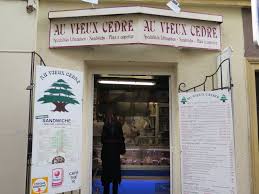
Unknown-1                                                                Au Vieux Cadre


Paris Day 25

Wednesday April 25

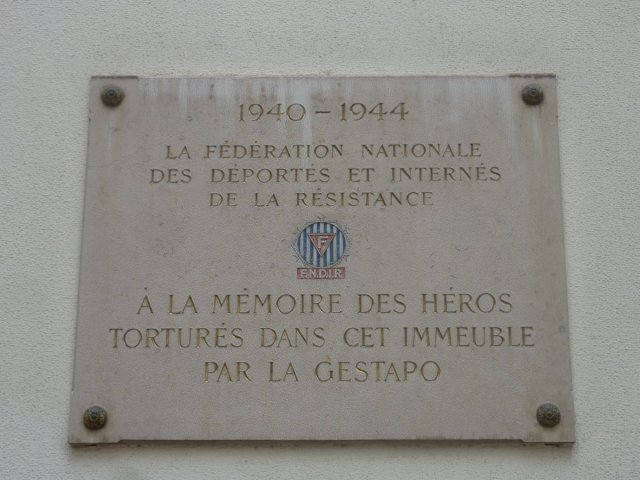
I planned to explore various locations gleaned from Marguerite Duras’ memoir La Douleur (The Pain) in French or The War in English.  The memoir recalls her experiences during the German occupation and the difficulty adjusting after the liberation of Paris. She and her husband, Robert Antelme, were members of The Resistance.  In June 1944, Robert Antelme, was arrested by the Gestapo at his family home where his sister, Marie-Louise also a member, lived.  Rue Dupin had become a meeting place for their group which included Francois Mitterand.  Eventually Antelme was imprisoned at Dachua.   While he was held in Paris, Duras tried to send packages to him through the Gestapo at its headquarters at 11 Rue des Saussaies.

Csk4E8xWIAQ8xmWGestapo Headquarters, 11 Rue Saussaies

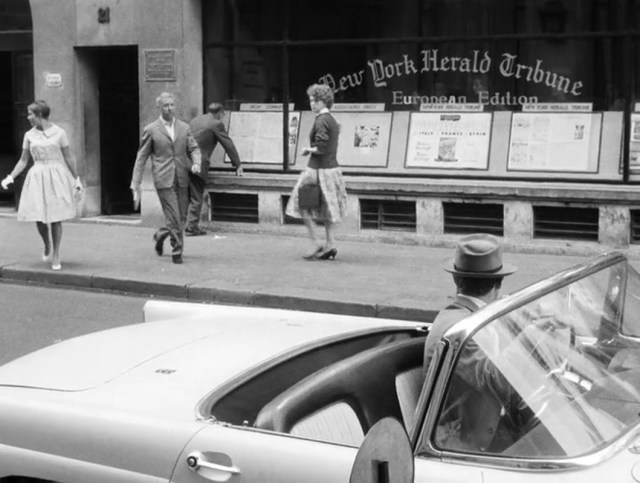
I could get to Rue Saussaies through the Jardin des Tuileries, wander up the Champs Elysees, following my old newspaper route, make a right on Rue de Berri, look for the old Herald Tribune office where I picked up my papers, turn right on Rue Saint Honore, and, a few blocks later, hit Rue Saussaies.  On my way back to the Irish College, I could go by Rue Dupin located in the 6th off Rue de Sevres.

8856460_origParis Herald Tribune Office, Rue de Berri, Still from A Bout de Souffle (Breathless)
It was not to be. The night before, I had spent every Euro I had on dinner.  On Rue de Soufflot, I went to a bank ATM to withdraw some cash.  Denied.  I assumed something was wrong at their end, not mine. I had plenty of funds in my bank account.  After trying two more banks, I realized my bank card ne march pas, didn’t work.

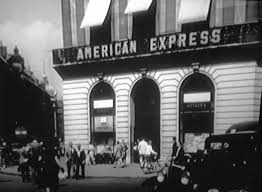
As it was noon in Paris, therefore, six in the morning in the states, I had to return to my room.  After 10 minutes of pacing, I tried the 800 number on the back of my bank card, but it only dealt with lost cards.  I searched for an American Express office hoping that as a card holder, they might help.  None exist.  Not like the days when I could pick up my mail, cash a check, meet a friend there.

UnknownAmerican Express Office, Rue Scribe, Paris
I asked an administrator at the college if they could cash a check for me.  No. He suggested I try a currency exchange office.  Back to Rue Soufflot.  No again.  I went to a few banks.  Absolument pas!  Back to my room.  Two hours later, my bank remained closed.  I called American Express in the states, no go.  I didn’t have the right account to withdraw money.  Finally at 9, I reached my bank.  A digital glitch.  A questionable withdrawal had shown up on my account automatically freezing it.  It could not be unfrozen.  They assured me they had called me at home and sent me a new card.  I reminded them that I wasn’t at home but in Paris with no dough.  Then, they informed me they could not send me money.  I suggested they get on a plane with some moola as I had none, and, therefore, was unable to buy food or even get a cab to the airport.

Five hours later after moving up the chain of command, they advised me to wire money to myself using Western Union.  I hurried to an office on Boulevard Saint Michel as closing time was approaching.  Their computers were down.  Merde.  They directed me to another office further down towards Boulevard Saint-Germain.  Their computers worked.  I spoke to the clerk using English and French: no, I could not wire myself money.  Someone else would have to send it to me.  And so, a family member saved the day.  It had taken only 7 hours to be rescued.  A lesson: always have a secondary source of funds.

I had expected to go to a reading by my daughter’s novelist friend, but the thought of traveling to Montmartre at 8 in the evening overwhelmed me.  I settled for a gyro from Au P’tit Grec on Rue Mouffetard.  I, also, ordered a bottle of retsina but first had to convince one of the customers, a Greek man, that I knew what I was getting myself into, mostly through nodding my head up and down.  As I walked back to my room, I figured out what I could have said to him in French.  It seems I can speak adequate French after the fact.  Should I have tried Ellenika, that is, Greek?

images-1

Food

The Lower Road 10:00 P.M.

I love to cook and I love to be fed. Maura provides breakfast for all the guests and dinner most nights. My plan was to eat a hearty breakfast, skip lunch, and “eat all my dinner.” This I have done. My first morning I had to have it all, a full Irish breakast: 2 pieces of Irish bacon (more like ham), two sausages, two fried eggs, a tomato, and four pieces of brown bread. While Maura got that ready, I had a bowl of porridge. It tasted better than any I had before. I have begun each breakfast with the wonderful porridge, but have not repeated the Irish Breakfast. I can only be a morning glutton once.

My poor depth perception (good vision in only one eye) has created a problem in the dining room.  At least, I’m attributing the noise and mess I make to visual inadequacy.  I tend to bang my cutlery  rather noisly.  Maybe I don’t see how close they are to the plates as they often tend to fall on to the table, sometimes, even the floor.  A small circle of food can be found around my salad plate, and drops of salad dressing find their way to distant spots on the table.

Maura is an excellent cook. Everything that comes out of the kitchen is delicious and 0ften straight from the garden. I have eaten fish almost every day whether for breakfast in the form of smoked salmon or for dinner from sea trout to sea bass. All of it tastes as if it was just caught. I asked her if she has always liked to cook.  She nodded yes and said that when her children were in school, she wanted to get a job catering, but Joe wouldn’t have it as he said she wouldn’t have enough time.  Instead she went to a cooking school which she declared was the best thing she ever did.

On Tuesday, Maura went to Galway, so I had to fend for myself. Joe had to pick her up from the return ferry and offered me a ride.   We had a free ranging conversation.  He loves to read and gets taken with a subject.  For awhile it was the Romans.  Presently, he is immersed in Mozart’s Operas.  He isn’t sure if Maura also appreciates hearing so much Mozart. When I told him that he was a lucky man as she is such an accomplished cook, he said “Well its nice she’s good at something.”  We finished the conversation with my Irish roots and that I had named my daughter, Medb (Maeve) after the Queen of Ireland.  We talked of how she had been a lusty queen, and he added, “Celtic women had it good and had their way until the Normans came and imposed their patriarchal culture.”

Ti Joe Wattys

I returned to Ti Joe Wattys with the notion of being able to walk back after dinner. This night it was sea bass again delectable and under it was the familiar taste of a mashup I had in Dublin years ago: turnips and parsnips mashed with butter. I began my meal with Jameson’s and had two glasses of wine with dinner. I felt rather optomistic.  The sun was out, it was 8:30, I could make it home by 10 and it would still be light. I took the low road again.

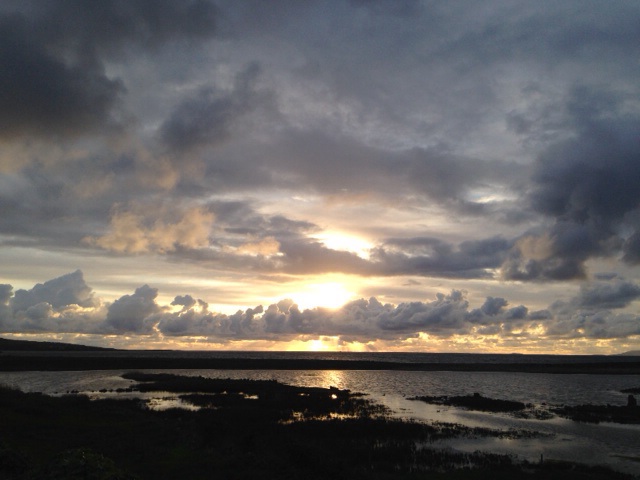
During most of my walk I talked to myself, sighing in wonder. The sky was a bowl above my head, nothing to block the 180 degree view. Surrounding me were clouds made for the heavens lit from behind like jewels, sapphires, onyx. I skipped and danced down the road. Joy, freedom, visual ecstasy.