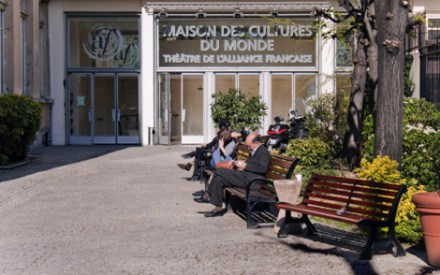
Days of adjustment.I often travel alone and for extended periods of time.Yet, Iforget how difficult the first week can be.My second day began with lashing rain, as the Irish call it, arriving for my first class at the Alliance Francaise bedraggled which aptly describes my understanding of French and my ability to communicate with the instructor, indeed, with the class.
I wonder why am I doing this?I will never master this language.
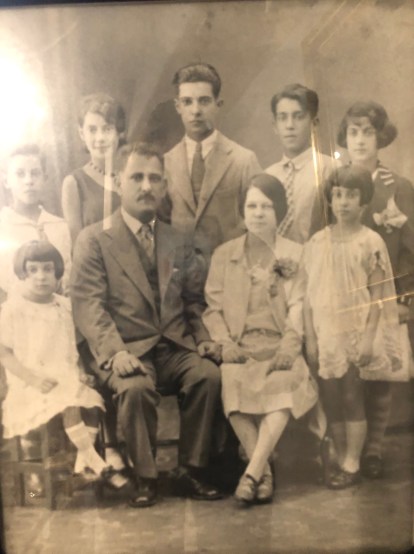
I consider my ancestors who landed in New York and had to do just that, master a foreign language and a foreign culture. They had relatives whom they joined, but each encoutered difficulties patching themselves into the fabric of America. My Greek grandfather eventually spoke, not fluently, seven languages but when he first stepped off the boat, English wasn’t one of them.
Efstadiou (Tom) Zinis and Germaine de Jorna with their children
My “French” grandmother probably had some English as Saint Lucia, from where she hailed, had been a British colony since 1832.Yet, she only spoke French with her sisters or her husband, my Greek grandfather, when they didn’t want the children to understand. What kind of French? The French of Paris or the patois of Saint Lucia?
My Irish grandmother came to the states at age 13 and refused to continue her education. She didn’t want anyone making fun of her brogue.
Molly Daly
Here I am, a privileged American, trying to become part of my heritage, the holy land of France and I’m unable to converse with anyone or to even order food. I forget the importance of “politesse” that is, the polite way of interacting.I’m more a bull in a china shop.In the states, we don’t bother with greetings, with leavings when we are doing business.We get right to the point.“I want a coffee” instead of “Bon Jour Monsieur.Je voudrais un cafe, s’il vous plait.” “Good day sir.I would like a coffee if you please.”And always when leaving “Au Revoir or Bonne Journee.” “Good bye, have a good day.”
Confusion again. I stopped at the same cafe as yesterday and ordered a cafe allonge, that is an espresso with a pitcher of hot water to elongate it.This I understood, but what was I do with the green bottle of cold water and small glass placed on the table?I maximized my stay by using all the hot water and never touched the other or inquired about their purpose. Like my Irish grandmother, I wouldn’t risk being the object of a joke.
These small setbacks create feelings of isolation.So minimum but so heartfelt.What could my grandparents have experienced when Greeks were called “Dirty Greeks” and Irish faced “No dogs or Irish allowed?”Although perhaps, being American today is just as unseemly.
The day began with an expensive cab ride to the city: I had too much baggage to manage on public transportation. As soon as I put my bags in my room, I rushed to the Alliance Francaise to buy books for classes I plan to take over the next month. Immediately all the French I had been studying and listening to deserted me. I understood nothing and could only state when necessary, “Je parle un peu francais” and, then, ask meekly, “Est-ce que vous parlez anglais?” I only speak a litttle French. Do you speak English?
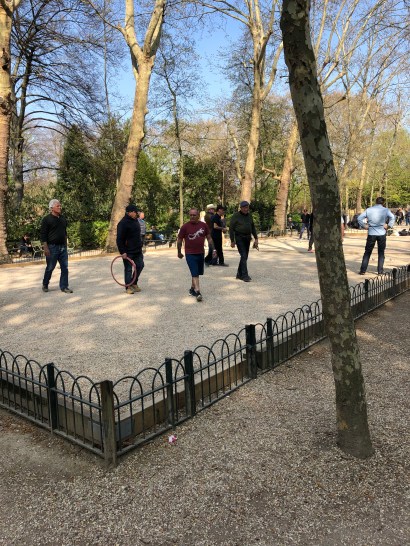
The walk back through the Jardin au Luxembourg heartened me as I passed men playing pentanque. Here is France on a beautiful day. It’s okay.
But not for long. I hadn’t eaten all day, so I decided on an early dinner. I walked behind the Pantheon and down Rue de la Montagne Saints Genevieve to a restaurant I remembered as pal mal, not bad, La Methode. It was a particularly beautiful spring night, almost 70 degrees with a gentle breeze making it’s way along the streets of Paris. All the outdoor tables were full. When I sat in the last row, a waiter appeared and asked if I wanted to dine. I did and was given a menu. Only then did I notice that I was sitting at the three tables set for dinner. Everyone else was having an aperitif: it was 6:30, much too early for dinner. I couldn’t sit there and eat, the only one to be chewing. I made a hasty retreat, telling the woman behind the bar in English that I’d changed my mind. I didn’t even try French. She nodded with disdain.
Now what to do while the rest of Paris laughed and talked and drank? I decided not to retreat to my room with a sandwich; instead, I went to a nearby cafe and ordered a pastis. Several times, the waiter asked impatiently what brand of pastis I would like. Finally I understood and confidently said Ricard. He moved his head side to side in irritation and explained they only had one kind, a kind I never heard of. I agreed, happy to send him off.
Like most Parisiens that night, I sat for an hour, watching passersby. As the waiter never appeared, I had to go in the cafe to pay. Is that allowed?
Paris isn’t for the faint hearted. How did my relatives manage as they tried to slip by unnoticed?
After spending two weeks in Dublin, feeling at home didn’t happen as easily as last year.An outsider.The language deserted me and my fears of offending the French took hold.
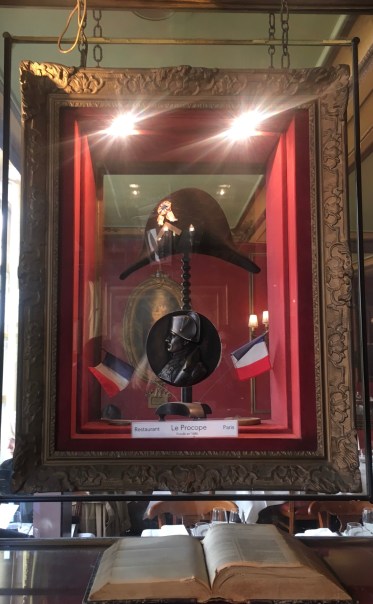
Napoleon’s Hat at Le Procope, Paris
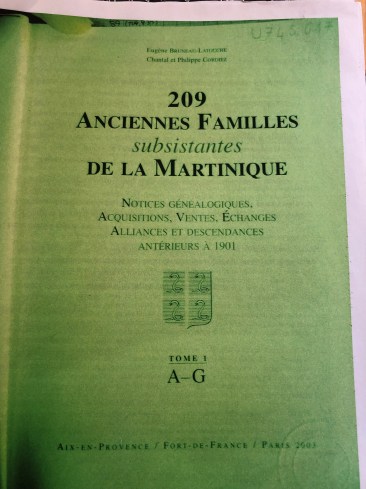
France even Paris was Mecca to my family. My arriere grand pere was a doctor, kicked out of France or was it Switzerland because he used forceps, perhaps code for abortion.An earlier relative had an argument with the king of France, not sure which one, about a naval tactic and was demoted from what to what? Supposedly, we descended from aristocracy as our family name, de Jorna, begins with a small “de” denoting nobility.
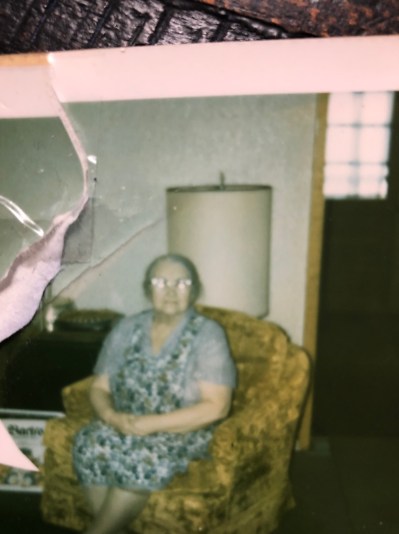
And my grand mere came from France as did my great Aunts and older cousins. The de Jorna’s did come from France and some did live in Paris, but my branch had lived in the French West Indies for more than 300 years.Once that truth was uncovered, a second emerged.My arrriere grandmere’s death certificate listed her as “colored.” On a ship’s manifest from Barbados to New York, my great aunt was listed as colored.
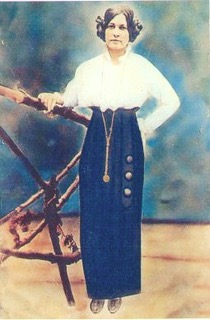
All their lives in the states and perhaps in France, this branch of the de Jorna’s from the lates 1800’s when Armand de Jorna, my great grandfather, married the “colored” Noelline Noel, were passé blanc, passing for white.
My grandmother, Germaine de Jorna, daughter of Armand de Jorna and Noelline Noel
This time in Paris, I return not as an descendent of an ennobled de Jorna, but as a passé blanc, the daughter of a man who resembled Louie Armstrong and who cautioned me to stay out of the sun lest my skin expose me and him.
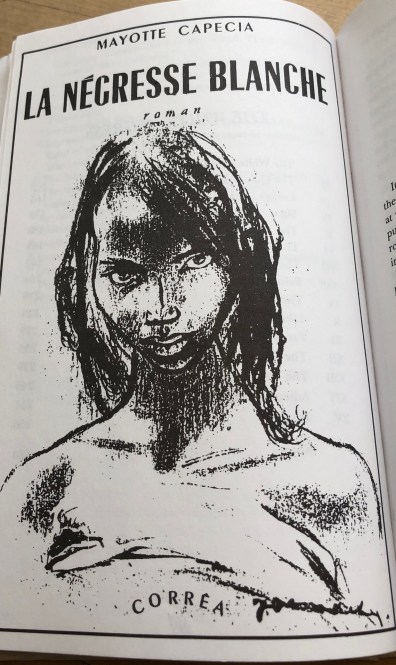
Instead of looking for women artists outside the norm, Margureitte Duras, Agnes Varda, or Sophie Calle, I will look for those who pass and don’t pass, those from the colonies, Mayotte Capecia from Martinique who wrote The White Negress, Jean Rhys a beke, that is a white creole, born and bred in the Carribbean, and others who supposedly are French but are they?
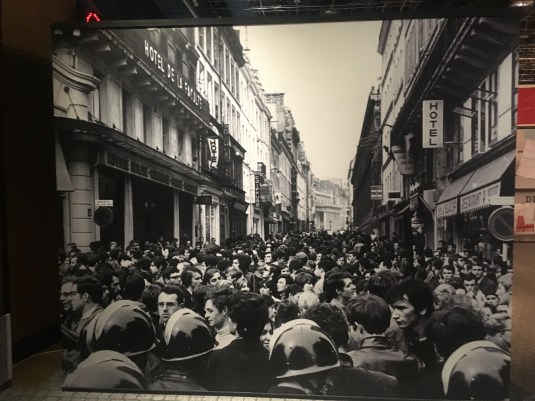
On this May day, the last day, a full day, a full meal. I continued my search for the 1968 revolution and found May 68:Pano Ne Passera Pas, a film showing at Le Saint André des Arts Cinema. The day would include the film, a walk to the store Merci for present buying and finally, packing. But much much more filled my last twelve hours afoot in Paris.
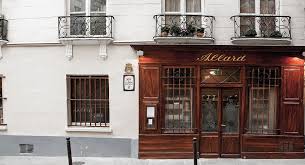
The film was scheduled for noon. The walk to the cinema located on Rue Saint André des Arts took less time than I allotted, so I walked around the block a few times and made a few discoveries. On one of my rounds, I passed a restaurant, Allard, a familiar name. Almost a decade ago, I had wanted to have a meal there but it never came to pass. Carpe Diem. I must have my last meal at Allard. Inside the restaurant, cooks scrambled. I approached the receptionist. Alas, the only available seating was at 9. Too late for me.
Disappointed, I walked around the block again and found a tree lined square, a good place to while away a half hour. I sat down at a café and ordered tea. After some eavesdropping and people gawking, I decided to call Allard and give it one more try. Success. A table at 7 was available.
At the cinema, there was some confusion about which door to enter. It was guarded enthusiastically by a rather fierce woman. “Non, non, interdit” she called loudly and with disdain from the ticket window. Several people, old enough to have participated in May 68, stood talking to each other oblivious to the drama. Finally, we were allowed to go through the “right door.”
The film reminded me of the American film, Medium Cool. Both involved a journalist trying to cover an event in 1968. In the French film, it is the revolution unfolding in the streets: in Medium Cool, it was the 1968 Democratic Convention, a revolution of sorts with similar violence between students, activists and the authorities. Both journalist were seeking to tell the truth while being hindered by their workplace. Both films use fiction and documentary throughout the narrative. I felt right at home.
The same people I had observed outside were the filmmakers who spoke after the film. They agreed it could not be made today as such a revolution couldn’t take place. We are too carefully monitored. C’est dommage.
I walked to Merci by crossing Pont Saint Michel to Boulevard de Palais. At the intersection with Rue de Lutèce a poster announced an exhibit devoted to May 1968 at the Préfecture de Police. C’est bizarre. I went in and was invited to see “Derrière Les Boucliers” or Behind the Shields, that is, a look at the events of May 1968 from the perspective of the police. The exhibit through sound and images immersed me, put me on the streets with a barrage of noise, cobblestones being thrown, tear gas exploding, screams of protest and pain from students attacked by police.
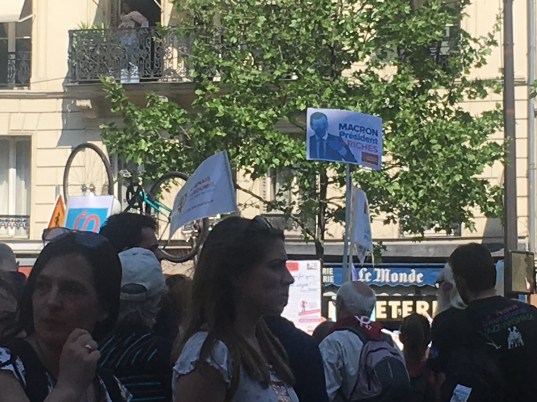
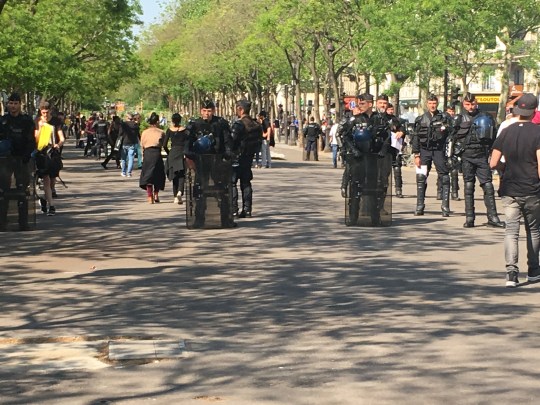
Stunned, I walked to Merci, the upscale hip store where I bought presents for friends and family. As I left the store at the Boulevard Beaumarchais exit, I saw protesters against French President Macran had filled the streets. I joined them and like the citoyens and citoyennes of 68, I was faced with the “shields.” However, no violence.
I rushed home, changed, and got to Allard on time. The intimate restaurant seemed to be divided into two sections. I was placed with the tourists. Americans to my left and right and down a table or two a woman whose companion was a large teddy bear. She asked the waiter to take a photo of the two of them.
I ordered an expensive first course of asparagus with hollandaise, the most exquisitely cooked asparagus I’ve every eaten and the saltiest hollandaise. The salinity continued throughout the meal. I had to say something: my meal cost well over 100 Euros. I asked the waiter if I could speak to him using French so as not to make a scene with the other English speakers. I explained about the seasoning: he was surprised but offered an explanation. They use salted butter from Normandy. When I raised my eyebrows, he agreed to talk with the chef. Later I discovered that the woman I had seen earlier in the kitchen was the well known chef Fanny Herpin and that Allard was now under the auspices of Alain Ducasse who vowed to save traditional French restaurants. At one time, Allard had been in the same family for close to 50 years.
Paris, a city of contradictions: strikes and privilege, liberty, tradition, anarchy. All in one day
I walked home through cool night air and spent the rest of the night packing. I had an 8:00 AM taxi for my noon flight. Luckily, I awoke at 3 A.M. and looked at my phone. My flight had been cancelled. After furiously phoning the airline, I was able to rebook for a 9 A.M. flight. But how to get there. How to get a cab by 6 A.M.? Another stroke of luck, par hasard, I found the security guard who was able to get me a taxi.
At the airport, I discovered that due to strikes, all flights on United from Paris had been cancelled. I was on the only one that left that day.
I got the last seat on the plane, facing a bulkhead. At a loss as to how to handle the devices, that is, the location of the television and the tray for meals, I sighed loudly. The passenger next to me gallantly helped me arrange myself. He was lanky, laconic, and spoke with a west Texas drawl.
He’d spent a week in Paris with his wife who was seated on his other side. When asked how he liked the city, he replied, “Well the wife likes museums and I just go along to keep her happy.” Welcome home to a part of America, a kindly man with graceful manners, and a willingness to accommodate. Another country filled with contradicitons.
Southwest by Southwest Musical Festival Austin, Texas
My last day at the Alliance. On my way, I prepared what I would say about today’s significance: May 3,1918, the 50th anniversary of the 1968 French Revolution.
The class began with the teacher asking how we spent our holiday. I began by connecting my Paris Walk about the 1789 revolution to the May 3, 1968 revolution. He looked confused. I repeated, “C’est le cinquantieme anniversaire de la revolution du 3 mai 1968.” “Ah, oui, oui” he replied and quickly moved on to another student. Is he is too young for it to have any significance? I dismissed that notion since the government almost collapsed under the protests. Perhaps the policy of the Alliance is to not engage in political discussions.
After class, a student from Ireland and I discussed staying at the Irish College when our teacher joined us as we lamented the high cost of living in Paris. He was very open about his salary, which if I heard right, is around 20,000 euros a year, amazingly low. He has to share an apartment in the 11th arrondissement in order to make ends meet. I asked him about improving my French and self deprecatingly referred to my lack of progress. He assured me I speak well but lack confidence and kissed me on both cheeks in a friendly good-bye which warmed me considerably.
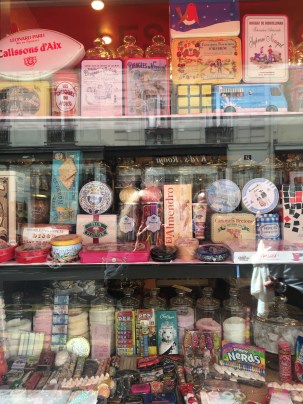
My task after class was to buy gifts for my two nieces, 7 and 10. There are a cluster of children’s stores off Blvd Raspail on Rue Vavin and Rue Brea. I found the perfect shop, just candy. Candy in charming metal boxes. Les petits magasins of Paris delight me, for just socks, for just parapluies, for just nostalgically boxed candy.
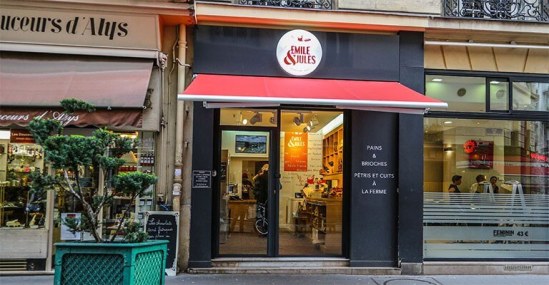
On my way home, I passed Emile and Jules where Rue Vavin meets Rue d’Assas in front of Le Jardin du Luxembourg. I have frequently pasted my face against their window, looking longingly at the breads, brioches, croissants, and sandwiches. Today, I finally entered and choose a small whole grain baguette filled with salad nicoise.
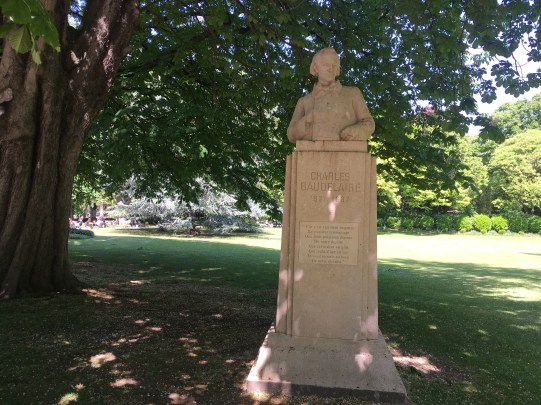
I dined next to Baudelaire in the le jardin. The sandwich was delicious, but unwieldy. I managed to drop a significant amount on my lap. After a half hour, I gave up, chucked the remains, and headed back home.
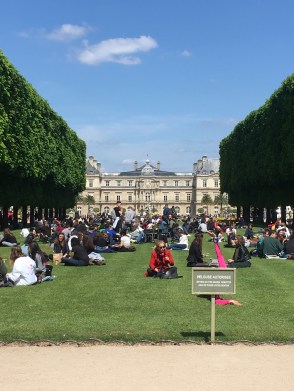
As I passed the lawn at Place Andre Honnorat, students were strewn across it’s expanse. Usually, in Paris parks, it is “Pelouse Interdite.” No sitting on the grass. Is this their way of remembering May 3, 1968? Not much at stake, not like their predecessors. When I looked more closely, the sign read “Pelouse Authorisee.” C’est vrai?
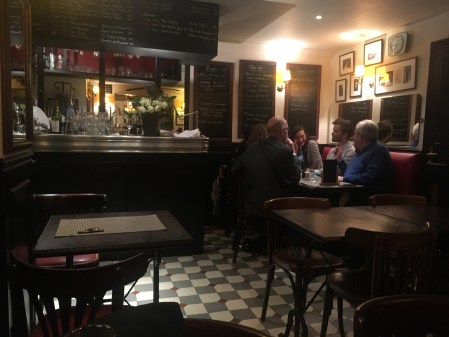
This was the night for L’Estrapade, the restaurant at the end of my street. When I opened the door, I hadn’t much hope: it’s 12 or so tables were full. However, the wait person assured me she would find me a place. She managed to seat me and another couple check to jowl. In order to use la toilette, I had to ask a diner to get up, had difficulty squeezing by, and then had to go through the same embarrassment on my way back to my table.
I went all out. First, l’entrée, la terrine de foie de volaille, next, le plat, le magret de canard aux clémentines, and finally, le dessert, la tarte tatin, the meal accompanied by un pichet de vin. Most satisfying. And later, out my bedroom window, the Pantheon.




 An Itinerant Woman