Return to Paris Day 14

Sunday, April 14

Palm Sunday.  I peeked out my window to see how the day would be celebrated.  The church goers had gathered in the courtyard to receive fresh palms.   As a child, I made crosses from dried palms.

IMG_6075

Instead of mass, I went to the market to buy flowers for that very window.

IMG_6078

When I returned, I planned my route to the Musee d’Orsay to see “Le modele noir de Gericault a Matisse” (The Black Model from Gericault to Matisse) which I had first seen at Columbia University.

I liked the route as it took me through my old neighborhood of Odeon.  After crossing Blvd. Saint Germaine to Rue de l’Ancienne Comedie, I turned onto Rue de Buci, a virtually pedestrianized narrow street filled with restaurants, Parisians. and a group of blues buskers.

IMG_6079

I arrived at the museum early enough to avoid long lines. The exhibit had greatly expanded from what I had seen in New York.  At first I’m was in a frenzy: there was so much to see, so many wonders: films of Harlem projected on the walls high enough so everyone can see.

And a film of Katherine Dunham, the choreographer, anthropologist, and metissage (her mother was French Canadian, her father African America) dancing Les Ballets Caribes in Paris.


I tried to photograph much of the text displayed on the wall but had to maneuver around other visitors. At one point I backed into a display and fell on my backside.  It was worth it.  One section entitled “Metissages Litteraires,” Mixed Race in Literature, mentioned Alexandre Dumas.  The author of The Three Musketeers was the grandson of an emancipated slave (Slavery in the French colonies wasn’t abolished until 1832.)   

My grandmother, Germaine de Jorna, nicknamed her sons after the three musketeers.

De Jorna Family

Armand de Jorna married Noeline Noel

Children

Andreid (Yia)  Germaine  James (father of Adria and Everard)

Zinis Family

Germaine de Jorna Married Efstadiou Zinis

Children

Andrew  Germaine  Alma  Louis  Flora  Gabriel  Stella

Louis Zinis married Mary Daly (daughter of Mary McGann)

Children

Judith  Linda  Edward

My father was Porthos, the character who wanted to make a fortune.  Since he worked from an early age in order to have his own spending money, the choice seems apt.  Did she choose this book because she knew of Dumas’ heritage.  Because she knew that another de Jorna had actually been a “mousquetaire?’

dadandmom1930scar

Louis Zinis (Porthos) who liked nice cars

Also discussed was Jeanne Duval born in Haiti around 1827.  She became Baudelaire’s mistress and was an important part of the poems in Les Fleurs du mal.  One edition included Matisse’s drawing, Martiniquaise, A Martinique Woman.  An exciting coincidence, so similar to the title of Mayotte Capecia’s novel, Je Suis Martiniquaise, 

IMG_6102

My de Jorna relative arrived in Martinique in 1690, five years after the enactment of the Code Noir, an edict of Louis XIV that set forth the policy for the slave population and remained in effect until 1789.  In the 1700’s one of the Martinique de Jorna’s angered a King of France: he was demoted from a high level administrative position to head of the militia.  In either case, he had to be involved in controlling slaves and having slaves.  But years later, they mixed, the de Jorna’s and the slaves.  So like Dumas, I am also descended from a slave.  Nevertheless, my military writer friend is somewhat correct in assessing it’s limited effect on me.  My father didn’t wash my skin with lye in order to “whiten” me.  However, my great aunt Yia tried this method on her nieces.

Edouard Glissant, Martinique poet and philosopher,  wrote ”One of the assumptions of French culture is to assimilate people, to have them all become like a transcendent French model.”  The French Antilleans believed they were French and according to Glissant, emulated French values which meant being white forming what he called a “pseudo-elite,” that resulted in a “depersonalization” of their identity.  Consequently. being identified as African or black was an insult.  They, as my grande-tante did, wanted to get as close as possible to white, to French culture.  Every summer she sent her nieces to a relative’s farm on Long Island where they were scrubbed with a diluted lye solution to make sure their one drop wasn’t too evident.

4x6- The Girls

Germaine de Jorna’s daughters once washed with lye

When she brought her brother’s daughter and son from Saint Lucia to live with her, the nephew was banished from her household.  He couldn’t pass.  He was too dark.  He joined the Merchant Marines so the story went.  However, he spent most of his life in Manhattan never to be seen again, at least not by his family or even the sister with whom he had lived.  Her skin tone did pass.  She kept that secret all her life.

By chance, on my way home,  I passed where Richard Wright had once lived.  Fitting.

IMG_6158

Paris Day 26

Thursday April 26

Only twelve days left before I return to the United States.  I don’t have enough time to explore Sophie Calle or even my own family at the National Archives.  Many shoulds.  I feel pressured to squeeze it all in.  An impossibility.  I must remember to take a photo of the charming street I pass every day on the way to the Alliance Française.   I have only today and two more classes.

IMG_3696

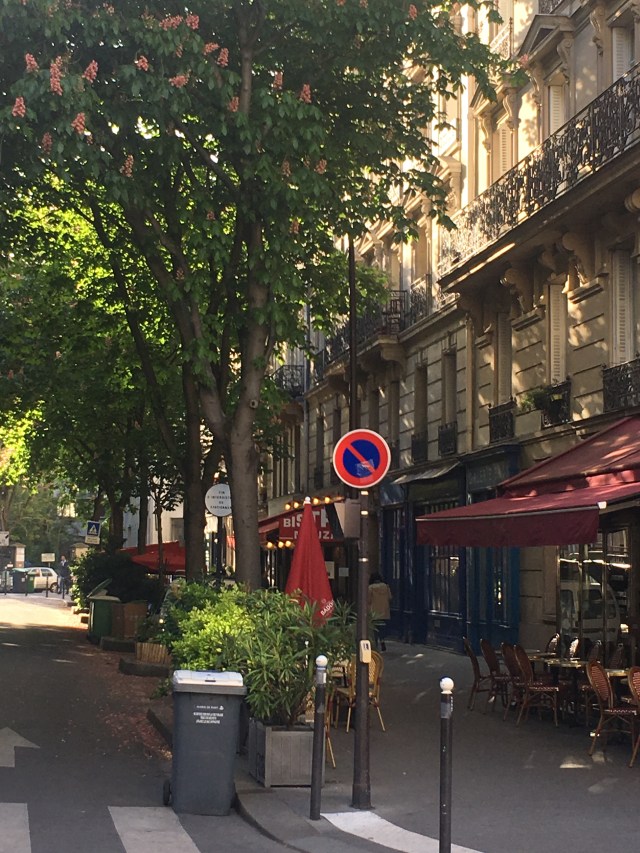
Rue de l’Abbé de l’Epée

Given yesterday’s debacle, I decided to approach Duras by visiting Musée D’Orsay.  As part of The Resistance, she often visited Gare D’Orsay working with the BCRA, Bureau Central de Reseignement et d’Action (Central Office for Intelligence and Action) which coordinated intelligence supplied by French networks.  In her memoir The War, she describes her days at the Gare:

 “…I set myself up there by stealth with forged papers and permits. We managed to collect a lot of information…about movements of prisoners and transfers from one camp to another. Also a good many personal messages.”

and after the arrival of French political deportees,

“Orsay.  Outside the center, wives of prisoners of war congeal in a solid mass.  White barriers separate them from the prisoners.  ‘Do you have any news of so-and-so?’ they shout.  Some stay till three in the morning and, then, come back again at seven.  But there are some who stay right through the night.”

6d822e44ff03aefcbec98716e13e6f17                              Returning Prisoners Arriving at Gare de l’Est 1945
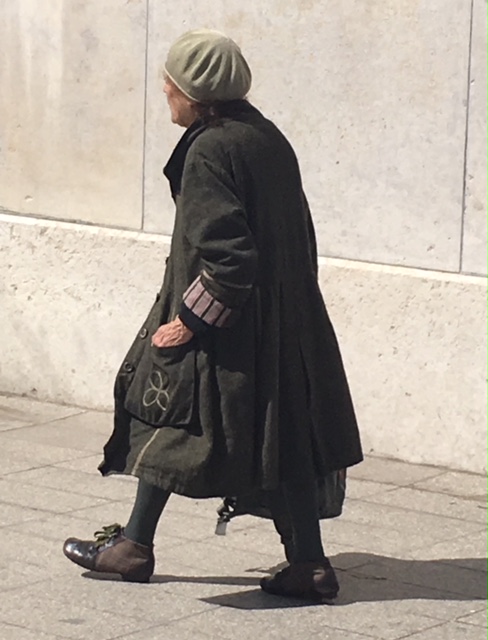
On my way, I passed several sandwich shops: all smelled delicious. I don’t have time for breakfast on the days I go to class, so I was particularly hungry.  While trying to decide which shop to patronize, I passed a woman from a fashion time warp, a thirties coat, 1900’s shoes. Up and down the street she strode.  Maybe this was my Sophie Calle moment.  Sophie Calle, a French multimedia artist, that is, writer, photographer, installation and conceptual artist, followed a man on the streets of Paris and all the way to Venice photographing him without his knowledge.  Later, she had her mother hire a detective to follow and photograph her as she went through her day.

IMG_3709

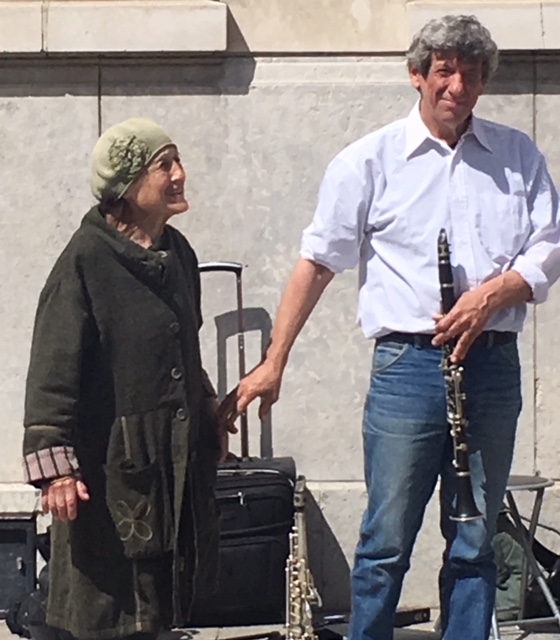
I walked a few hundred feet behind the woman until she entered a drug store.  When she emerged, I couldn’t maintain the stalking.  I’m not made for artistic ruthlessness where another person unknowingly becomes a source of creative endeavor.  Instead, I got in line at a sandwich shop, which would have been at home in Brooklyn: locally sourced ingredients, minimalist design, lots of grains and vegetables.  I took my lunch to the steps of the Musée d’Orsay.  There she was, my thirties’ prey, standing next to a trio busking in front of the museum.  I can’t seem to escape my country: the group played American blues music.  Then, she came alive, dancing in all her magnificence from one song to the next.  When they took a break, the clarinet player raised the dancer’s hand and said to the audience “Merci, Madeline”

IMG_3725                                                                  Madeline

If I wanted to write, I had to get going.  After a long day, Duras describes her walks home from Gare d’Orsay.

“As soon as I leave the embankment (along the seine) and turn into Rue du Bac, the city is far away and the Orsay center vanishes.”

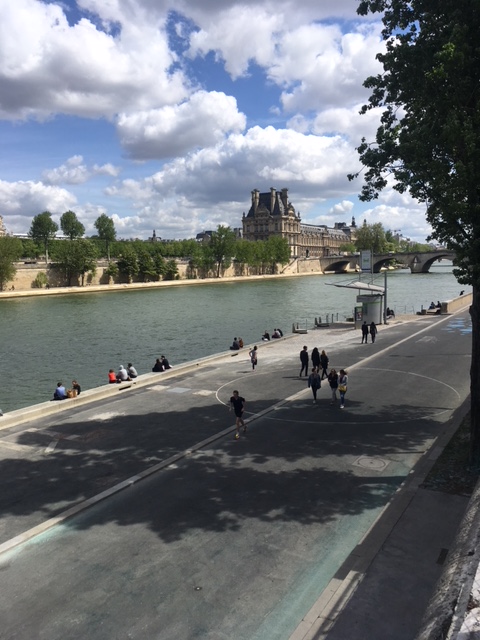
I would do the same.  The sun was shining just as it was for Duras.  The Seine winked blue-green at passers by.  How privileged we are sitting on the steps of the museum, walking along the Seine, having tea in Restaurant du Musée d’Orsay.  In 1945- hunger, fear, despair, loved ones tortured, killed.  But I walk along the Seine undisturbed, unmolested, unafraid.  And just last year, miles away in Calais, a makeshift refugee camp was destroyed.  Even here, the homeless don’t always find shelter.

IMG_3742

Quai Anatole Franc

I enjoyed meandering back to the Irish College and decided to forgo writing.  I made one more Duras stop, the office of her publishers for many years, Gallimard, who collaborated with Vichy in order to publish resistant writers, Jean-Paul Sartre and Camus.  When Patti Smith visited Gallimard, her French publisher, she writes:

“My editor Aurélien opens the door to Albert Camus’s former office.”

Did she know it’s history?  Does it matter?  Can we compromise and be ethical?

Unknown

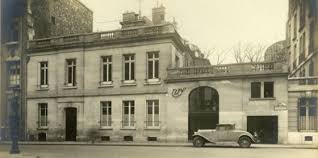
Gallimard Office, Rue Gaston Gallimard

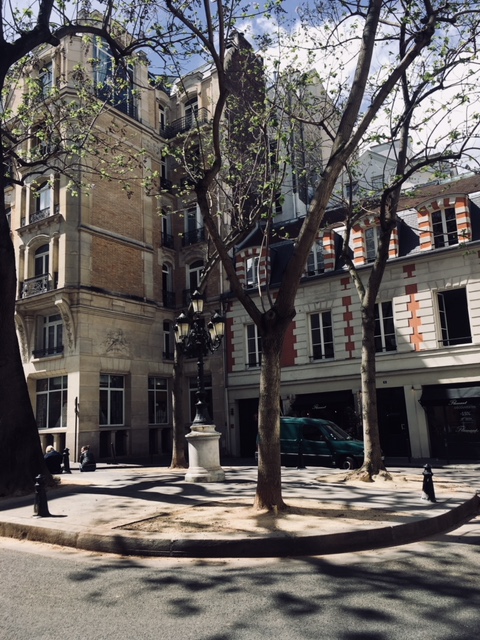
Gallimard is off Rue de l’Université which becomes Rue Jacob and ends at Rue de Seine.  Towards the end of Rue Jacob, I looked right and discovered an empty Place de Furstemberg.  Was I in Paris or Aix-en-Provence where such retreats abound?

IMG_3784                                                    Place du Furstemberg

On Rue Monsieur le Prince, I passed Les 3 Luxembourg Cinema.  I spotted a connection to Agnes Varda. A film entitled Peau d’Ame sur les traces du film de Jacques Demy (Varda’s husband) was playing that night followed by a discussion with the filmmaker, Pierre Oscar Levy.

Two hours later I was seated.  The film is a tongue in check archaeological exploration of the setting of Jacques Demy’s film Peau d’Ame, a musical based on the Charles Perrault fairy tale of the same name, that is, Donkey Skin, about a King who wants to marry his daughter.  Demy used Michel Legrand for the music and Catherine Deneuve as the lead just as he had in The Umbrellas of Cherbourg.

In the film, made over four years, students brushed dirt from artifacts such as pieces of costumes and colored glass as they would on any archealogical dig.  Demy and Varda’s daughter, Rosalie, was interviewed when a ring worn by Deneuve was discovered. The audience occasionally laughed but I couldn’t get the jokes.  Afterwards, the filmmaker and an archaeology professor from the Sorbonne discussed the authenticity of such an endeavor for well over an hour.  Mon Dieu.  I dozed a bit; then the need to get some dinner overroad politeness.  I departed just in time to get a Lebanese sandwich at Au Vieux Cedre near Place de la Contrescarpe.  While I waited, the owner offered me a glass of mint tea. A graceful gesture to the other who, now, doesn’t feel like the other.

Unknown-1                                                                Au Vieux Cadre