Return to Paris Day 10,11,12

Wednesday April 10

At breakfast, a resident asked why I was drawn to this project.  I told him I had a keen sense of injustice especially concerning “the other” first expressed at the age of seven when my father forbid me to go to my friend’s house: she was black.  Then, I explained my personal interest, the family secret.  He didn’t buy it.  According to him, I hadn’t been affected.  Stunned, I agreed, considering my privileged life.  But no.  He’s wrong.  My father worked tirelessly to overcome his secret heritage, to fit in, to make sure I didn’t get too dark in the summer, to aggrandize his history, to be prejudiced himself as a false means of elevation.  Yes, it affected me.

I live in a country whose MO is oppression, destruction of the other: Native Americans, African Americans, any immigrant of color, any non-Christian.  The land of opportunity mostly works if you are white and male and, sometimes, if you can pass.

Since last night I had been thinking about violence committed by American police mostly against men of color.  While I was enjoying my aperitif, four French soldiers dressed in camouflage, cradling machine guns walked past me.  I asked my breakfast companion if he knew what they were doing: he writes about military matters.  He said it’s a strategy against terrorism.  Small groups of armed military pop up unexpectedly and, by their presence, deter possible attacks, a Macron strategy not entirely embraced his citoyens, (citizens).  When I was 21 living in Paris, soldiers with machine guns stood in corners on Boulevard Saint Michel.  I was told they were there to protect “us” from Algerians, yet another colonized group.

Unknown-1

Thursday April 11

At the end of class, I told the teacher I wouldn’t be returning.  She wondered did she speak too quickly.  I reassured her.  I rushed home, dropped off my books, and met a woman introduced to me by mutual friends.  We had a noisy and interesting lunch in the Marais at Miznon, an Israeli import.  Afterwards, we meandered along Rue de Montorgrueil, a mostly pedestrianized street in the 2nd, got a cup of coffee at L’Arbre a Cafe, sat on a wall in a small square and continued our conversation from lunch, mostly about the state of the world.

Unknown-2

She has a few concerns about life in Paris: people in big cars thinking they own the road, ignoring pedestrians and their safety.  I watched her take a few to task and applaud her.  She’s also concerned about the yellow vest movement.  She understands their situation but believes the destruction in Paris doesn’t make their situation better and abuses a city that is theirs to enjoy.  When we parted, she asked how I would get home.  Walking, I told her.  She directed me to go towards the Seine-her only advice.  Without any additional navigational aids, I found my way home.

Friday April 12

Nose to the grindstone.  Using the Mediatheque, the library that is part of the Irish Cultural Center, I unsuccessfully searched for the location of Mayotte Capecia’s grave and failed to locate any Caribbean groups.  I’ve written to the Christiane Makward the scholar and author of the book, Mayotte Capecia ou l’Alienation selon Fanon and asked for help. A long shot.

IMG_6342


Return to Paris Day 9

Tuesday April 9

B5D82E2F-AEDD-4C85-8274-74C6E6B0CF4A.jpeg

I been thinking of Jean Rhys.  She was a beke, that is, an Antillean creole descended from early European colonists in Dominica, like my relatives in Martinique before the African pot got stirred.  In her novel, Good Morning Midnight, the protagonist has returned to Paris after more than 15 years, a Paris she recognizes but doesn’t seems to fit. She’s older, she’s alone.  It resonates.

B0CC2C46-6CF4-4C2A-88CC-11E9ECB20743

From Good Morning Midnight, page 1

“I have been here five days. I have decided on a place to eat in at midday, a place to eat in at night, a place to have my drink in after dinner.  I have arranged my little life.”

I’m into my second week but can’t say that I’ve made much of an adjustment. Would it be enough to take every meal in the same place?

Paris has always been home for me.  The first place I could own, that fit me, that did away with shyness, with not belonging and trying to belong.  At the other home, I monitored my speech, my friends’ reactions, my family’s approval, disapproval.  Like my father, I didn’t want to be discovered.  In Paris, I only adhered to the, then, strict rules of tutoyer, hand shakes, meal time punctuality, and the language I used with “adults’ versus my friends, mostly students.  Don’t use the shortened “formid,” only use the correct, “formidable.”  And never use “fric,” the slang for police.  These requirements weren’t personally attached to me. 

In Paris, that first time, I talked to strange men on motorcycles while walking along a road in Sottteville sur Mer.  But it was daylight and there were passerby’s.  I was safe.  My French family didn’t agree: I understood their concern but wasn’t deterred.  I broke it off with a boyfriend after a week when I learned he was smuggling cigarettes.  I created my own group of friends from other newspaper sellers of The New York Herald Tribune and The New York Times.  My last liaison took me to meet his friends, to his favourite cous cous restaurant, and to a studio belonging to an artist friend.  As we approached the elevator, the concierge made her presence known.  He explained that I was his fiancé.  The only way to make it past her.  Under the eaves on a small bed, we kissed, tumbled, and that was all.  He didn’t get his way but he didn’t drop me.  We spent my last day in Paris saying good-bye at the Select where we met almost every night.  And, il a plura, it rained.

Like Jean Rhys’ character, I’ve returned to a Paris that doesn’t quite fit.  Or I don’t fit.  And like her character, some of it is age but also the blinders of narcissism and youth are off.  As they were in Au Bout de Souffle where in the end, the lovers don’t recognize each other, a free spirited thief and a conventional American.

After Tuesday’s class at the Alliance, students clustered together complaining.  One student said she dreaded coming each morning.  I feel the same and have decided to quit at the end of this week.  I’ll have more time to explore Mayotte Capecia’s experience as a woman of color living between two cultures, Martinique and Paris.   Her characters, Isaures and Mayotte, both leave Martinique for Paris, hoping for a better life.  Did she get it?  Do colonized people of color get that better life?  My grandmother and her sisters lied and said they were from France because surely France was better than Saint Lucia.

A long day, a difficult day saved by an aperitif at Bistrot L’Estrapade located at the end of my street.  I thought only dinner was served  but when I passed by,  the owner was enjoying a cigar at one of the four outside tables.  I asked if I could have just a drink.  Yes, yes, he agreed but could only find vermouth rouge.

3ED2C97F-63B3-4EC2-A412-3A9860994A65

Ca suffit as I look down the street towards the Pantheon.

38F96636-11F0-4630-9BF9-D5430F164EA0


Return to Paris Day 6

Saturday, April 6

I decided to go to Cemetiere Montparnasse in search of Mayottte Capecia’s grave.  A listing of prominent residents hangs outside the guardhouse facing the Boulevard Edgar Quinet entrance.  She’s not listed, perhaps not seen as important, not seen at all.

Frantz Fanon, prominent psychiatrist and philosopher from Martinique, thought so and even worse, describing her novel, Je Suis Martiniquaise  (I Am A Martinque Woman) in his book Black Skin, White Masks as “cut-rate merchandise, a sermon in praise of corruption.”  Both the protagonists in her novels prefer white men.  Frantz Fanon saw her preference as a form of self-hatred.  Maryse Conde, revered Guadeloupian author and Professor Emirita of Columbia University, believes Fanon ignored the context in which the novel was written (1948), that is, a time of racial difficulties and identity confusion, perhaps, what W.E.B Dubois called “depersonalization,” “two heritages,” “two identities.”

My great aunt made similar choices, insisting her family’s, my family’s African “blood” be kept secret.  When her brother’s children came to live with her in Washington Heights, only the niece was allowed to stay.  The nephew deemed too dark had to leave.  Stories were told about his joining the merchant marines and living abroad although Everard de Jorna spent most of his life in Manhattan never to be seen again.

I asked the guard to look for her name: he came up empty.  I gave him an alternative, Lucette Ceranus, as Mayotte Capecia is a pseudonyme. No luck.  He asked me for the date of her death.  When I answered 1955, he said he didn’t have the lists for that year and suggested I look on the internet.  I told him I would try to find her using my eyes.  I perused several rows but realized I was on a fool’s errand.  The cemetery holds over 40,000 graves.

9E3EBF22-5A1E-4FF3-8C7F-787C89BE6704

Perhaps, I could pay homage to Agnes Varda who had died just days ago.  Would she have been buried so soon with her husband, Jacques Demy?  I had no trouble finding it: the gravesite was awash in flowers.

4868DE0A-B768-4758-BD0B-8013A68EDB96

Last year, when she was still alive, I visited him, sitting on the small bench flanking the grave.  Now that bench is almost invisible.  Many of the  messages to Mme. Varda seem so intimate.  There was even one from the merchants of Rue Daguerre where she lived and that she documented in the film Daguerrotypes.  

D45C7431-E027-48E2-8E4B-09407D640897

I intended to visit that street one more time but managed to get completely tangled up, losing my way as I seem to be doing literally and metaphorically, and so, instead, made my way home.

Every night I’ve been eating alone in my room.  Enough is enough.  I had seen a little restaurant on Rue Pot au Fer with a menu that appealed to me: entree, grenouille, plat, sole meunière, dessert, tarte tatin.  All my favorites.  The street tends to be commercially “charmante,” so I had my doubts.  I began with a pastis: this time a large Ricard.  When I ordered my dinner, the waiter discouraged me from getting a pichet of vin ordinaire.  I hesitated,  wondering if this was a scam.  He showed me the demi bouteille of white Bordeaux and, then, bought me a glass of the vin ordinaire to taste.  He was right: il n’etait pas bon.  The frog’s legs were fried not sautéd so not great.  However, the sole was fresh with good flavor.

Two hours of decent food, being a bit tipsy, watching pedestrians traipse up and down the street.  Pas mal.

Return to Paris Day One

Monday April 1

After spending two weeks in Dublin, feeling at home didn’t happen as easily as last year.  An outsider.  The language deserted me and my fears of offending the French took hold. 

389845D4-B6E4-410D-9B8E-066B99CD4942

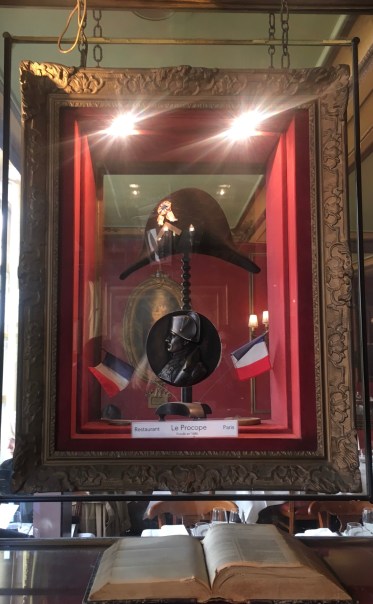
Napoleon’s Hat at Le Procope, Paris

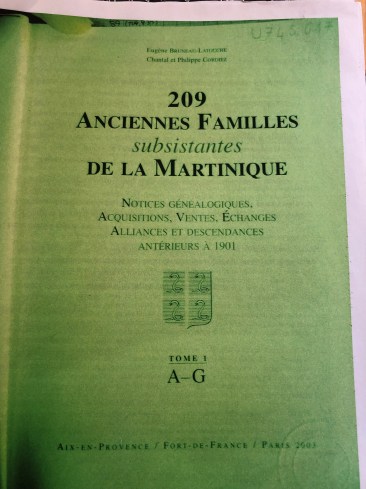
France even Paris was Mecca to my family.  My arriere grand pere was a doctor, kicked out of France or was it Switzerland because he used forceps, perhaps code for abortion.  An earlier relative had an argument with the king of France, not sure which one, about a naval tactic and was demoted from what to what?  Supposedly, we descended from aristocracy as our family name, de Jorna, begins with a small “de” denoting nobility.  

9424F814-18F4-498E-9602-A88921AE97A0

And my grand mere came from France as did my great Aunts and older cousins.   The de Jorna’s did come from France and some did live in Paris, but my branch had lived in the French West Indies for more than 300 years.  Once that truth was uncovered, a second emerged.  My arrriere grandmere’s death certificate listed her as “colored.”  On a ship’s manifest from Barbados to New York, my great aunt was listed as colored.

All their lives in the states and perhaps in France, this branch of the de Jorna’s from the lates 1800’s when Armand de Jorna, my great grandfather,  married  the “colored” Noelline Noel, were passé blanc, passing for white.

60F8C0D0-AD0A-4E58-83A9-4A718AB3BA28

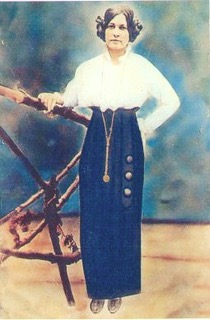
My grandmother, Germaine de Jorna, daughter of Armand de Jorna and Noelline Noel

This time in Paris, I return not as an descendent of an ennobled de Jorna, but as a passé blanc, the daughter of a man who resembled Louie Armstrong and who cautioned me to stay out of the sun lest my skin expose me and him.

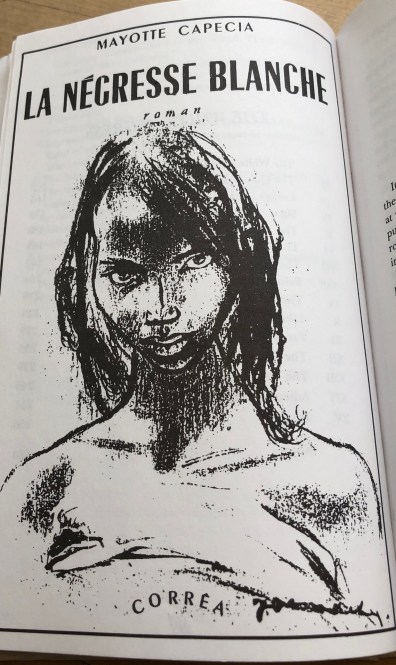
Instead of looking for women artists outside the norm, Margureitte Duras, Agnes Varda, or Sophie Calle, I will look for those who pass and don’t pass, those from the colonies, Mayotte Capecia from Martinique who wrote The White Negress, Jean Rhys a beke, that is a white creole, born and bred in the Carribbean, and others who supposedly are French but are they?

13177FAF-5F02-44ED-AA3B-27548194CD80