The Last Time Down the Low Road

image


At dinner, the night before my departure, I had told Maura not to fix any breakfast, but when I came into the dining room, she had freshly squeezed orange juice ready for me. Joe was there to send me off as well. He said the sonnet required framing and would be hung on the wall in the living room, that is, if he could keep the women from banging down the doors. In the sonnet, I had referred to him as a “good stallion” and Maura as a “strong mare.” “Well, I had to work in the animals, ” I retorted.

The night before I left, Maura said John would be driving me, but she didn’t want to call that night as he would forget. She would phone him in the morning. At 7:45, he was at the door, a familiar face, he being the one who had given me a ride from Kilronan and preferred to talk about testicles.

We hadn’t gone but a few hundred feet when he said, “I’m having trouble with my bulls. They are crying out every night and getting very randy. They even tried to bolt over the walls.” “Really,” I responded. “Yes, and one made it.” “What’s wrong, I asked.” John lightly touched my knee, and smiled. “Well, my dear, They haven’t been fixed. And like I said, they are mighty randy. They are driving me crazy.” He explained he had waited too long to castrate them as the vet hadn’t been to the island recently. He wondered if he might have to do it himself and was about to launch into another explanation of how it used to be done when I slipped in my regret at never seeing the low road again.

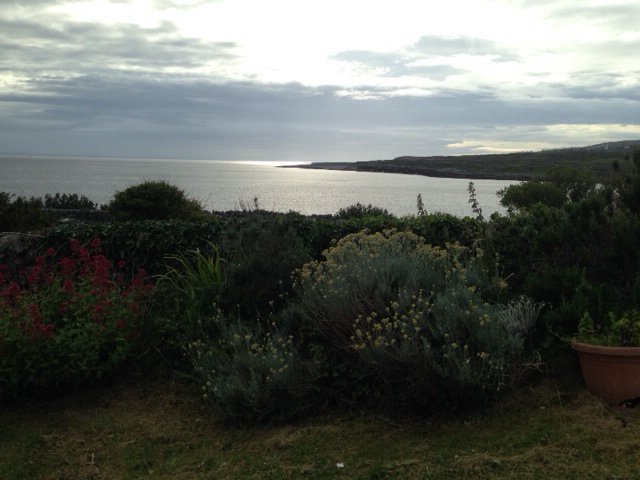
“We can do that” he told me, and down we went one more time, sighting seals lounging on rocks while the tide moved out.
On the Way to Inishmore

Image

“We live in the poor heart of Ireland” John McGahern wrote about his beloved County Leitrim. I, instead, am in the heart of a wild beauty of Ireland, Inishmore in the Aran Islands. I sit in my room in Kilmurkey looking out on the North Atlantic down the coast towards Kilronan, fat raindrops on the window, hands chilled as the radiator doesn’t seem to work.

My chaotic departure began two days ago. I was running late for the shuttle that would take me to the airport. I instructed my neighbor, who had volunteered to transport me, to throw everything on the dining room table into my carry-on bag. Later, I discovered my garage door opener and a pair of one-armed glasses has found their way into the bag. Meanwhile, I searched frantically for the special pants I had purchased for the trip. No luck. I threw everything I could see into my suitcase. As I settled into the car, shoes popped out of my open handbag. I made the shuttle and on the way to Newark airport rearranged my belongings.

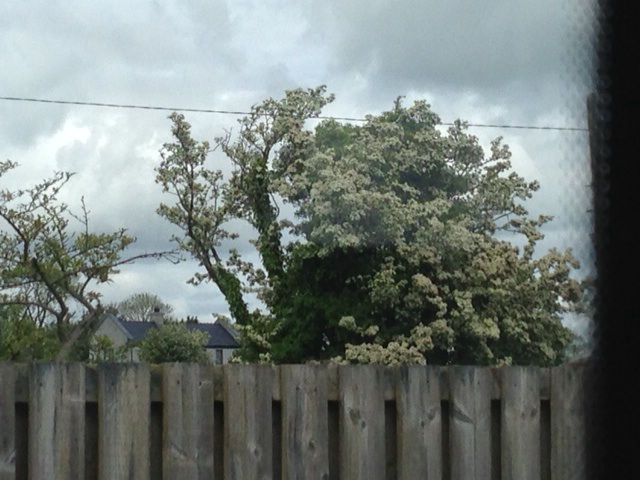
Twenty-four hours later on the train to Galway, peace and excitement sat comfortably within me. I had a seat all to myself, McGahern’s book of essays, and the green of Ireland outside my window. In his love song to Lietrim, he describes ancient hedges separating properties and left undisturbed as no one seemed interested in developing that part of the country. “The hedges are the glory of these small fields, especially in late May and early June when the whitethorn foams out into streams of pink and white blossoms.” As it was May 31st, I spent most of the trip looking for whitethorn and found them, just as he described, between fields dotted with cows, sheep, and sometimes horses. The Irish have a saying,  “If you don’t like the weather, wait five minutes and it will change.”  The sun had been out since we left Dublin, but as we approached  Galway, the sky filled with large sooty clouds, dominating the flattened landscape.

Given the upheaval when I left the states, I opted out of exploring Galway during the hour before the bus left for the ferry. I played it safe and sat in the Victoria Hotel directly across from the bus stop. The hotel, fixed up to honor its heritage, is overdone and inauthentic. However, the white and pink peonies in large vases atop sideboards were for real. I wiled away my time gazing at thier large feathered heads and thought of McGahern and his whitethorn.