Return to Paris Day 6

Saturday, April 6

I decided to go to Cemetiere Montparnasse in search of Mayottte Capecia’s grave.  A listing of prominent residents hangs outside the guardhouse facing the Boulevard Edgar Quinet entrance.  She’s not listed, perhaps not seen as important, not seen at all.

Frantz Fanon, prominent psychiatrist and philosopher from Martinique, thought so and even worse, describing her novel, Je Suis Martiniquaise  (I Am A Martinque Woman) in his book Black Skin, White Masks as “cut-rate merchandise, a sermon in praise of corruption.”  Both the protagonists in her novels prefer white men.  Frantz Fanon saw her preference as a form of self-hatred.  Maryse Conde, revered Guadeloupian author and Professor Emirita of Columbia University, believes Fanon ignored the context in which the novel was written (1948), that is, a time of racial difficulties and identity confusion, perhaps, what W.E.B Dubois called “depersonalization,” “two heritages,” “two identities.”

My great aunt made similar choices, insisting her family’s, my family’s African “blood” be kept secret.  When her brother’s children came to live with her in Washington Heights, only the niece was allowed to stay.  The nephew deemed too dark had to leave.  Stories were told about his joining the merchant marines and living abroad although Everard de Jorna spent most of his life in Manhattan never to be seen again.

I asked the guard to look for her name: he came up empty.  I gave him an alternative, Lucette Ceranus, as Mayotte Capecia is a pseudonyme. No luck.  He asked me for the date of her death.  When I answered 1955, he said he didn’t have the lists for that year and suggested I look on the internet.  I told him I would try to find her using my eyes.  I perused several rows but realized I was on a fool’s errand.  The cemetery holds over 40,000 graves.

9E3EBF22-5A1E-4FF3-8C7F-787C89BE6704

Perhaps, I could pay homage to Agnes Varda who had died just days ago.  Would she have been buried so soon with her husband, Jacques Demy?  I had no trouble finding it: the gravesite was awash in flowers.

4868DE0A-B768-4758-BD0B-8013A68EDB96

Last year, when she was still alive, I visited him, sitting on the small bench flanking the grave.  Now that bench is almost invisible.  Many of the  messages to Mme. Varda seem so intimate.  There was even one from the merchants of Rue Daguerre where she lived and that she documented in the film Daguerrotypes.  

D45C7431-E027-48E2-8E4B-09407D640897

I intended to visit that street one more time but managed to get completely tangled up, losing my way as I seem to be doing literally and metaphorically, and so, instead, made my way home.

Every night I’ve been eating alone in my room.  Enough is enough.  I had seen a little restaurant on Rue Pot au Fer with a menu that appealed to me: entree, grenouille, plat, sole meunière, dessert, tarte tatin.  All my favorites.  The street tends to be commercially “charmante,” so I had my doubts.  I began with a pastis: this time a large Ricard.  When I ordered my dinner, the waiter discouraged me from getting a pichet of vin ordinaire.  I hesitated,  wondering if this was a scam.  He showed me the demi bouteille of white Bordeaux and, then, bought me a glass of the vin ordinaire to taste.  He was right: il n’etait pas bon.  The frog’s legs were fried not sautéd so not great.  However, the sole was fresh with good flavor.

Two hours of decent food, being a bit tipsy, watching pedestrians traipse up and down the street.  Pas mal.
Paris Day 26

Thursday April 26

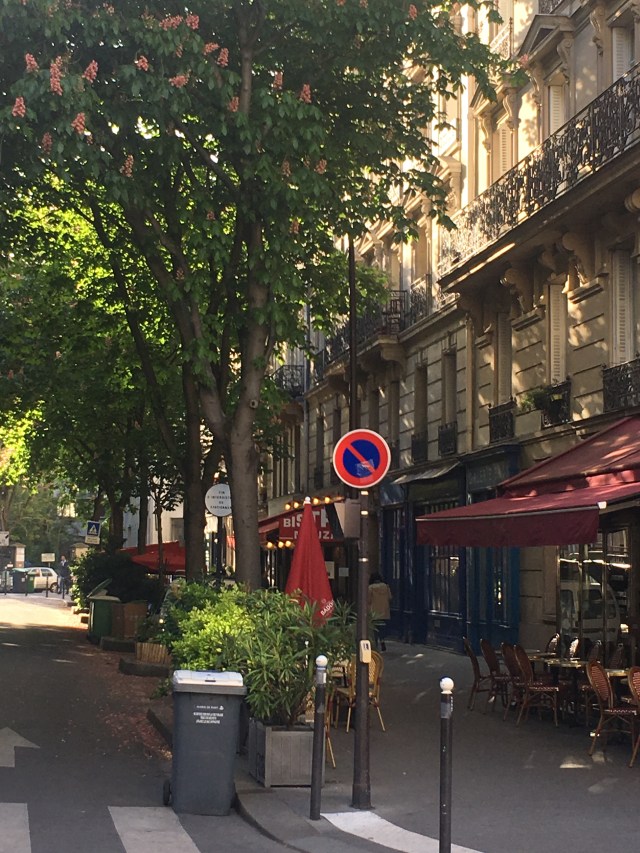
Only twelve days left before I return to the United States.  I don’t have enough time to explore Sophie Calle or even my own family at the National Archives.  Many shoulds.  I feel pressured to squeeze it all in.  An impossibility.  I must remember to take a photo of the charming street I pass every day on the way to the Alliance Française.   I have only today and two more classes.

IMG_3696

Rue de l’Abbé de l’Epée

Given yesterday’s debacle, I decided to approach Duras by visiting Musée D’Orsay.  As part of The Resistance, she often visited Gare D’Orsay working with the BCRA, Bureau Central de Reseignement et d’Action (Central Office for Intelligence and Action) which coordinated intelligence supplied by French networks.  In her memoir The War, she describes her days at the Gare:

 “…I set myself up there by stealth with forged papers and permits. We managed to collect a lot of information…about movements of prisoners and transfers from one camp to another. Also a good many personal messages.”

and after the arrival of French political deportees,

“Orsay.  Outside the center, wives of prisoners of war congeal in a solid mass.  White barriers separate them from the prisoners.  ‘Do you have any news of so-and-so?’ they shout.  Some stay till three in the morning and, then, come back again at seven.  But there are some who stay right through the night.”

6d822e44ff03aefcbec98716e13e6f17                              Returning Prisoners Arriving at Gare de l’Est 1945
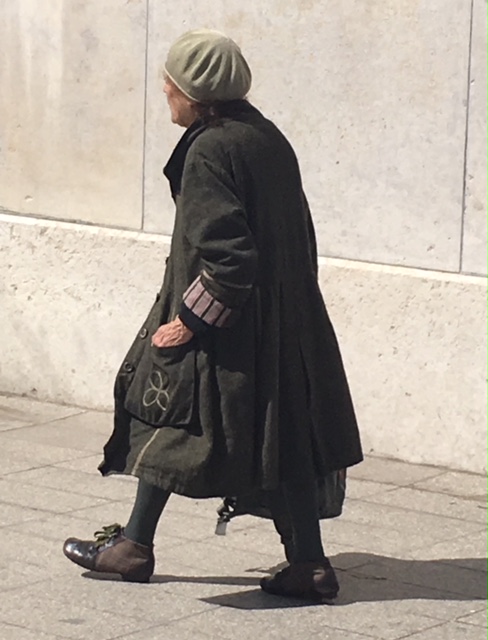
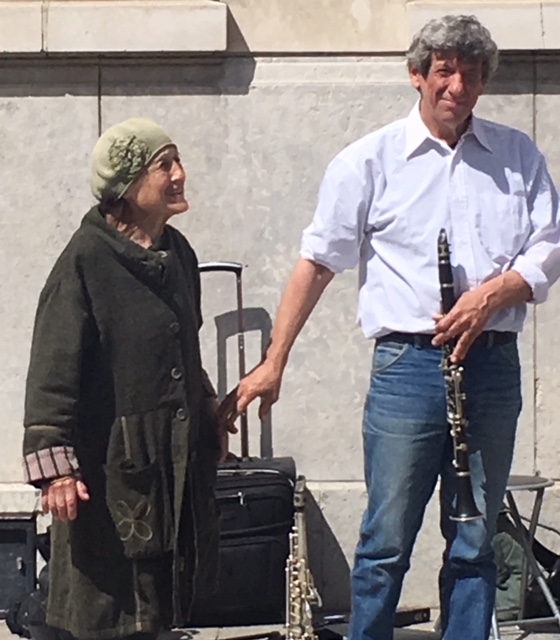
On my way, I passed several sandwich shops: all smelled delicious. I don’t have time for breakfast on the days I go to class, so I was particularly hungry.  While trying to decide which shop to patronize, I passed a woman from a fashion time warp, a thirties coat, 1900’s shoes. Up and down the street she strode.  Maybe this was my Sophie Calle moment.  Sophie Calle, a French multimedia artist, that is, writer, photographer, installation and conceptual artist, followed a man on the streets of Paris and all the way to Venice photographing him without his knowledge.  Later, she had her mother hire a detective to follow and photograph her as she went through her day.

IMG_3709

I walked a few hundred feet behind the woman until she entered a drug store.  When she emerged, I couldn’t maintain the stalking.  I’m not made for artistic ruthlessness where another person unknowingly becomes a source of creative endeavor.  Instead, I got in line at a sandwich shop, which would have been at home in Brooklyn: locally sourced ingredients, minimalist design, lots of grains and vegetables.  I took my lunch to the steps of the Musée d’Orsay.  There she was, my thirties’ prey, standing next to a trio busking in front of the museum.  I can’t seem to escape my country: the group played American blues music.  Then, she came alive, dancing in all her magnificence from one song to the next.  When they took a break, the clarinet player raised the dancer’s hand and said to the audience “Merci, Madeline”

IMG_3725                                                                  Madeline

If I wanted to write, I had to get going.  After a long day, Duras describes her walks home from Gare d’Orsay.

“As soon as I leave the embankment (along the seine) and turn into Rue du Bac, the city is far away and the Orsay center vanishes.”

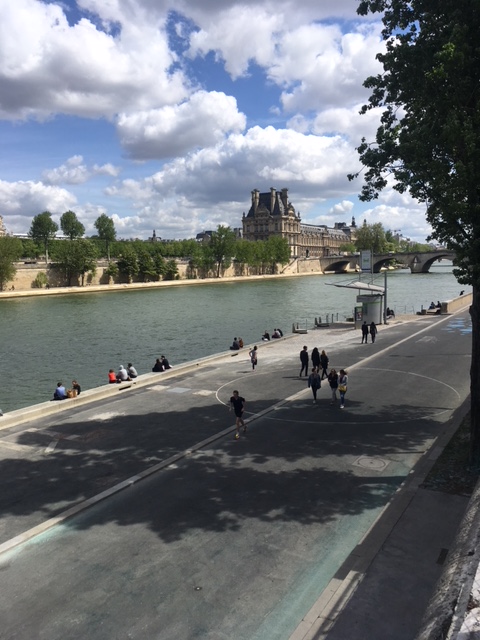
I would do the same.  The sun was shining just as it was for Duras.  The Seine winked blue-green at passers by.  How privileged we are sitting on the steps of the museum, walking along the Seine, having tea in Restaurant du Musée d’Orsay.  In 1945- hunger, fear, despair, loved ones tortured, killed.  But I walk along the Seine undisturbed, unmolested, unafraid.  And just last year, miles away in Calais, a makeshift refugee camp was destroyed.  Even here, the homeless don’t always find shelter.

IMG_3742

Quai Anatole Franc

I enjoyed meandering back to the Irish College and decided to forgo writing.  I made one more Duras stop, the office of her publishers for many years, Gallimard, who collaborated with Vichy in order to publish resistant writers, Jean-Paul Sartre and Camus.  When Patti Smith visited Gallimard, her French publisher, she writes:

“My editor Aurélien opens the door to Albert Camus’s former office.”

Did she know it’s history?  Does it matter?  Can we compromise and be ethical?

Unknown

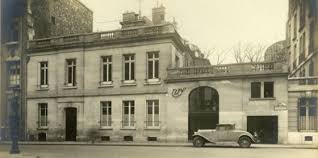
Gallimard Office, Rue Gaston Gallimard

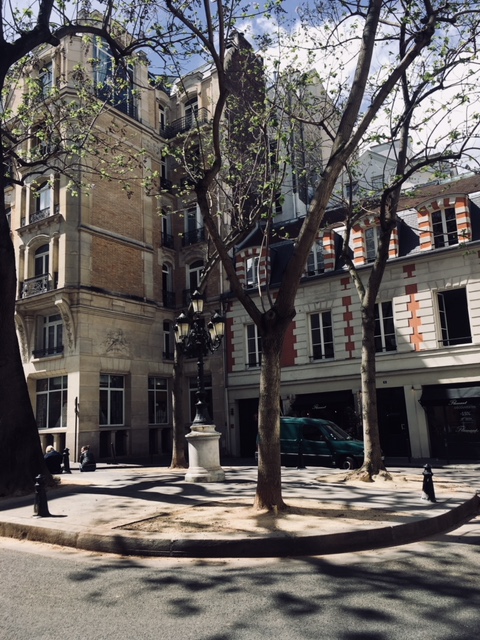
Gallimard is off Rue de l’Université which becomes Rue Jacob and ends at Rue de Seine.  Towards the end of Rue Jacob, I looked right and discovered an empty Place de Furstemberg.  Was I in Paris or Aix-en-Provence where such retreats abound?

IMG_3784                                                    Place du Furstemberg

On Rue Monsieur le Prince, I passed Les 3 Luxembourg Cinema.  I spotted a connection to Agnes Varda. A film entitled Peau d’Ame sur les traces du film de Jacques Demy (Varda’s husband) was playing that night followed by a discussion with the filmmaker, Pierre Oscar Levy.

Two hours later I was seated.  The film is a tongue in check archaeological exploration of the setting of Jacques Demy’s film Peau d’Ame, a musical based on the Charles Perrault fairy tale of the same name, that is, Donkey Skin, about a King who wants to marry his daughter.  Demy used Michel Legrand for the music and Catherine Deneuve as the lead just as he had in The Umbrellas of Cherbourg.

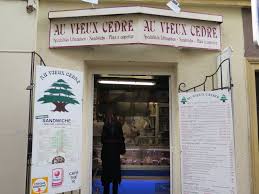
In the film, made over four years, students brushed dirt from artifacts such as pieces of costumes and colored glass as they would on any archealogical dig.  Demy and Varda’s daughter, Rosalie, was interviewed when a ring worn by Deneuve was discovered. The audience occasionally laughed but I couldn’t get the jokes.  Afterwards, the filmmaker and an archaeology professor from the Sorbonne discussed the authenticity of such an endeavor for well over an hour.  Mon Dieu.  I dozed a bit; then the need to get some dinner overroad politeness.  I departed just in time to get a Lebanese sandwich at Au Vieux Cedre near Place de la Contrescarpe.  While I waited, the owner offered me a glass of mint tea. A graceful gesture to the other who, now, doesn’t feel like the other.

Unknown-1                                                                Au Vieux Cadre