The Last Time Down the Low Road

image


At dinner, the night before my departure, I had told Maura not to fix any breakfast, but when I came into the dining room, she had freshly squeezed orange juice ready for me. Joe was there to send me off as well. He said the sonnet required framing and would be hung on the wall in the living room, that is, if he could keep the women from banging down the doors. In the sonnet, I had referred to him as a “good stallion” and Maura as a “strong mare.” “Well, I had to work in the animals, ” I retorted.

The night before I left, Maura said John would be driving me, but she didn’t want to call that night as he would forget. She would phone him in the morning. At 7:45, he was at the door, a familiar face, he being the one who had given me a ride from Kilronan and preferred to talk about testicles.

We hadn’t gone but a few hundred feet when he said, “I’m having trouble with my bulls. They are crying out every night and getting very randy. They even tried to bolt over the walls.” “Really,” I responded. “Yes, and one made it.” “What’s wrong, I asked.” John lightly touched my knee, and smiled. “Well, my dear, They haven’t been fixed. And like I said, they are mighty randy. They are driving me crazy.” He explained he had waited too long to castrate them as the vet hadn’t been to the island recently. He wondered if he might have to do it himself and was about to launch into another explanation of how it used to be done when I slipped in my regret at never seeing the low road again.

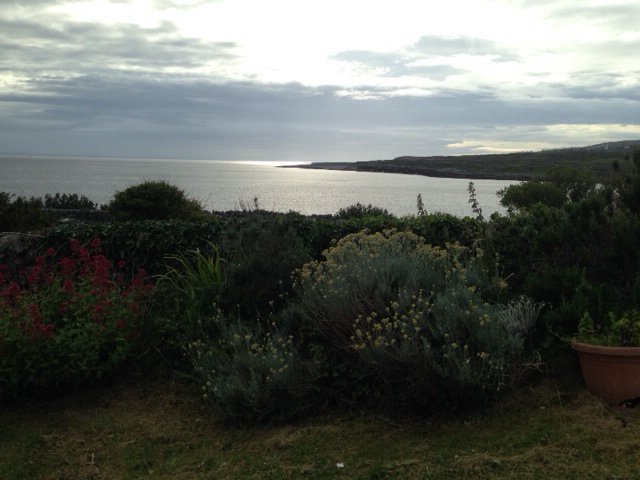
“We can do that” he told me, and down we went one more time, sighting seals lounging on rocks while the tide moved out.
Food

The Lower Road 10:00 P.M.

I love to cook and I love to be fed. Maura provides breakfast for all the guests and dinner most nights. My plan was to eat a hearty breakfast, skip lunch, and “eat all my dinner.” This I have done. My first morning I had to have it all, a full Irish breakast: 2 pieces of Irish bacon (more like ham), two sausages, two fried eggs, a tomato, and four pieces of brown bread. While Maura got that ready, I had a bowl of porridge. It tasted better than any I had before. I have begun each breakfast with the wonderful porridge, but have not repeated the Irish Breakfast. I can only be a morning glutton once.

My poor depth perception (good vision in only one eye) has created a problem in the dining room.  At least, I’m attributing the noise and mess I make to visual inadequacy.  I tend to bang my cutlery  rather noisly.  Maybe I don’t see how close they are to the plates as they often tend to fall on to the table, sometimes, even the floor.  A small circle of food can be found around my salad plate, and drops of salad dressing find their way to distant spots on the table.

Maura is an excellent cook. Everything that comes out of the kitchen is delicious and 0ften straight from the garden. I have eaten fish almost every day whether for breakfast in the form of smoked salmon or for dinner from sea trout to sea bass. All of it tastes as if it was just caught. I asked her if she has always liked to cook.  She nodded yes and said that when her children were in school, she wanted to get a job catering, but Joe wouldn’t have it as he said she wouldn’t have enough time.  Instead she went to a cooking school which she declared was the best thing she ever did.

On Tuesday, Maura went to Galway, so I had to fend for myself. Joe had to pick her up from the return ferry and offered me a ride.   We had a free ranging conversation.  He loves to read and gets taken with a subject.  For awhile it was the Romans.  Presently, he is immersed in Mozart’s Operas.  He isn’t sure if Maura also appreciates hearing so much Mozart. When I told him that he was a lucky man as she is such an accomplished cook, he said “Well its nice she’s good at something.”  We finished the conversation with my Irish roots and that I had named my daughter, Medb (Maeve) after the Queen of Ireland.  We talked of how she had been a lusty queen, and he added, “Celtic women had it good and had their way until the Normans came and imposed their patriarchal culture.”

Ti Joe Wattys

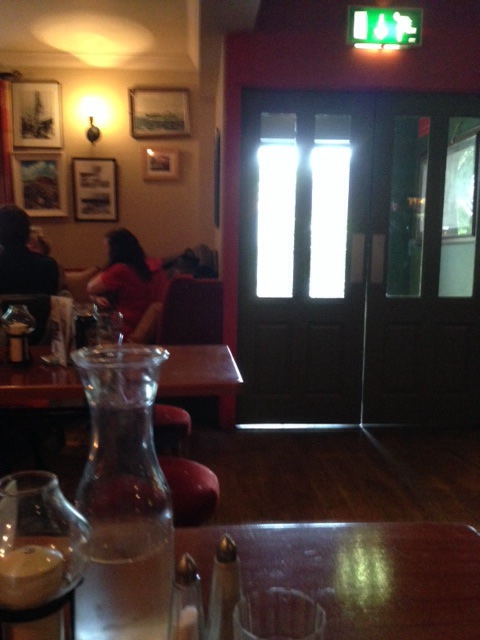
I returned to Ti Joe Wattys with the notion of being able to walk back after dinner. This night it was sea bass again delectable and under it was the familiar taste of a mashup I had in Dublin years ago: turnips and parsnips mashed with butter. I began my meal with Jameson’s and had two glasses of wine with dinner. I felt rather optomistic.  The sun was out, it was 8:30, I could make it home by 10 and it would still be light. I took the low road again.

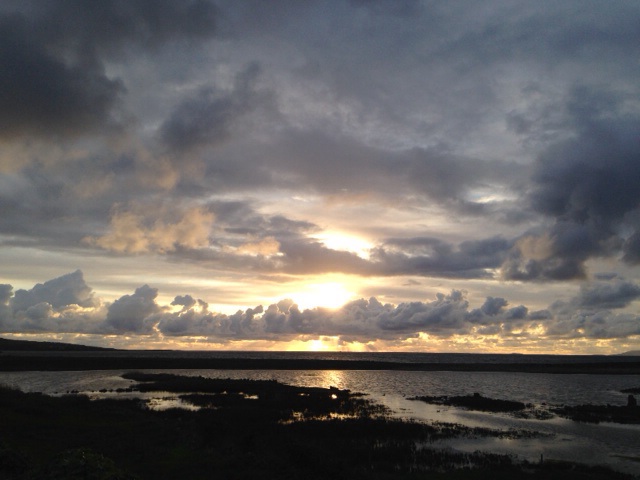
During most of my walk I talked to myself, sighing in wonder. The sky was a bowl above my head, nothing to block the 180 degree view. Surrounding me were clouds made for the heavens lit from behind like jewels, sapphires, onyx. I skipped and danced down the road. Joy, freedom, visual ecstasy.


The Ride Back to Kilmurvey

The Seven Churches

After finishing the Guinness, I made my way to the Tourist Office where I was given maps to all the islands: Inishmore, Inishmaan, and Inisheer. I plan to visit the other two next week. The four mile walk and the Guinness had done me in. I asked the driver of a tour bus to give me a ride to Kilmurvey, thinking he was waiting for passengers and it would cost just 3 Euros. He looked at me but didn’t speak. “Do you want me to wait for more people to show up?” I asked him. “But there’s only youself,” he answered. I assured him I would pay him and off we went, me up front in the seat next to him. He told me he had been a fisherman, but since only the big companies succeed in fishing, he drove a tour bus. I had to listen hard as his English sounded more like the Irish I had heard on the ferry, the words melting one into the other.

We spoke of the type of fish found in the waters off Inishmore, prawns and lobsters mostly at this time of year. As we went past livestock, this time on the upper road, the talk turned to testicles, a conversation that lasted for several miles. He said before vets were available on the island, the balls of the bulls were cut off with a knife.  In another method, the testicles were tied until they fell off.  I threw in, “Well maybe that was more humane, less painful.” He laughed and commented, “Not if you were a bull.” He said there was one man in particular who would come around and do the deed. I told him that Carlo Levi, in his account of being exiled by the Fascist to the hills of Italy, had described the same set up but with pigs. One day a year, a “specialist” would arrive in town and all the women would bring their pigs to the square for ball removal. His final contribution was to mention that he heard in Wyoming they ate them. He chuckled and shrugged his shoulders. Why Wyoming, I wondered?

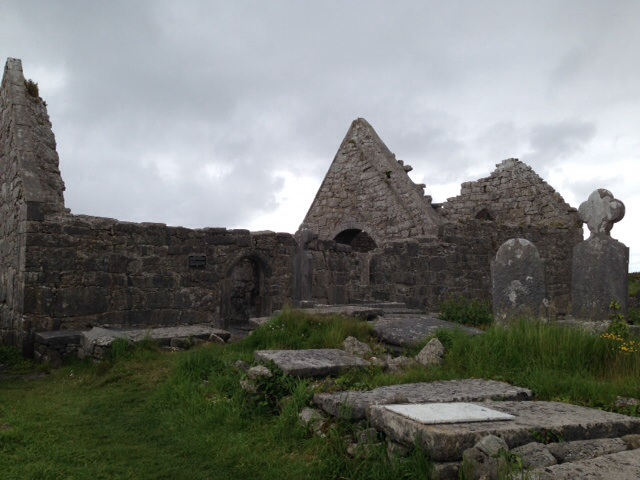
He convinced me to visit the Seven Sisters, a monastic ruin, before going home.  According to him, it had been destroyed by Cromwell, the cause of much horror in Ireland.  I climbed among the buildings under an overcast sky.  It seemed a place for Druids, not Christian monks.  But the Irish never let go of their myths or pagan rituals just to accomodate the Pope. I guess he wanted to earn more than 3 Euros and so he did. I see him almost every day on the road taking busloads of day trippers to the various sites. He doesn’t wave at me as most of the drivers do when they pass the only person walking.

The Low Road to Kilronan

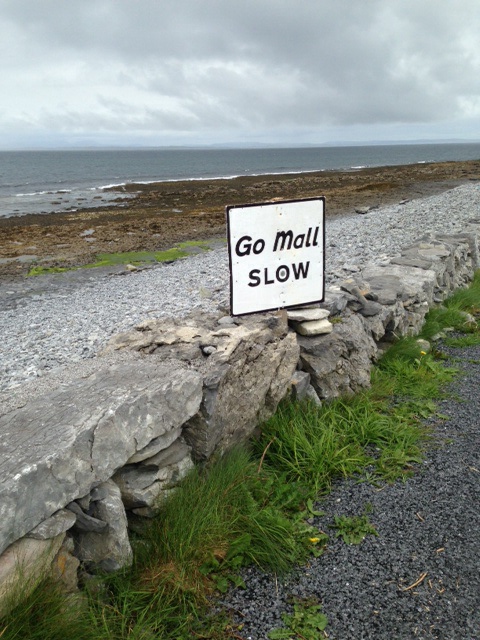
The Low Road

On his first day in Inishmore, John Millington Synge, author of The Playboy of the Western World, recalls sitting in front of a peat fire with “a murmur of Gaelic” in the background.  Like Synge, the lilt of Irish was with me on my first day in Inishmore.  An older couple who sat behind me on the ferry used Irish the whole trip, their sentences spilling softly over each other’s.  A good beginning.  Synge wrote in 1898 that he had to leave commerical Inishmore for the more authentic Inishmaan.  Over 100 years later, and I haven’t had that experience.  I had been warned that staying two weeks would be too much, that I wouldn’t last more than a few days.  During my first dinner at the Man of  Aran B&B, I mentioned this warning to several lodgers.  Two American women were sure I had made the right decision.  An Irish couple envied me.  And right they were.

A treasured fantasy of mine is to live on a sparsely inhabited island small enough to navigate by foot.  So far, I think I’m on to something.  I take long walks, read in my room or write, and, sometimes, talk to people at breakfast or dinner.  Some ask me why I don’t bicycle.  For example, the three hour trek to Kilronan  would have taken 20 minutes.  I prefer being a flaneur, walking, pausing, looking, talking to the animals I pass.

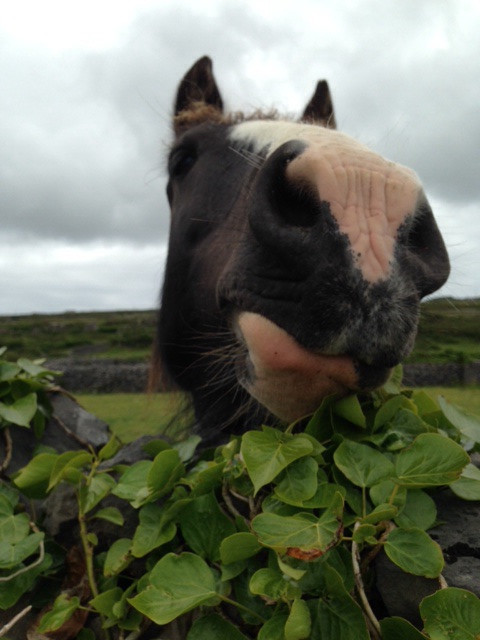
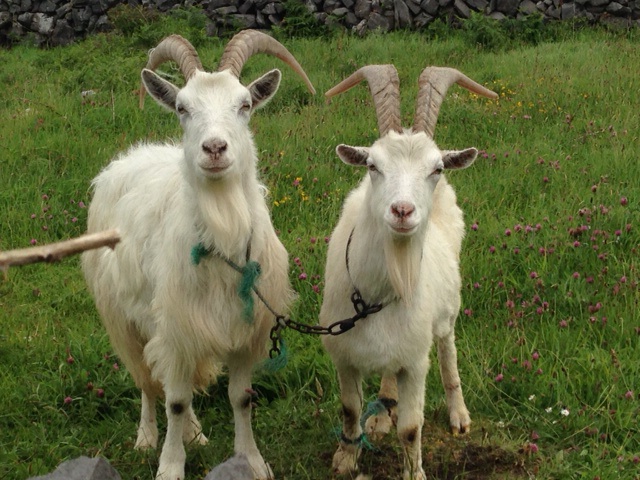
Using the low road to Kilronan, I met two horses, a donkey, two billy goats, a teenage goat, and some kids.  All moved as slowly as I did.  Most meandered to the stone walls that separated us, in hopes I would give them food or set them free.  One old horse was adamant.  After he licked my hand, he pushed insistently into my bag searching for a treat.  The two billy goats were tied to one another and it took them awhile to reach me. Their plight saddened me, my empty pockets disappointed them.  The teenage goat just wanted petting, nudging his head against my hand, following me along the fence in hopes for more.  The kids enjoyed the simple pleasure of running and jumping.

The Ti Joe Watty’s Bar sits at the end of the low road and the beginning of Kilronan.  I was going to head directly to the tourist office as planned, but the bar called to me.   I sing the praises of Inishmore’s natural beauty, but the Guinness I drank was a little bit of heaven as well, the black/brown liquid with its tan head, its sweetness.


imageimage

On the Way to Inishmore

Image

“We live in the poor heart of Ireland” John McGahern wrote about his beloved County Leitrim. I, instead, am in the heart of a wild beauty of Ireland, Inishmore in the Aran Islands. I sit in my room in Kilmurkey looking out on the North Atlantic down the coast towards Kilronan, fat raindrops on the window, hands chilled as the radiator doesn’t seem to work.

My chaotic departure began two days ago. I was running late for the shuttle that would take me to the airport. I instructed my neighbor, who had volunteered to transport me, to throw everything on the dining room table into my carry-on bag. Later, I discovered my garage door opener and a pair of one-armed glasses has found their way into the bag. Meanwhile, I searched frantically for the special pants I had purchased for the trip. No luck. I threw everything I could see into my suitcase. As I settled into the car, shoes popped out of my open handbag. I made the shuttle and on the way to Newark airport rearranged my belongings.

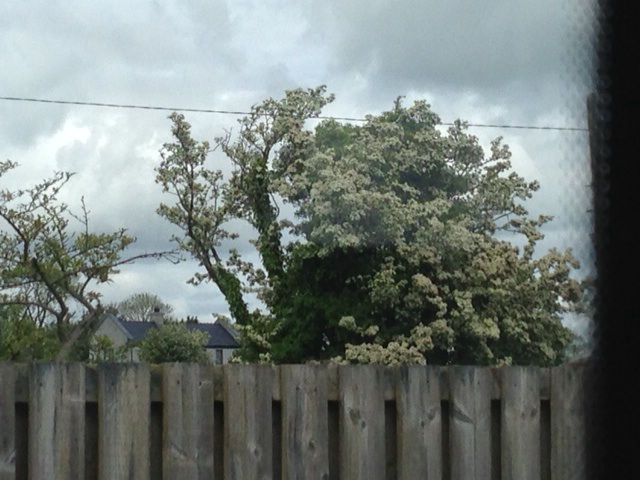
Twenty-four hours later on the train to Galway, peace and excitement sat comfortably within me. I had a seat all to myself, McGahern’s book of essays, and the green of Ireland outside my window. In his love song to Lietrim, he describes ancient hedges separating properties and left undisturbed as no one seemed interested in developing that part of the country. “The hedges are the glory of these small fields, especially in late May and early June when the whitethorn foams out into streams of pink and white blossoms.” As it was May 31st, I spent most of the trip looking for whitethorn and found them, just as he described, between fields dotted with cows, sheep, and sometimes horses. The Irish have a saying,  “If you don’t like the weather, wait five minutes and it will change.”  The sun had been out since we left Dublin, but as we approached  Galway, the sky filled with large sooty clouds, dominating the flattened landscape.

Given the upheaval when I left the states, I opted out of exploring Galway during the hour before the bus left for the ferry. I played it safe and sat in the Victoria Hotel directly across from the bus stop. The hotel, fixed up to honor its heritage, is overdone and inauthentic. However, the white and pink peonies in large vases atop sideboards were for real. I wiled away my time gazing at thier large feathered heads and thought of McGahern and his whitethorn.