Return to Paris Day 15

Monday April 15

I met with Christiane Makward to discuss Mayotte Capecia at Le Brelan, a cafe on Rue Beaubourg.  On my way, I passed the Pompidou Center: it’s exterior fits this streetscape quite differently than the celebratory atmosphere exuded on the Rue Saint-Martin entrance.

Unknown-2

I arrived early and scanned the passersby but realized I had no idea how to recognize her.  Then, I noticed a woman standing to my right, smiling wryly, and carrying a book.

IMG_6342

When we found a table away from the noise in the cafe, she asked “How did you find Mayotte Capecia?”  The question surprised me since I had been “living’ with Capecia for the last two months.  It seemed obvious.  I unwound my story of exploring the black experience in Paris, in particular, those immigrants from the French West Indies.

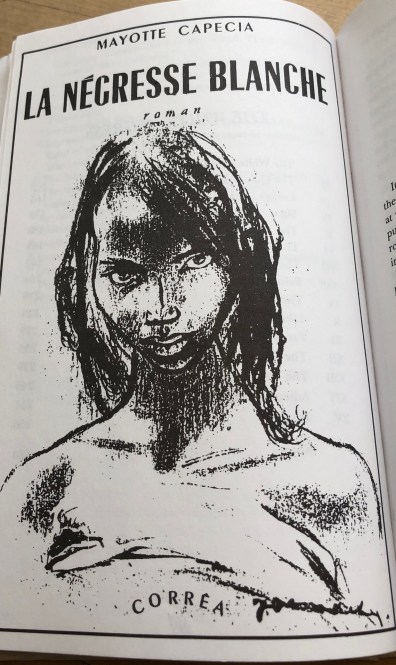
I asked about Capecia’s life in Paris.  Professor Makward explained that Capecia worked as a cook when she first arrived.  Somehow, she met a publisher who became her lover and who encouraged her to write of her life in Martinique.  Then, Madame Makward dropped a bomb, “You know, she didn’t really write those novels?”  I said no and asked who did.  She believes the most likely culprits were her publisher and his assistants.  Moreover, much of the second novel, La Negresse Blanche was plagiarized from a diary written by a French Naval officer who had had an affair with Capecia while stationed in Martinique.  Before we parted, she gave me a copy of Mayote Capecia ou l’Alienation selon Fanon.

Her book about Capecia revealed this subterfuge: she had had access to Capecia’s sister and children as well as primary sources including the diary.  What to do?  I thought Je Suis Martiniquaise had given me a window into my grandmother’s early life in the Caribbean.

Unknown-4
Church of the Aussumption, Soufriere Saint Lucia where grandmother Germaine de Jorna was baptized.

Although I’d read other portraits of Saint Lucia and Martinique, this was the first that described coming of age from a woman’s perspective.  Of course, these were the same comments made by critics supporting Capecia after Frantz Fanon’s dismissal of the novels.  Was I on a fool’s errand as I had feared?

I walked home in a daze unsure how to proceed.  Each attempt seemed a dead end.  I crossed in front of Notre Dame just as the many of the tourist buses were pulling away.  Earlier thousands had waited in line in hopes of entering.

Tired and discouraged, I took refuge at La Method, a cafe close to my home, and ordered a Ricard.  A minute later, I heard a loud boom; then, green clouds filled the sky.  Other patrons and servers came out to watch as more and more clouds emerged.   Soon, helicopters circled above us.

IMG_6163

My phone had died, so I had no idea what had happened.  I malingered for an hour or so attempting to read Makward’s book in French.

When I got back to the Irish Cultural Center, I discovered the reason for the billowing green clouds: Notre Dame was on fire.  The first time I left for France at age 21, Notre Dame had been my go to for mass.

The day before I left for France that first time, I made sure I went to confession.  After some pointed questioning by the priest, I admitted indulging in “heavy petting” with my boyfriend.  He said I had committed a sin: I disagreed as I was in love.   How to get absolution?  Without it, I would go straight to hell should my plane go down over the Atlantic.  We compromised.  I didn’t have to agree to sinning as long as I went to mass every Sunday while living in Paris.  And each Sunday found me at Notre Dame or Sacre Coeur.

The last time I visited Notre Dame, my husband cried at its grandeur and beauty.  At the main alter a book lay open for visitors to name a loved one who had died.  I wrote my father’s name: he would have liked being remembered in the family’s “country of origin” even though our de Jorna’s left France in the late 1600’s.  Then, the cathedral would have been 400 years old and most likely known to that earlier ancestor.

My father did visit Paris once.  My mother told me he used French to get around.  His mother’s tongue came back to him.  I returned him to Paris in words, his name.

Return to Paris Day 10,11,12

Wednesday April 10

At breakfast, a resident asked why I was drawn to this project.  I told him I had a keen sense of injustice especially concerning “the other” first expressed at the age of seven when my father forbid me to go to my friend’s house: she was black.  Then, I explained my personal interest, the family secret.  He didn’t buy it.  According to him, I hadn’t been affected.  Stunned, I agreed, considering my privileged life.  But no.  He’s wrong.  My father worked tirelessly to overcome his secret heritage, to fit in, to make sure I didn’t get too dark in the summer, to aggrandize his history, to be prejudiced himself as a false means of elevation.  Yes, it affected me.

I live in a country whose MO is oppression, destruction of the other: Native Americans, African Americans, any immigrant of color, any non-Christian.  The land of opportunity mostly works if you are white and male and, sometimes, if you can pass.

Since last night I had been thinking about violence committed by American police mostly against men of color.  While I was enjoying my aperitif, four French soldiers dressed in camouflage, cradling machine guns walked past me.  I asked my breakfast companion if he knew what they were doing: he writes about military matters.  He said it’s a strategy against terrorism.  Small groups of armed military pop up unexpectedly and, by their presence, deter possible attacks, a Macron strategy not entirely embraced his citoyens, (citizens).  When I was 21 living in Paris, soldiers with machine guns stood in corners on Boulevard Saint Michel.  I was told they were there to protect “us” from Algerians, yet another colonized group.

Unknown-1

Thursday April 11

At the end of class, I told the teacher I wouldn’t be returning.  She wondered did she speak too quickly.  I reassured her.  I rushed home, dropped off my books, and met a woman introduced to me by mutual friends.  We had a noisy and interesting lunch in the Marais at Miznon, an Israeli import.  Afterwards, we meandered along Rue de Montorgrueil, a mostly pedestrianized street in the 2nd, got a cup of coffee at L’Arbre a Cafe, sat on a wall in a small square and continued our conversation from lunch, mostly about the state of the world.

Unknown-2

She has a few concerns about life in Paris: people in big cars thinking they own the road, ignoring pedestrians and their safety.  I watched her take a few to task and applaud her.  She’s also concerned about the yellow vest movement.  She understands their situation but believes the destruction in Paris doesn’t make their situation better and abuses a city that is theirs to enjoy.  When we parted, she asked how I would get home.  Walking, I told her.  She directed me to go towards the Seine-her only advice.  Without any additional navigational aids, I found my way home.

Friday April 12

Nose to the grindstone.  Using the Mediatheque, the library that is part of the Irish Cultural Center, I unsuccessfully searched for the location of Mayotte Capecia’s grave and failed to locate any Caribbean groups.  I’ve written to the Christiane Makward the scholar and author of the book, Mayotte Capecia ou l’Alienation selon Fanon and asked for help. A long shot.

IMG_6342


Return to Paris Day One

Monday April 1

After spending two weeks in Dublin, feeling at home didn’t happen as easily as last year.  An outsider.  The language deserted me and my fears of offending the French took hold. 

389845D4-B6E4-410D-9B8E-066B99CD4942

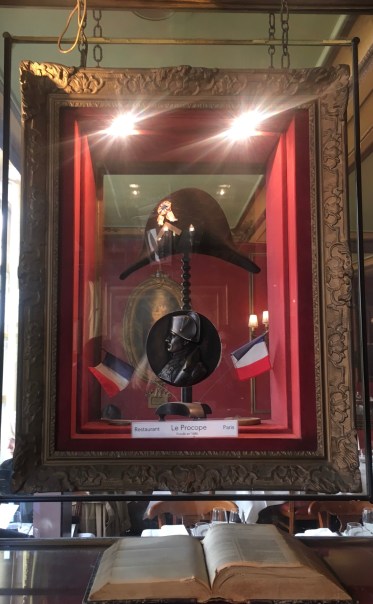
Napoleon’s Hat at Le Procope, Paris

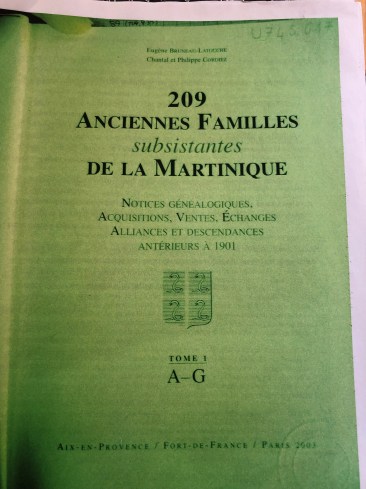
France even Paris was Mecca to my family.  My arriere grand pere was a doctor, kicked out of France or was it Switzerland because he used forceps, perhaps code for abortion.  An earlier relative had an argument with the king of France, not sure which one, about a naval tactic and was demoted from what to what?  Supposedly, we descended from aristocracy as our family name, de Jorna, begins with a small “de” denoting nobility.  

9424F814-18F4-498E-9602-A88921AE97A0

And my grand mere came from France as did my great Aunts and older cousins.   The de Jorna’s did come from France and some did live in Paris, but my branch had lived in the French West Indies for more than 300 years.  Once that truth was uncovered, a second emerged.  My arrriere grandmere’s death certificate listed her as “colored.”  On a ship’s manifest from Barbados to New York, my great aunt was listed as colored.

All their lives in the states and perhaps in France, this branch of the de Jorna’s from the lates 1800’s when Armand de Jorna, my great grandfather,  married  the “colored” Noelline Noel, were passé blanc, passing for white.

60F8C0D0-AD0A-4E58-83A9-4A718AB3BA28

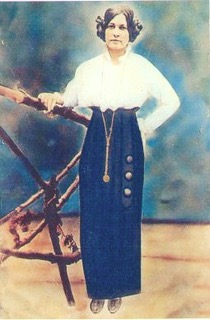
My grandmother, Germaine de Jorna, daughter of Armand de Jorna and Noelline Noel

This time in Paris, I return not as an descendent of an ennobled de Jorna, but as a passé blanc, the daughter of a man who resembled Louie Armstrong and who cautioned me to stay out of the sun lest my skin expose me and him.

Instead of looking for women artists outside the norm, Margureitte Duras, Agnes Varda, or Sophie Calle, I will look for those who pass and don’t pass, those from the colonies, Mayotte Capecia from Martinique who wrote The White Negress, Jean Rhys a beke, that is a white creole, born and bred in the Carribbean, and others who supposedly are French but are they?

13177FAF-5F02-44ED-AA3B-27548194CD80