Paris Day 11 and 12

February 25 Tuesday

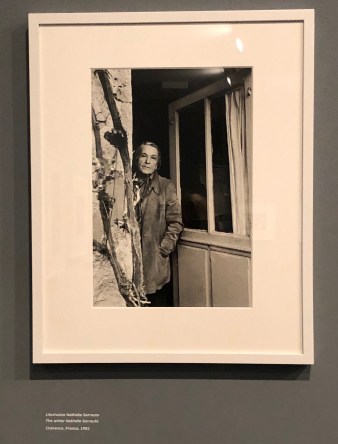
Equipped with sunglasses to cover my still badly bruised eye, I visited the Henri Cartier Bresson Foundation in the Marais.  This gallery or museum is exactly my cup of tea- just a few rooms to explore.  The two exhibits of women photographers, Bresson’s wife, Martine Franck and Marie Bovo who lives in Marseille were stunning.  Martine Franck photographed older artists believing the images might change ageism, that these faces would be seen as interesting, perhaps beautiful.
IMG_7386

Nathalie Sarraute

Marie Bovo used extended time exposure to film Marseille and it’s refuge camp at night: she finds beauty in the ordinary.  I want the images to stay with me, to live inside me.

IMG_7366

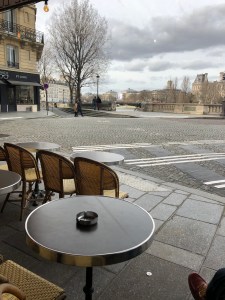
Perhaps, trying to recapture the past, I walked a few blocks to Camille’s.  An old haunt of my daughter’s when she lived in Paris.  On cold rainy days, we would find ourselves there in the late afternoon ordering snails, pate, a glass of wine.
IMG_7703

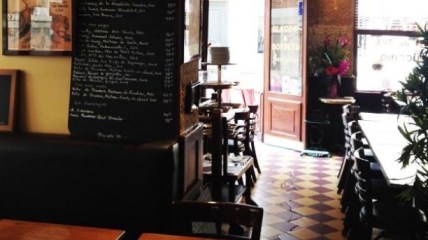
Camille’s

Seated by the window, I enjoyed potage crème de celeriac and watched pedestrians along Rue Elzevir.  Paris is home.

Like last year, I wrote during the quiet of late afternoon.  Satisfying- today at least.


February 26 Wednesday.

Spent the morning researching my Irish grandmother.  I jump from country to country.  Why am I looking at her information while I’m in Paris?  Overwhelmed by the subject, I jump back and forth: double consciousness of W.E.B. Dubois, the famine in Ireland.

I discovered some new information from the materials I brought with me about Nana, that is, Molly Daly.  The County Roscommon 1901 Census indicated she lived with her grandmother, two uncles, and an older sister in a house that had just two windows and an outbuilding, probably an outhouse.  Also, they didn’t own the land, as I thought, but rented it.  I’ve asked the artists in residence here at the center if they knew of any books or journals that depict the lives of Irish women on small farms during the late 19th and early 20th century.  No luck.  They attribute this deficiency to the lack of education  for the poor who, therefore, may have been illiterate.  Yet, my grandmother went to the eighth grade in Ireland.  Also, the census listed her grandmother and uncles as able to read and write.

Decided to have lunch around the corner at Au Port du Salut on Rue Saint-Jacques.     There weren’t many customers, just two older white French men and a younger black man.  At the end of the room was a piano.  From the bit of eavesdropping I understood, it seems the younger man is a musician and they were discussing a gig, maybe at this restaurant.
IMG_7704.JPG

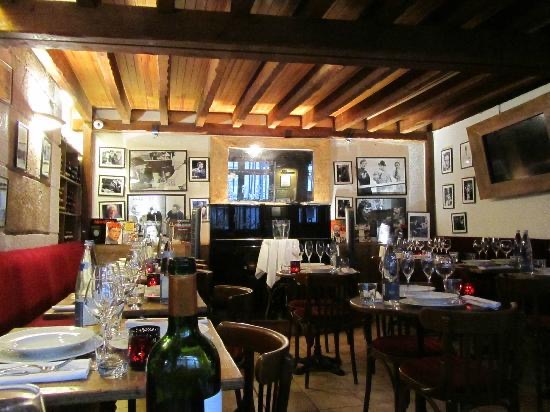
Au Port du Salut

The room is partially underground, the windows looking out on the feet of passersbys.  It reminded me of a jazz club or cave as they were once known on Rue de la Huchette that I visited when I was 21.  The colors are the same, red, black, dark wooden beams.  As I drank my coffee, I looked more closely at the photos on the walls: Serge Gainsbourg, Francoise Hardy, Barbara, French singers of another era.

I asked the waiter if they had visited?  He answered yes, they had performed in this very room.  Formidable!

Later, I saw Bela Tarr’s Satantango (Part 2), a Hungarian film in three parts, each two hours long, shot in black and white, and focusing on life in a poor village.  The opening scene is close to 15 minutes long as the camera follows cows wandering around a muddy field.  Although tedious, another long take, this of an older, overweight doctor watching and chronicling the movement of his neighbors, captivated me.  Did I picture myself, writing, drinking, looking out the window?

Attachment-1

From Bela Tarr’s film Satantango

Tonight another artists’ gathering, this time in the painter’s studio.  Much of her work is located in the forests of Sweden where she feels more attuned to the landscape than Galway where she’s lived for 16 years.  Another interesting discussion about place, it’s effect and the position from which it is observed.  Satantango is also about a place “that has such people in it.”

I’m always looking for “place.”  The place to write?  The place to…?  Is my longing to live on an island a desire for a place from which I can’t escape.   A dilemma.  A fantasy.


Paris Day Nine and Ten

Sunday  February 23

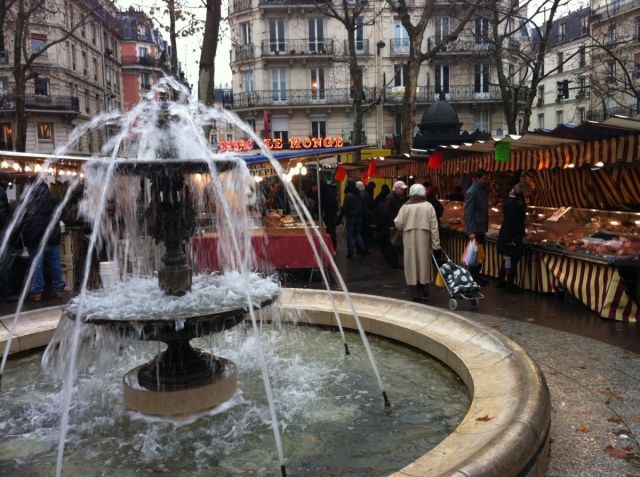
I found the marche!  It was Marche Monge.  I had confabulated several markets and lost my way.  Here were the familiar stalls: the excellent cheese monger, the flower seller, the cous cous stand (not great as I remembered) and the Italian stall.  I had plans for most of the day, so I bought a slice of vegetable lasagna for dinner in my room and two bunches of tiny daffodils.

D3DC87B0-C9C1-4D0B-A62A-7DB94BC7E759
Marche Monge

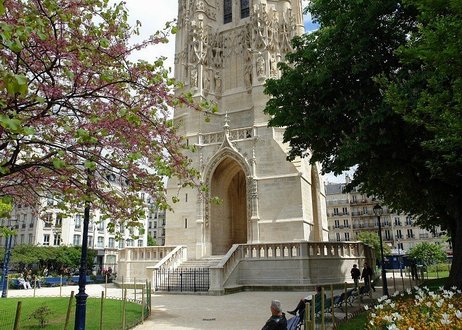
I gave myself an hour to get to Gare de L’Est where I was meeting Christiane.  We were to visit Cimetière de Montmartre in search of a de Jorna grave.  Usually, I walk around Place Tour Saint Jacques.  But today, walking through a park on an overcast day appealed to me.  These small green oases in Paris restore.  As I was exiting on to Blvd. de Sebastopol, I felt myself falling and could see there was no escape.  Flat on my face, bruising my left eye while hitting my right side.

6E135CD5-92E3-4E62-88D2-44823ACDF99C
            Place La Tour Saint Jacques

First, had I ripped my jeans?  No.  Second was there a pharmacist close by, open on a Sunday?  I was in luck.  French pharmacists are excellent sources of advice, almost like going to Emergency Care.  He gave me a cold pack, medication to help oxygen move to the bruise, and a salve.  He told me that every day someone comes in with the same condition as if the street had caused the injuries.  That soothed me somewhat, but this wasn’t the first time I had literally fallen on my face in France.  Last time, I lost four front teeth.

I returned to Place Tour Saint Jacques, found a bench, applied the cold pack, and cancelled my plans.  No one looked at me except by accident and, then, the onlooker’s eyes widened in shock.  I took a selfie and understood their surprise. I had a real shimmer.

I spent the rest of the day in my room: reading, resting, applying cold packs.

Monday February 24

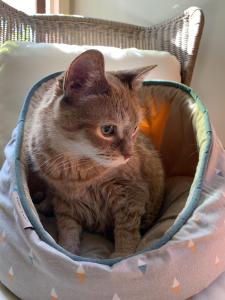
When I woke up, felt the bruises on my face, and got a look at my black eye, I wanted to go home.  Like a child who needs it’s mother, the comfort and familiarity after being hurt, I wanted my house with it’s beautiful light, my cat who loves me, sort of, my garden, my, my.  But this desire to bolt isn’t unique.  The last two times I stayed in Paris, I left early, just a few days, but why?

5B84BE6E-FE64-44FE-B4AF-3A0870EB6BD8
   Milo, the man in my life

What am I looking for?  I always thought I should have stayed in Paris when I was 21 and not come home to do the expected, that is, get a degree.  I felt free, accepted, in control, unburdened.  Well, I can’t get that back.  And what burdens am I looking to unload?  A state of mind unencumbered by expectations, by obligations?  Yet, when I want to leap across the Atlantic, the ties to loved ones, to landscape pull at me.  Aren’t they encumbrances of a sort?  Whether writing or traveling, essentially the same question rears it’s unwanted head.  What the hell am I doing?  Part of the process of making a life, of trying to create something?

After spending part of the day writing, I decided to hide myself in the movies.  Armed with sunglasses, I walked to Reflet Médicis to see Visconti’s White Nights.  I passed the Champo: a line extended along Rue des Écoles, people of all ages waiting to buy tickets to Fellini’s La Notti de Cabiria, Nights of Cabiria.  The scene heartened me: you’ve got to applaud the French love of cinema.

At the ticket booth, I had to remove my sunglasses and felt the need to explain my appearance: Je suis tombe dans la rue ( I fell in the street).  Immediately the clerk asked if I was all right.  Did it hurt?  Scratch the surface and the French can be tres gentils.

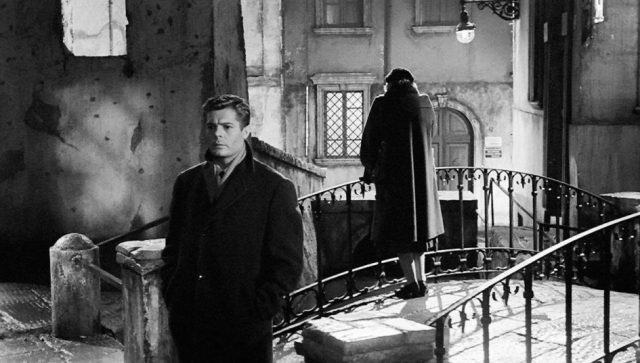
I came to see Visconti’s 1957 adaptation of Dostoevsky’s short story “White Nights” (La notti bianche): the cinematography seemed strangely real and unreal.  The black and white photography reminded me of his La Terra Tréma.  Whereas that film was shot on location in Sicily, this film takes place on a set, a carefully reconstructed section of Livorna.  Disconcerting.  Like the characters, I was thrown off guard.

27712D2F-9F81-4B73-97DB-EFD6E1F365F2
                     La Notti Bianche

Visconti explained,

”It must look as if it is false but when you start to think it’s fake, it must look as if it were real.”

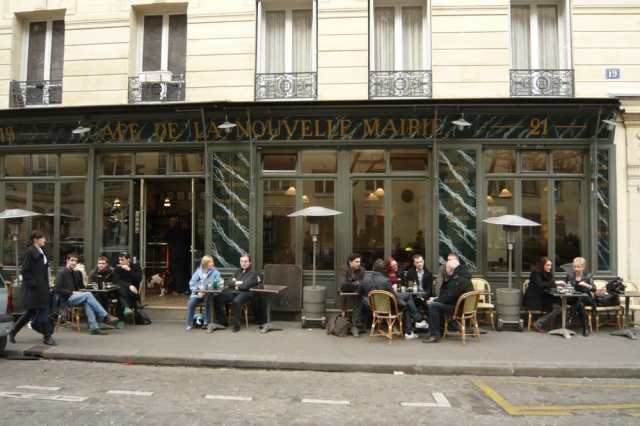
On my way home, adorned with sunglasses, I decided on a pastis at  Cafe de la Nouvelle Mairie.  Again, I felt compelled to explain my shiner to the barman.  Again concern.

199C1BC2-CB32-4C1F-89E0-30EB5D2DF80A
          Cafe de la Nouvelle Mairie

Paris Day 7 and 8

Friday  February 21

I meet with the woman who is renting my house next week.  How strange she lives in Paris.  We have some common interests like film and, so, spent an hour together.  Afterwards, I walked to the Ile Saint Louis for coffee at Le Lutetia.  It can’t be 10 years since I sat here with my husband.  We each had our small black notebooks, writing side by side, watching the Seine, and waiting for our daughter.  She worked at a boutique down the street: Le Lutetia was her place.

B9487DD0-9AC8-4D89-A36F-A85CC7188D3ELe Lutetia   Île Saint Louis

Today, I’m sitting in the same seat, looking out at the same Seine, but instead of writing, I’m trying to read Paris Creole.  It’s tough going as I get deeper into the text.  I think it’s the tenses as the events take place in the past: passe simple, passe compose, passe anterieur, imparfait, etc.

Later a meal in my room- a gyro filled with French fries and a small baklava.

Saturday  February 22

A very long breakfast until almost noon.  Several of the artists in residence myself, another woman writer, and the military historian talked for several hours about the importance of place.  Our preferences are deeply felt.  One artist, a painter, lives by the sea but prefers the forest where she feels protected.  Myself and an actress have opposite reactions, experiencing claustrophobia in the woods, needing the sea.  For me, it’s the edge so I can escape.  An irrational concept.  What do I plan to do?  Swim?  Where to?  One person believes place has more weight than family.  Certainly, sense of place seems to be associated with safety.

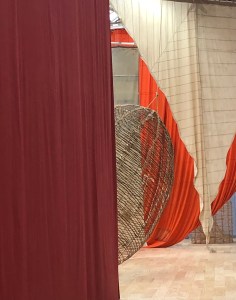
Then a description of the Ulla von Brandenberg exhibt at the Palais de Tokyo mesmerized me.  Fabric, people folding clothes, a film.  The walk would take me an hour and half clocking in close to six miles.  But six miles along the Seine intrigued me as well.

I wasn’t alone.  Despite the cold, the damp, the grey sky, Parisiens were out: alone, in couples, in families, strolling, running, biking.

D877D6F0-780B-4CC1-B784-07F25A522A27

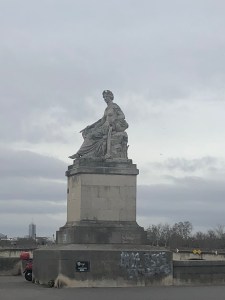
Pont du Carrousel   La Seine by Louis Petitot

When I finally got to Avenue du President Wilson where Palais de Tokyo is located, I remembered being there with my husband and daughter.  We were looking for a pharmacy: he had a blister and insisted on ignoring his discomfort.  We wouldn’t let him.  For the life of me, I can’t think why we were in this part of town.  Is he haunting me or maybe just accompanying me.

I preferred the architectural aspects of the exhibit more than actual exhibit itself.

FA1F812C-6A39-4699-86A9-08101A6133E8
Ulla von Brandenburg Exhibit
Palais de Tokyo

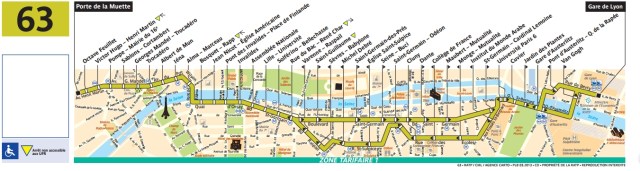
I finally took a bus after much resistance.  Not at all difficult and I prefer it to the metro.  I travel alone which seems very brave to some of my friends, yet such small matters make me anxious, can incapacitate me.

F046FE58-3490-4924-A367-B507D041127C

Paris Day 6

Thursday February 20

My plan was to read and take notes from Paris Creole: my weather app predicted 12 hours of rain.  The day got off to a distressing start.  At breakfast, one of the resident artists told us she had been attacked on Rue Pierre-et-Marie Curie just around the block.  She repeated how she had always felt safe here.  As have I.  Now most of us feel vulnerable, our freedom restricted.


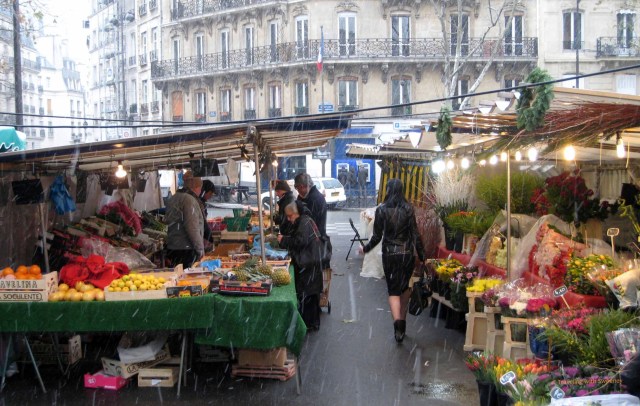
A good time to get new flowers.  The daffodils have seen better days.  I’m still looking for that little market I frequented last year.  Marche Maubert was suggested.  I found it but it’s still not the right one.  How I wish I had my own kitchen.  The haricots verts a vibrant green and thin as the slimmest pencils tempt me.
B505EB2A-4436-4354-B11D-87026735C4F3
Marche Maubert at Place Maubert

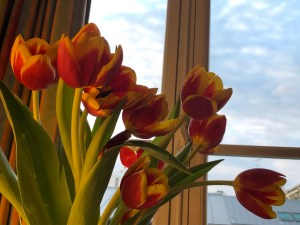
I did find a good bunch of tulips, radishes, and “une tranche” (a slice) of Swiss raclette.  Still using French, still not speaking in complete sentences except when I rehearse “dans ma tete” afterwards.

FF9229C6-61D8-403A-BE92-7DAF1C53D091

While eating lunch at my desk, another attack of exhaustion hit me.  I tried doing research into my Irish grandmother.  I pulled out the 1901 Roscommon County Census: she lived there in a small village known as Kilnamanagh.  The census, also, included information on dwellings.  My grandmother, age 7,and her sister, age 9, lived with her grandmother, Bridget Kearns, and two uncles.  The house had 2 rooms, 2 windows and an outhouse.  I know they kept livestock which according to Nana, sometimes, came into the house in cold weather.  I thought they owned the house but it’s listed as leased from a Caroline Ball. The 1911 census shows only one of the uncles, Patrick Kearns, living there with his new wife.  My great grandmother must have died.  By then, my grandmother, her sister and her other uncle, Michael Kearns, had immigrated to the United States.

When I was a young girl, my family would visit that uncle, great Uncle Micheal, whom we called Papa Daddy and his wife Papa Mommy.  Due some illness, he was confined to a room in the attic of his son’s house.  My sister and I didn’t want to visit with him but we were obliged out of respect.  To us, he smelled of tobacco and old age but more problematic was his brogue.  We couldn’t understand a word he said.  Did immigrants from Roscommon or Kilnamanagh have a particularly strong accent?

Well, I’m getting on with it, not just writing about avoiding the “book.”
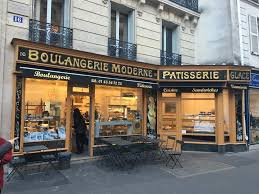
It wasn’t long before I had to nap again, waking at 5.  I intended to go to the movies but felt almost drunk.  Besides, it was raining .  After another hour of reviewing my grandmother’s papers, I went to the Boulangerie Modern on Rue des Fosses Saint-Jacques for some vittles: pizza and tarte au citron.
D58A1D06-0F41-4018-B236-430717CF50A5

Longing for greens, I settled on eating my radishes with dinner.  Afterwards, I crashed again.  Allergies? Jet lag?

Paris Day Five

Wednesday February 19
I spent a few hours keeping track of myself in this blog and then, went to Mokonuts for lunch.  A good 2.5 mile walk over the Seine to Bastille.  Approaching Pont Sully, I noticed a lone house at the end of Ile Saint Louis.  Was I in a Flaubert novel looking at Madame Bovary’s house or riding along the Seine in Sentimental Education?
05CD085C-05A6-4D4B-8F9C-D9934691CA0A
 
In order to get to Mokonuts, I had to go around Bastille to Faubourg Saint Antoine, a good street for window shopping.  As expected, Mokonuts was full.  Luckily I had grabbed the last 2 o’clock lunch reservation.  And as usual, the food was delicious.  Although I had sworn off dessert, I couldn’t resist the blood orange cake.  When I went up to pay the bill, I discussed  the changes in Manhattan with one of the owners.  Since I’ve been using French everyday, I kept switching back and forth forgetting she was from Brooklyn.  A hefty price for lunch; 46 Euros for a main course of chicken with spinach, dessert, two glasses of wine, and coffee.  Twice as much as the dinner at La Methode.  Yet, I must remember to use nasturtium leaves in salad.  Not as pretty as the edible flowers but tender and delicious.
I returned home, again in the rain, and in time for a get together arranged by one of the artist in residence which she called a “pow wow.”  A military historian gave a presentation on the books he’s authored , then the audience (only 3- 2 resident artists and me) asked him about his work and his process.  Most of the discussion revolved around Irish politics which could have been heated but differences were respected.  They told me the town of Dundalk on the border of Northern Island was called El Paso: during the troubles, members of the republican movement stayed there before going on missions in the north.
ABE00FD3-0299-4DC9-8870-168EB264B784
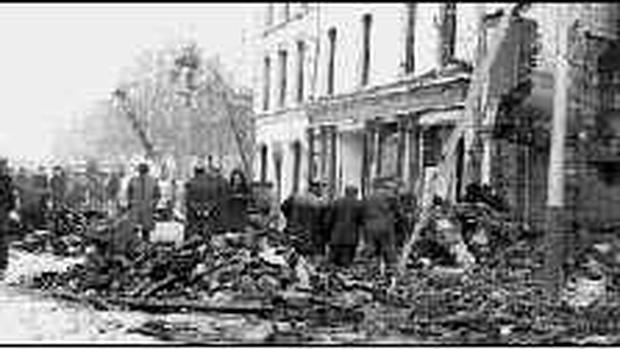
The Dundalk Christmas Bombing by the Ulster Volunteers 1975
As he is very prolific, we were intrigued by the historian’s routine. He tried to
sideswipe the question but, finally, he relented.  He gets up very early, 6 or so,  and writes a bit before breakfast.  After breakfast, he writes until 1, has lunch, and may take a nap, then back to writing until dinner.  He does his reading in the evening.  A monk’s life. And this is almost every day.  Sunday’s he does go to mass and does a bit of socializing but mostly his nose is to the grindstone.  We talked about finding a balance while being in Paris.  Easy to just play given these environs.
Although we started at 6, it was 11 before we finished.  The conversation ranged from working to ecological grieving to captialism vs. socialism to Sinn Fein.