The Ride Back to Kilmurvey

The Seven Churches

After finishing the Guinness, I made my way to the Tourist Office where I was given maps to all the islands: Inishmore, Inishmaan, and Inisheer. I plan to visit the other two next week. The four mile walk and the Guinness had done me in. I asked the driver of a tour bus to give me a ride to Kilmurvey, thinking he was waiting for passengers and it would cost just 3 Euros. He looked at me but didn’t speak. “Do you want me to wait for more people to show up?” I asked him. “But there’s only youself,” he answered. I assured him I would pay him and off we went, me up front in the seat next to him. He told me he had been a fisherman, but since only the big companies succeed in fishing, he drove a tour bus. I had to listen hard as his English sounded more like the Irish I had heard on the ferry, the words melting one into the other.

We spoke of the type of fish found in the waters off Inishmore, prawns and lobsters mostly at this time of year. As we went past livestock, this time on the upper road, the talk turned to testicles, a conversation that lasted for several miles. He said before vets were available on the island, the balls of the bulls were cut off with a knife.  In another method, the testicles were tied until they fell off.  I threw in, “Well maybe that was more humane, less painful.” He laughed and commented, “Not if you were a bull.” He said there was one man in particular who would come around and do the deed. I told him that Carlo Levi, in his account of being exiled by the Fascist to the hills of Italy, had described the same set up but with pigs. One day a year, a “specialist” would arrive in town and all the women would bring their pigs to the square for ball removal. His final contribution was to mention that he heard in Wyoming they ate them. He chuckled and shrugged his shoulders. Why Wyoming, I wondered?

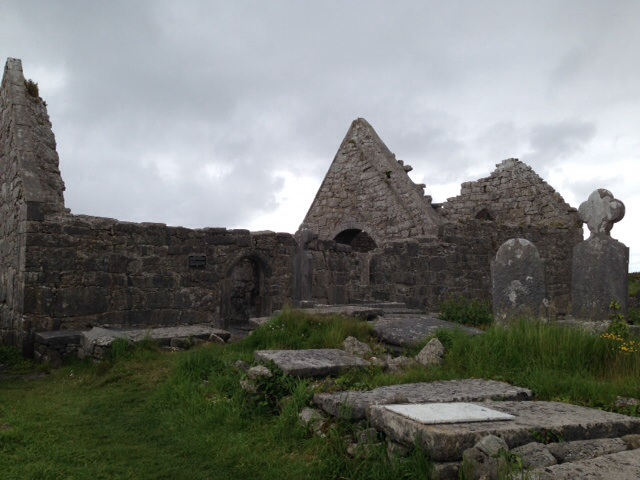
He convinced me to visit the Seven Sisters, a monastic ruin, before going home.  According to him, it had been destroyed by Cromwell, the cause of much horror in Ireland.  I climbed among the buildings under an overcast sky.  It seemed a place for Druids, not Christian monks.  But the Irish never let go of their myths or pagan rituals just to accomodate the Pope. I guess he wanted to earn more than 3 Euros and so he did. I see him almost every day on the road taking busloads of day trippers to the various sites. He doesn’t wave at me as most of the drivers do when they pass the only person walking.
The Low Road to Kilronan

The Low Road

On his first day in Inishmore, John Millington Synge, author of The Playboy of the Western World, recalls sitting in front of a peat fire with “a murmur of Gaelic” in the background.  Like Synge, the lilt of Irish was with me on my first day in Inishmore.  An older couple who sat behind me on the ferry used Irish the whole trip, their sentences spilling softly over each other’s.  A good beginning.  Synge wrote in 1898 that he had to leave commerical Inishmore for the more authentic Inishmaan.  Over 100 years later, and I haven’t had that experience.  I had been warned that staying two weeks would be too much, that I wouldn’t last more than a few days.  During my first dinner at the Man of  Aran B&B, I mentioned this warning to several lodgers.  Two American women were sure I had made the right decision.  An Irish couple envied me.  And right they were.

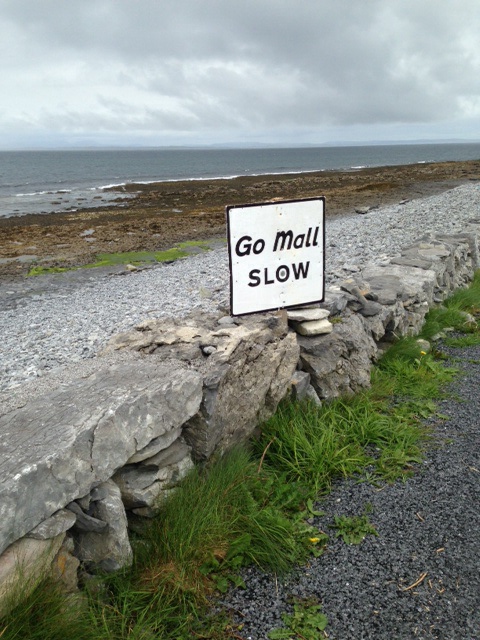
A treasured fantasy of mine is to live on a sparsely inhabited island small enough to navigate by foot.  So far, I think I’m on to something.  I take long walks, read in my room or write, and, sometimes, talk to people at breakfast or dinner.  Some ask me why I don’t bicycle.  For example, the three hour trek to Kilronan  would have taken 20 minutes.  I prefer being a flaneur, walking, pausing, looking, talking to the animals I pass.

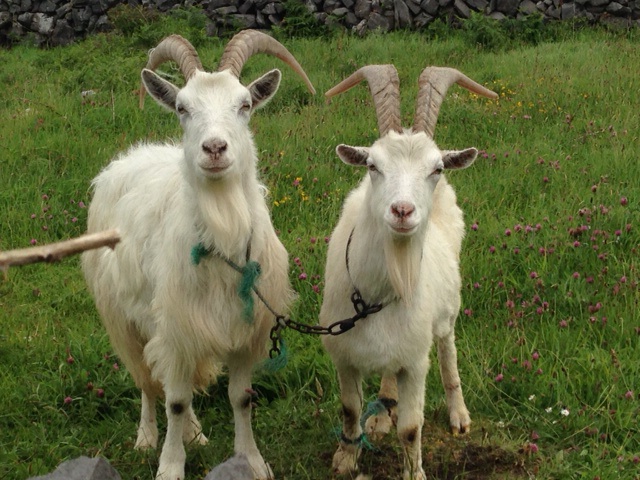
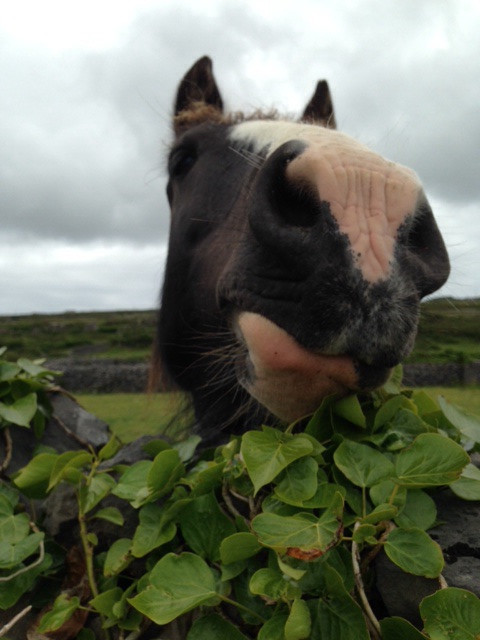
Using the low road to Kilronan, I met two horses, a donkey, two billy goats, a teenage goat, and some kids.  All moved as slowly as I did.  Most meandered to the stone walls that separated us, in hopes I would give them food or set them free.  One old horse was adamant.  After he licked my hand, he pushed insistently into my bag searching for a treat.  The two billy goats were tied to one another and it took them awhile to reach me. Their plight saddened me, my empty pockets disappointed them.  The teenage goat just wanted petting, nudging his head against my hand, following me along the fence in hopes for more.  The kids enjoyed the simple pleasure of running and jumping.

The Ti Joe Watty’s Bar sits at the end of the low road and the beginning of Kilronan.  I was going to head directly to the tourist office as planned, but the bar called to me.   I sing the praises of Inishmore’s natural beauty, but the Guinness I drank was a little bit of heaven as well, the black/brown liquid with its tan head, its sweetness.


imageimage

On the Way to Inishmore

Image

“We live in the poor heart of Ireland” John McGahern wrote about his beloved County Leitrim. I, instead, am in the heart of a wild beauty of Ireland, Inishmore in the Aran Islands. I sit in my room in Kilmurkey looking out on the North Atlantic down the coast towards Kilronan, fat raindrops on the window, hands chilled as the radiator doesn’t seem to work.

My chaotic departure began two days ago. I was running late for the shuttle that would take me to the airport. I instructed my neighbor, who had volunteered to transport me, to throw everything on the dining room table into my carry-on bag. Later, I discovered my garage door opener and a pair of one-armed glasses has found their way into the bag. Meanwhile, I searched frantically for the special pants I had purchased for the trip. No luck. I threw everything I could see into my suitcase. As I settled into the car, shoes popped out of my open handbag. I made the shuttle and on the way to Newark airport rearranged my belongings.

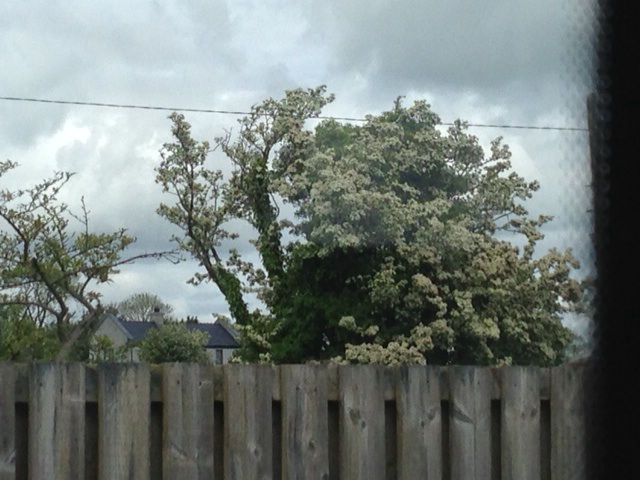
Twenty-four hours later on the train to Galway, peace and excitement sat comfortably within me. I had a seat all to myself, McGahern’s book of essays, and the green of Ireland outside my window. In his love song to Lietrim, he describes ancient hedges separating properties and left undisturbed as no one seemed interested in developing that part of the country. “The hedges are the glory of these small fields, especially in late May and early June when the whitethorn foams out into streams of pink and white blossoms.” As it was May 31st, I spent most of the trip looking for whitethorn and found them, just as he described, between fields dotted with cows, sheep, and sometimes horses. The Irish have a saying,  “If you don’t like the weather, wait five minutes and it will change.”  The sun had been out since we left Dublin, but as we approached  Galway, the sky filled with large sooty clouds, dominating the flattened landscape.

Given the upheaval when I left the states, I opted out of exploring Galway during the hour before the bus left for the ferry. I played it safe and sat in the Victoria Hotel directly across from the bus stop. The hotel, fixed up to honor its heritage, is overdone and inauthentic. However, the white and pink peonies in large vases atop sideboards were for real. I wiled away my time gazing at thier large feathered heads and thought of McGahern and his whitethorn.


A Citizen

On Thursday, March 6, 2013, I broke out of the comfort of my apartment in search of the Hilton Hotel where I hoped to swim on a regular basis. As I reached Vassilissis Sofias, I could see a crowd walking towards Symtagma Square. Change of plans. I followed them. The closer I got, the more police I could see. Finally the street was completely cordoned off, so no traffic except those of us on foot could pass in front of the Parliament Building. The police were stationed close to the florist I sometimes patronized. The incongruity of colorful, fragrant flowers along side riot-geared, machine-gunned, gas-masked police on the ready made me smirk in painful irony. I was reminded my own protests in the sixties. I am living the class I am teaching at the university, Film of the Sixties.

I put on big sunglasses and armed with my iphone readied myself to be a “citizen journalist.” I had tried to do the same this summer during the elections in Spetses.  At that time, a friend asked me, “How can you be ‘observing Greece” from the lap of luxury?'” I had been staying in a Villa.  Today, living in Kolonaki, another lap of luxury, on my way to the Hilton, and not speaking Greek does create some difficulty. I didn’t understand the signs; I didn’t know what was being protested. Most of the people in the streets were young, so I imagined the gathering might be about unemployment which is about 25% for youth.

My classes had been canceled on Tuesday due to a protest against the merging of departments at the University which would result in an elimination of part of the Humanities. However, I thought that protest took place on Tuesday.

I took photographs, placed myself directly in front of the Parliament, and waited to see what would happen. There seemed to be about two or three thousand people. Standing next to me was a “woman of a certain age” as the French would say. She petted a dog who like many in Greece has a collar but belongs to no one. She spoke to me in English after I made my one statement in Greek that everyone seems to understand, Then milaw Ellinika. I don’t speak Greek. She told me that the dog’s name is Victory. We laughed. I found out that the protest concerned the changes being made in education, that is, firing of teachers, getting rid of some schools. I was in the right place.

After some discussion about this situation, she confided that she had given up her Greek citizenship. Shocked, I asked her why. She said she couldn’t be part of a country that handled this crisis so stupidly, whose leaders were corrupt and still no one did anything. I told her that I had wanted to quit the United States when George W. Bush was president, but my husband had insisted that “someone had to stay and fight.” She went on to say that she is having trouble living in Greece because she speaks her mind, saying what other’s don’t want to hear. I wondered if she was being harassed by people from Golden Dawn as she kept mentioning cults. However, that wasn’t the case.

She is on her own and is in conflicts with her community, with her neighbors where she speaks freely about her frustration with Greece. I was reminded that Freedom has a price. Just that morning, I had been considering applying for a Greek passport, having dual citizenship. I can as my grandfather was born in Greece. Another contradiction, another consideration. What does it mean to be Greek with the blinders of romanticism taken off?

20130309-152303.jpg

20130309-152324.jpg

Return to Athens

I have been in Athens for almost a week; this visit is different. I will be living here for three months with an apartment, a neighborhood, and a job- teaching film studies. Presently, I am living in a posh neighborhood and seem to be partially “protected” from the desperation that lives in other parts of the city. There is graffiti on a few walls, and occasionally, a homeless person emerges, posting herself next to a kiosk; however, unless I move out of this enclave, I see little of the suffering that Greeks are experiencing.

Last week, as I walked to the National Library for an exhibit, a seemingly professional man seemed to be lost. He followed people, mostly women, looking for direction, not directions, but direction. Naturally, those he approached were uneasy. People moved away from him and police scowled. He drifted away.

Two days ago, as I sat in a cafe reading The International Herald Tribune, a middle aged man who also had the air of the middle class about him, paraded in front of the cafe speaking aloud to the coffee drinkers. He wasn’t particularly aggressive nor did he seem unhinged. Yet, there was something he needed to share. No one responded.

As I was walking home that same day, I crossed behind the National Gardens. At the corner, a soldier stood at attention with a machine gun held to his chest. Who is he protecting?

Another sight that seems more prevalent on the weekends are individuals laying prone on the sidewalk arm extended for an offering. One such women lay in front of an expensive boutique. She moaned as two young women discussed the price of the handbags displayed in the window. Now, I find myself crossing the street to avoid beggars. How much would it cost if I gave to each of the beggars I encounter? Then, there is my New York scepticism. Are they for real?

Yesterday, I decided to go to a high end shopping center which turned out to be a block long department store. As soon as I entered, I wanted to leave. There were many clerks but no customers. The store, Attica, could have been anyplace where wealth is possible. In Greece, where universal health care has been eliminated and people are cutting down wood in the national gardens to heat their homes, this store wreaks of moral decay. Berlin in the thiries?

20130305-004705.jpg