Glasgow, The Wee City

Argyll Hotel
Argyll Hotel

The transition from Inis Mor to Galway was difficult, too much noise, too many people.  Not so with Glasgow. On the way from the airport to my hotel, the cab driver made suggestions about what to do during my stay. He told me “I love my wee city.” I’m in love too.

As the plane from Dublin landed in Glasgow, rough grey clouds filled the sky.  Out of the windows on the left, was a tangle of rusty red blocks that is Glasgow. On the right, the moody sky sat over blue green hills surrounding a small loch, its waters a silver reflection of the sky. I hadn’t left the plane and I was already infatuated.

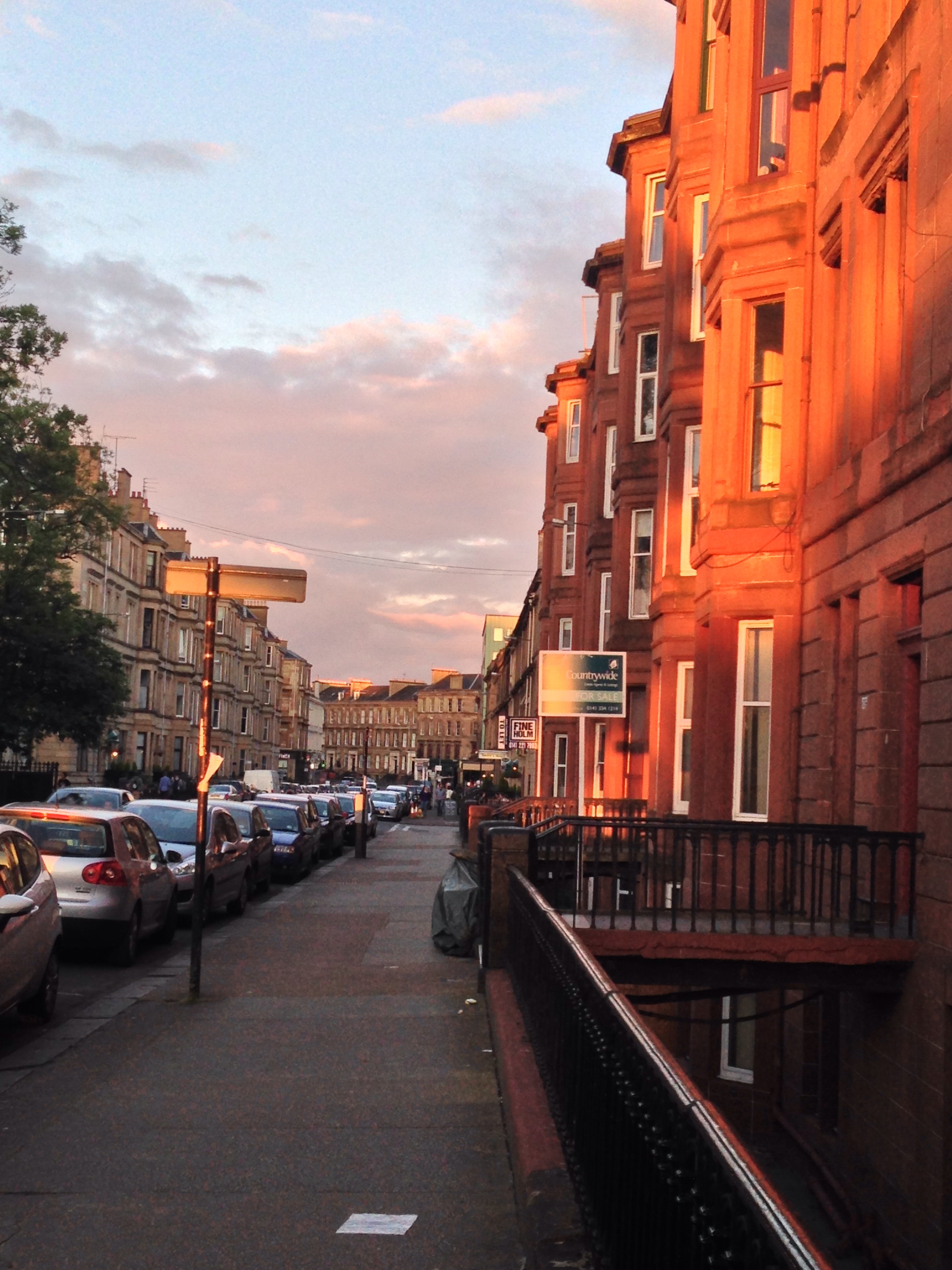
My hotel is excellent, tidy, an almost charming attic room with a good bathroom. By pure luck, I am in a perfect location in the West End: a block away from Kelvingrove Park with a stream running through it, the Kelvingrove Art Gallery and Museum, and up the hill through the park the University of Glasgow. If I walk along Sauchihill Road, I pass the Center of Contemporary Art which becomes  pedestrianized and ends at the main thoroughfare, Buchanan Street, also pedestrianized. At it’s end is the River Clyde.

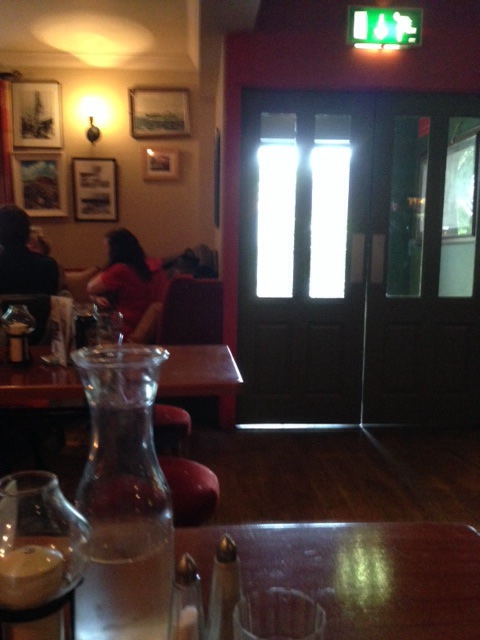
On my first night, I walked through the park to University Avenue in search of a restaurant, Stravagin.  It reminds me of Agricola in Princeton in terms of its’ long tablels and high stools, but there the comparison ends. It is less “designed” and more interesting.

I sat in the loft area looking down at the wooden tables and the customers that freqented them. I began my meal as I have several times during my stay in Scotland with whiskey. Then I had an excellent meal of sea bass. The man in the table next to me leaned over as he was leaving to tell me he had ordered the same and it was excellent. I was delighted with his friendliness and even, perhaps, with the bit of attention.

As the evening wore on, I could see he was, indeed, a very friendly man. At least in his late fifties, he managed to sit beside two young woman and insert himself into their company. They were polite but didn’t encourage him. After several unsuccessful attempts, he started looking up at me. I guess I shouldn’t be so easily beguiled.

On my walk home, as I looked over the wall next to the park. I sighted another fox, this one had four legs. He too seemed to be licking his wounds. He had been stalking a duck who managed to escape. Just as the man had looked up at me after his failure, the fox looked longingly over it’s shoulder at the meal that got away.
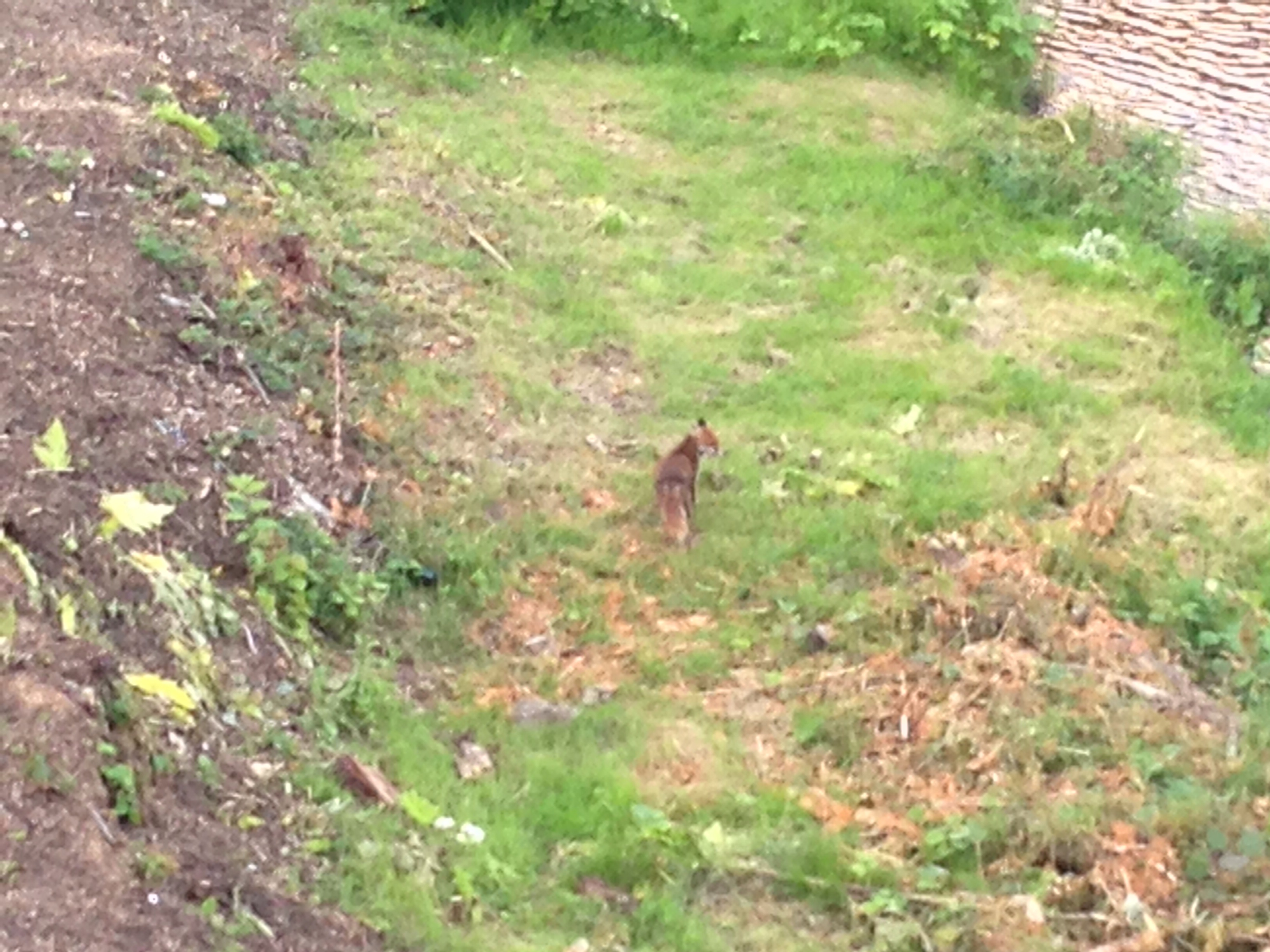
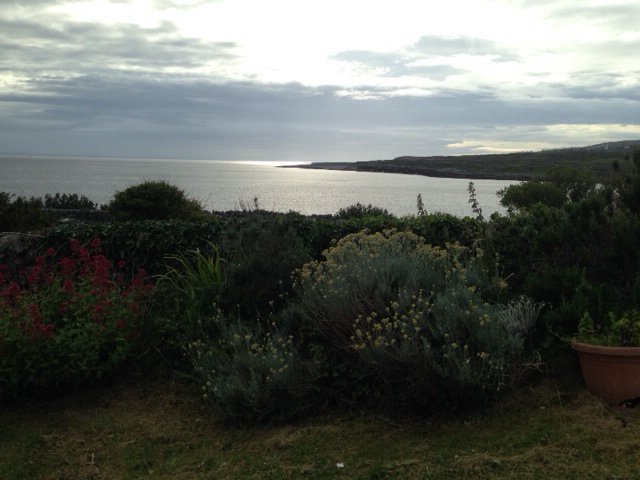
 

The Fox
The Fox


The Last Time Down the Low Road

image


At dinner, the night before my departure, I had told Maura not to fix any breakfast, but when I came into the dining room, she had freshly squeezed orange juice ready for me. Joe was there to send me off as well. He said the sonnet required framing and would be hung on the wall in the living room, that is, if he could keep the women from banging down the doors. In the sonnet, I had referred to him as a “good stallion” and Maura as a “strong mare.” “Well, I had to work in the animals, ” I retorted.

The night before I left, Maura said John would be driving me, but she didn’t want to call that night as he would forget. She would phone him in the morning. At 7:45, he was at the door, a familiar face, he being the one who had given me a ride from Kilronan and preferred to talk about testicles.

We hadn’t gone but a few hundred feet when he said, “I’m having trouble with my bulls. They are crying out every night and getting very randy. They even tried to bolt over the walls.” “Really,” I responded. “Yes, and one made it.” “What’s wrong, I asked.” John lightly touched my knee, and smiled. “Well, my dear, They haven’t been fixed. And like I said, they are mighty randy. They are driving me crazy.” He explained he had waited too long to castrate them as the vet hadn’t been to the island recently. He wondered if he might have to do it himself and was about to launch into another explanation of how it used to be done when I slipped in my regret at never seeing the low road again.

“We can do that” he told me, and down we went one more time, sighting seals lounging on rocks while the tide moved out.

Fauna, Flowers, and People

image

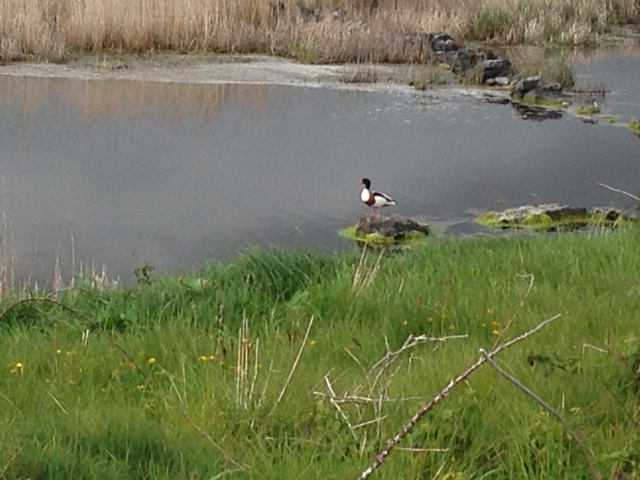
In my mad rush packing, I neglected to bring binoculars. Yet, where would they have gone? I’ve had only my eyes and my Iphone to sight birds, not a very effective method. And this is a bird’s paradise. They don’t seem to be in harm’s way no matter where they land. In a saltwater pond on the low road, geese and ducks paddle along diving for food. Various gulls join them. One gull had a fish in his mouth, so big, he had to drop it. I can attest to magpies, shelducks, mallards, herons, warblers, hooded crows, and even a skylark.

Shelduck
Shelduck


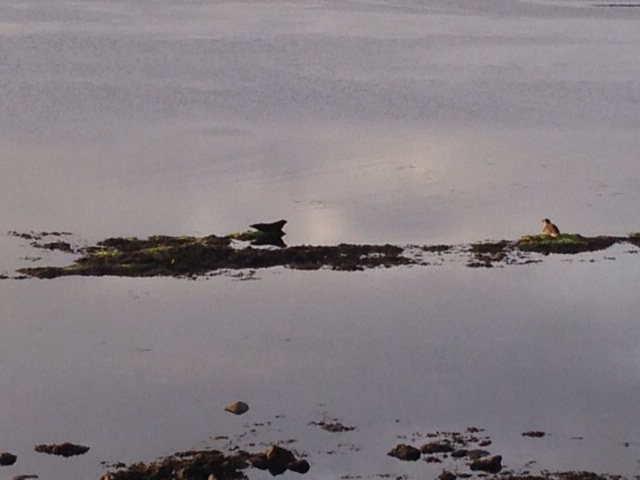
Perhaps the biggest surprise has been seal sightings. On that last evening walk, two seals sunned themselves on a sand bar turning their heads west to catch the rays.


Sunning Seals
Sunning Seals

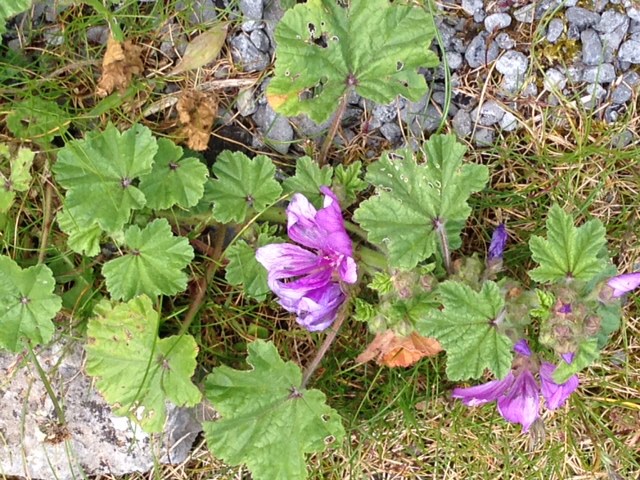
Along every stone wall wild flowers abound. Dandelions, often considered a pest in the United States, make luxurious lines of bright yellow. Hardy fuchsia spill over the walls like honey suckle, tempting lips, and smalll wonders appear at my feet: spring gentian, mountain pansey, bloody cranes bill, and birds foot trefoil along with many I have yet to identify. Walking back from the cliffs on the east side of the island, tiny red and yellow butterflies danced at my feet.

Cranes Blood Bill
Bloody Cranes Bill

Certainly, I have made the acquaintance of a number of interesting people at the Man of Aran and on my walk: a retired army nurse who is working with the University of South Carolina to start a sustainable farm; her friend, the vet from Boulder, who has developed an interesting method for deferring costs for her clients, cats and dogs; the educators from Rochtestor; the puppeteer from Connecticut; and the United Way worker from Toronto. However, my beginning relationship with the islanders is most precious, slight though it is. Just when I’m leaving, I feel connected. Joe saved the day by taking apart my bathroom sink to retrieve my lenses. He demanded a sonnet which I delivered, fourteen lines of iambic pentameter. Maura let me into her life a bit with what might have been the beginning of a friendship. Fionna, at the Internet cafe, told me about her attempts at fiction and poetry.

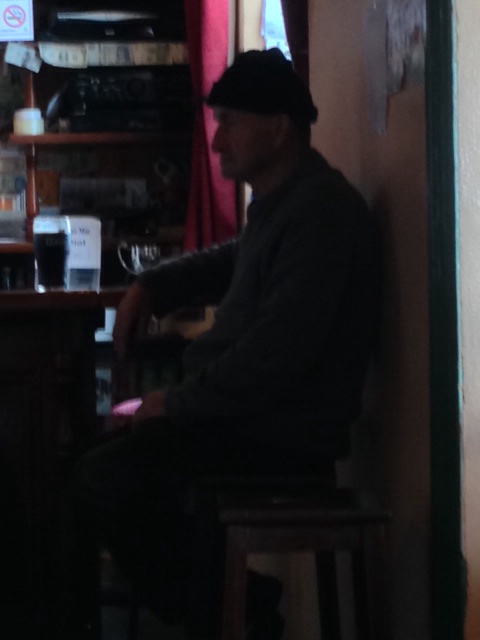
On my last full day on the island, I wanted to go to the pub in Kilronan frequented by Joe and Maura. There was just me and a male patron perched on a stool at the end of the bar. Five or ten minutes passed before a barkeep appeared. I ordered a Guinness inquiring if there was any food. He said no, but a few Guinnesses would do just as well. I gave him a fiver and left the rest for a tip. He nodded to the man at the end of the bar and said “See, you can give a tip if you want.” They both laughed.

I sipped my Guinness while the fellow at the bar talked to himself in Irish, hands lifted for emphasis. Eventually, he made his way to me and told me of his travels to the states including a treacherous voyage in a small boat from Boston to Cap Cod.  “A day full of squalls,” so he says. When he discovered where I was staying, he wanted to know if I had seen Robert Flaherty’s famous 1934 ethnographic film, Man of Aran as Flaherty had used the cottages in the film, hence the name of the B&B.  I commented that it was considered an important part of documentary filmmaking even though parts of it were staged. He responded, “Well, yes, yes, didn’t go shark hunting anymore, but that fella could have drowned, the sea was that bad.” He had first hand knowledge as one of his relatives, he assured me, had been in the film.

As the 4 o’clock ferry hadn’t arrived, no vans were at the harbor. Once again, I opted to walk. Without any food since breakfast, I grew weary. I passed 30 or so French tourists and then about the same number of Spanish tourists leaving Ti Joe Watty’s. My friend at the bar said he had a long walk home but would manage by stopping at pubs along the way. I followed his lead, found a seat at the bar at Ti Joe’s, ordered another Guinness, got a sandwich and exchanged some pleasantries with the owner. By the time I left, she asked me to to pass a message on to Maura. “Tell her Grace will see her in October.”

A Bit of Lore

image

My Irish grandmother, Nana, told us that if there is a blue sky bigger than a man’s pants, the sun will come out.  After I grazed a nettle bush and was tortured for hours by it’s sting, Joe, owner of The Man of Aran Cottages, said they had a saying, “Don’t put your fist around nettles.”  The next day, he couldn’t quite remember if that was the actual phrase.  I’m not sure about Nana’s prediction although I will steer clear of nettle bushes.  And I’m no closer to any of the “lore” I was seeking, but one bit of information direct from Maura, Joe’s wife, does seems right.  She claimed that when she went to church, she could tell by the “jumper” a person was wearing who it was before she even saw a face. And she added the same was true for stone walls.  Each family has its own patterns when they knit and when they build a wall.

My Irish grandmother also spoke knowingly of the “little people.”  In The Aran Islands,  Synge repeated the tales he had been told about faeries.  I might have fallen under that spell myself when I visited Inishmaan, the island in the middle, and the house where Synge stayed on his visits.  Inside beside a peat fire sat an older man, the grandson of the people who hosted Synge.  I could barely understand most of what he said even though it was in English.  Luckily what he did say, he repeated several times.  This isn’t the first time I have encountered such manner of speech.  Many islanders did the same. So when he directed me to the newspaper articles and photographs on a table, he said, “Yes, my grandparents, my grandparents.” When I asked if I could take pictures, he answered, “No, no. My sister, my sister, says no.”

The room seems to be exactly as Synge described: the warmth of the peat fire, a stool next to it, the red petticoat worn by the women of Inishmaan hanging on a hook.  His room, on the left of the central room, was large and more austere.  On the right side in the smallest room, the couple slept.

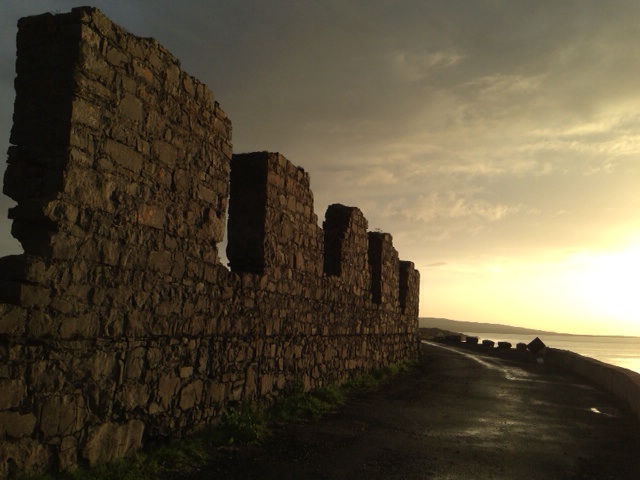
Magic followed me on another remarkable walk home from Ti Joe Watty’s pub.  This evening, I was on the low road a bit earlier, closer to eight.  The soft gold from the setting sun infused the air, the green fields shimmered, and stone walls mirrored the light. Coming across the abandoned kelp factory, the time of the fairies engulfed me, making me a believer.

Food

The Lower Road 10:00 P.M.

I love to cook and I love to be fed. Maura provides breakfast for all the guests and dinner most nights. My plan was to eat a hearty breakfast, skip lunch, and “eat all my dinner.” This I have done. My first morning I had to have it all, a full Irish breakast: 2 pieces of Irish bacon (more like ham), two sausages, two fried eggs, a tomato, and four pieces of brown bread. While Maura got that ready, I had a bowl of porridge. It tasted better than any I had before. I have begun each breakfast with the wonderful porridge, but have not repeated the Irish Breakfast. I can only be a morning glutton once.

My poor depth perception (good vision in only one eye) has created a problem in the dining room.  At least, I’m attributing the noise and mess I make to visual inadequacy.  I tend to bang my cutlery  rather noisly.  Maybe I don’t see how close they are to the plates as they often tend to fall on to the table, sometimes, even the floor.  A small circle of food can be found around my salad plate, and drops of salad dressing find their way to distant spots on the table.

Maura is an excellent cook. Everything that comes out of the kitchen is delicious and 0ften straight from the garden. I have eaten fish almost every day whether for breakfast in the form of smoked salmon or for dinner from sea trout to sea bass. All of it tastes as if it was just caught. I asked her if she has always liked to cook.  She nodded yes and said that when her children were in school, she wanted to get a job catering, but Joe wouldn’t have it as he said she wouldn’t have enough time.  Instead she went to a cooking school which she declared was the best thing she ever did.

On Tuesday, Maura went to Galway, so I had to fend for myself. Joe had to pick her up from the return ferry and offered me a ride.   We had a free ranging conversation.  He loves to read and gets taken with a subject.  For awhile it was the Romans.  Presently, he is immersed in Mozart’s Operas.  He isn’t sure if Maura also appreciates hearing so much Mozart. When I told him that he was a lucky man as she is such an accomplished cook, he said “Well its nice she’s good at something.”  We finished the conversation with my Irish roots and that I had named my daughter, Medb (Maeve) after the Queen of Ireland.  We talked of how she had been a lusty queen, and he added, “Celtic women had it good and had their way until the Normans came and imposed their patriarchal culture.”

Ti Joe Wattys

I returned to Ti Joe Wattys with the notion of being able to walk back after dinner. This night it was sea bass again delectable and under it was the familiar taste of a mashup I had in Dublin years ago: turnips and parsnips mashed with butter. I began my meal with Jameson’s and had two glasses of wine with dinner. I felt rather optomistic.  The sun was out, it was 8:30, I could make it home by 10 and it would still be light. I took the low road again.

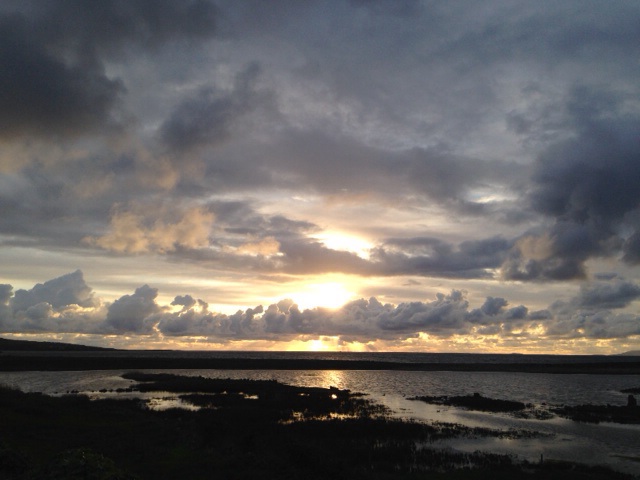
During most of my walk I talked to myself, sighing in wonder. The sky was a bowl above my head, nothing to block the 180 degree view. Surrounding me were clouds made for the heavens lit from behind like jewels, sapphires, onyx. I skipped and danced down the road. Joy, freedom, visual ecstasy.