Day 32 Paris

Wednesday May 2

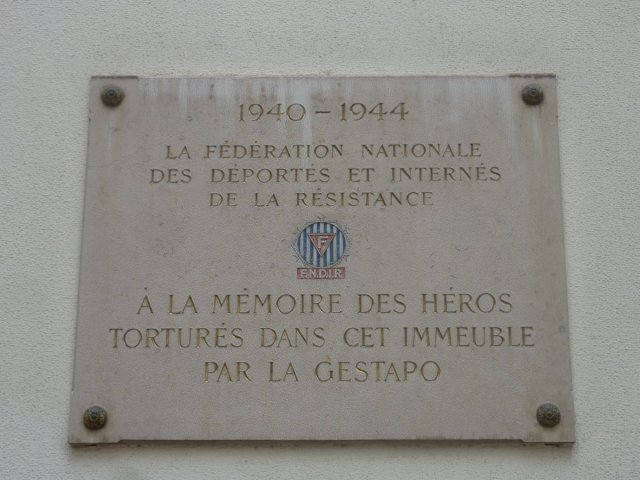
Today, I followed my previously upended plan of visiting the Jeu de Paume, now a museum of photography, by walking through the Tuileries, and, afterwards, searching for signs of Duras.  I will look for Rue Dupin, her husband’s family home where a resistance cell often met.  It was there that her husband, Robert Antelme, was arrested and, then, sent to Buchenwald and, finally, Dachau.  His arrest, imprisonment, and rescue figure largely in her memoir, La Douleur (The War).

“There’s no room for me here anywhere, I’m not here, I’m there with him in that region, no one else can reach, no one else can know, where there’s burning and killing.  I’m hanging by a thread, by the last of all probabilities….”

Another quiet breakfast without my pals.  I did nod hello to a younger resident who sometimes joined us.  But he was surrounded by a bevy of laughing young women, completely engaged.  I never saw him again.
staying_gallery_07_660_360_80_c1
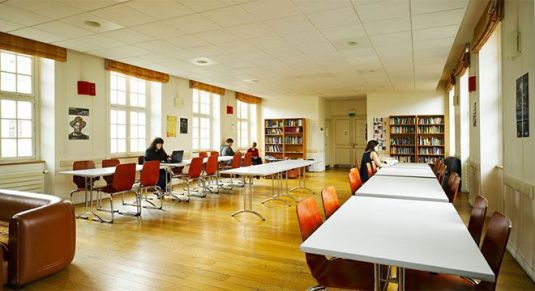
Residence Hall, Irish College, Paris

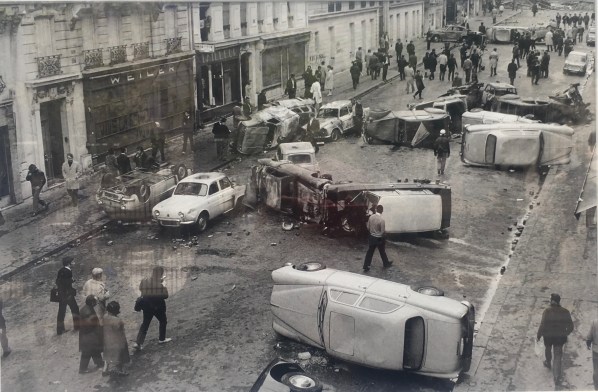
On my way  to the Tuileries in a gallery on Rue Bonaparte, I saw a photo depicting the riots in 1968- the revolution that sent De Gaulle running.  This is the first recognition I’ve seen of the momentous event that took place 50 years ago.  Why?  I’m thrilled I will be here on it’s anniversary.  Am I the only one?
IMG_3886 2
Cars used as a barrier by students, Rue Gay-Lussac, May-June 1968

Duras must have celebrated De Gaulle’s cowardice.  She wasn’t a fan as can be seen in La Douleur,

“De Gaulle doesn’t talk about the concentration camps, it’s blatant the way he doesn’t talk about them, the way he’s clearly reluctant to credit the people’s suffering with a share in the victory for fear of lessening his own role and the influence that derives from it.”

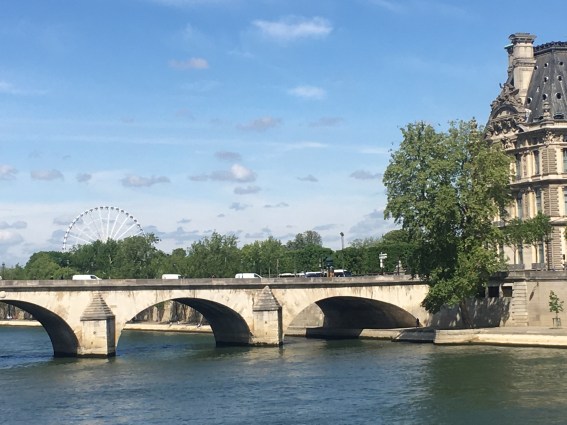
I walked to the Seine and over Pont Royal, crossing Quai Francois Mitterrand.
IMG_3890
Pont Royal, Paris

Mitterrand, a member of that very cell at Rue Dupin, narrowly escaped arrest the night Antelme did not, according to Laure Adler in Marguerite Duras, A Life:

“Mitterand called again from a public phonebook in Boulevard Saint-Germain.  This time Marie-Louise (Robert Antelme’s sister who was also arrested and later died in Ravensbruck) was curt, ‘Monsieur, I have already told you, you are mistaken.’ Then Mitterand understood.”
IMG_3903
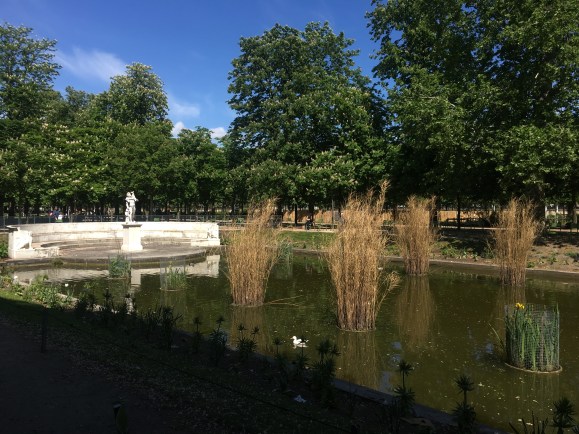
North Exedra Pond, Jardin des Tuileries

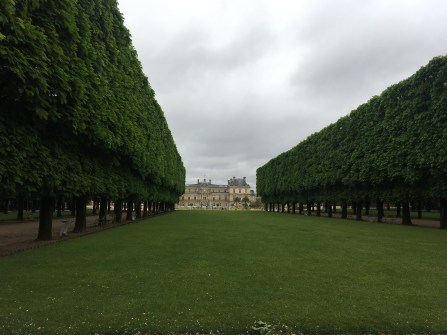
Dark thoughts as I wandered through the gardens on a cloudless spring day.

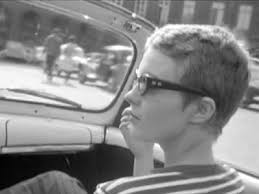
I reached the Jeu de Paume at the end of the Tuileries where it faces La Place de la Concorde.  In Breathless, Jean-Luc Godard used the same location to film Jean Seberg and Jean-Paul Belmondo taking a spin in a stolen car just 15 years after the liberation of France. Although he used jump cuts to shorten the film, his editing created visual energy and excitement mirroring the relationship between Seberg and Belmondo.
Unknown-3
Jean Seberg, A Bout de Souffle, Breathless, 1960

There are two exhibits at le musée: an Austrian photographer, Raoul Hausmann and an American, Susan Meiselas.  I began downstairs with Hausmann who was part of Berlin Dada, the images taken from 1927-1936.  At the entrance, the show’s curator introduced Hausmann’s work via a looped video.  Several minutes passed before I realized she was speaking in French. I understood it all.  Quelle surprise!
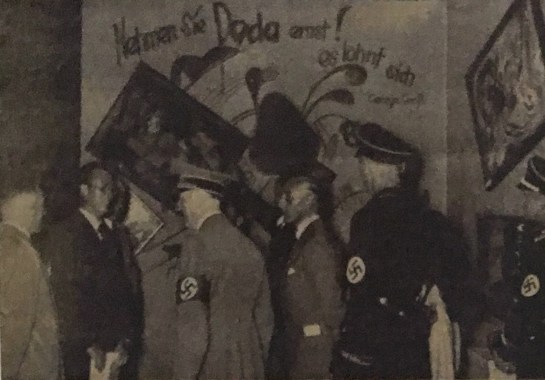
IMG_3927-1     A Nazi exhibition denouncing “degenerative art” which included Housmann’s work.

The Meiselas exhibit took up the entire second floor: it’s depth and humanity startled me.  I began photographing each note and image.  The Prince Street Girls reminded me of Little Italy in the winter- the smells of Italian pastries, small cups of espresso, steamed windows.
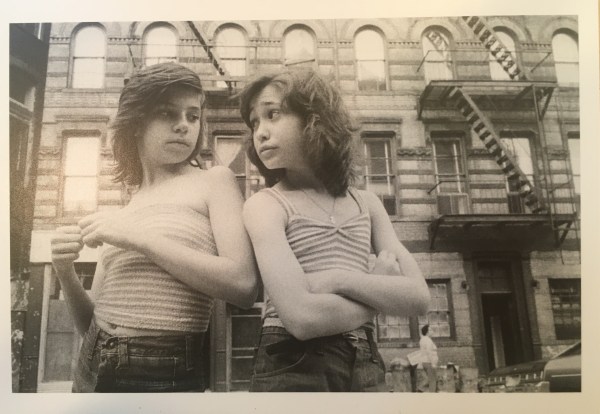
IMG_4413Dee and Lisa on Mott Street, Little Italy, New York, 1976

In the next room, the work on Nicaragua distressed me.  I wanted to leave: too much pain.  But I couldn’t pull myself away.  Her work makes me hopeful.  A humanist artist.  She, like the Iranian filmmaker Abbas Kiarostami, considers what it means to capture an image, a life, not just the shot.
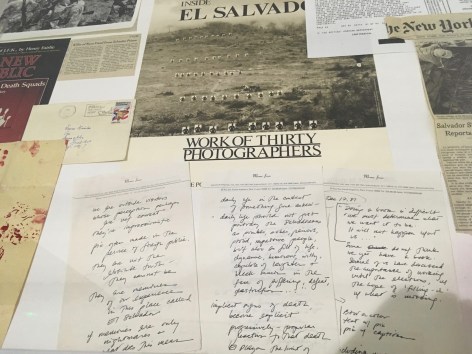
IMG_3986

In the bookstore, I find Duras and another American, Diane Arbus.  A celebration of both my histories, France and America.
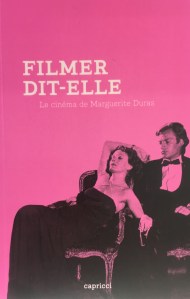
IMG_4005-2IMG_4007

I sat outside on the terrace of the museum’s salon de thé et café, La Boîte à Images, had a coffee, and gazed across the gardens.  Now, the photo I put up on Instagram of Agnes Varda as she entered her home haunts me.  I was so excited- I had caught her.  I didn’t consider her right to privacy, her right to go through her day unassaulted.  As a mea culpa, I took the image down, replacing it with a closed notebook and the comment, “Instead of Agnes Varda who deserves her privacy.”
IMG_4008

I left the cafe in search of Duras.  It took me a long time to get to Rue Dupin.  I kept getting turned around, finding myself going up and down Rue du Cherche-Midi or ending up on Rue de Sèvres.  One detour reaped a reward, the offices of Les Éditions de Minuit where Duras published many of her works.  In his book, A Walk Through Paris, Eric Hazan laments the loss of publishing houses in the 6th arrondissement to what he calls the “capitalist concentration of publishing”  and comments on those that stayed:

“A few major publishers have remained in the quarter, Gallimard, Minuit, Fayard, and Bourgois among others, but they are like vestiges of a past splendour.”
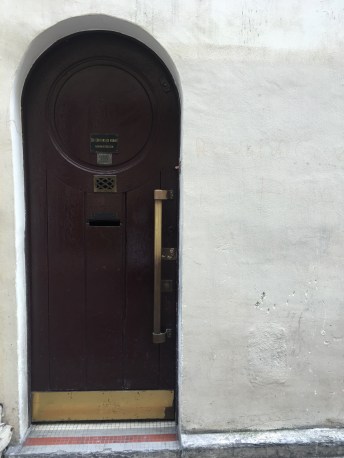
IMG_4028
Les Éditions de Minuit, 7 Rue Benard Palissy

Finally, I found 3 Rue Dupin where the Antelme apartment was located on the floor above the post office.

09afa8f54adcb6d.12890
3 Rue Dupin, Paris where Robert and Marie-Louise Antelme were arrested.

Then, I noticed L’Epi Dupin, a restaurant whose card I’ve been saving for years.  I don’t know why: I don’t remember eating there. How did I get it?  How easily I get waylaid by the minutiae of my own life even when faced with the tragedy and loss that took place on the same street almost 74 years ago.

IMG_3168

After ten miles of walking, cheese, radishes, and a baguette in my room became dinner.
 

Day 31 Paris

May 1 Tuesday

I’m on my own for real.  When I went down for breakfast, not a familiar face.  I spotted a visiting artist I’d seen yesterday.  Sitting alone, slumped over the table, she seemed isolated.  I approached her saying I had heard of her from a previous tenant, the poet.  I didn’t wish to bother her but wondered if she’d like some company.  “I haven’t even woken up,” was her retort.  I retreated to my seat, never to darken her breakfast again.  Other residents wandered in, and for the first time in a month, the room was silent, deadly silent.

No class today: it’s La Fête du Travail, a national holiday celebrating worker’s rights. America has it’s Labor Day but I’m not convinced the focus is on worker’s rights.

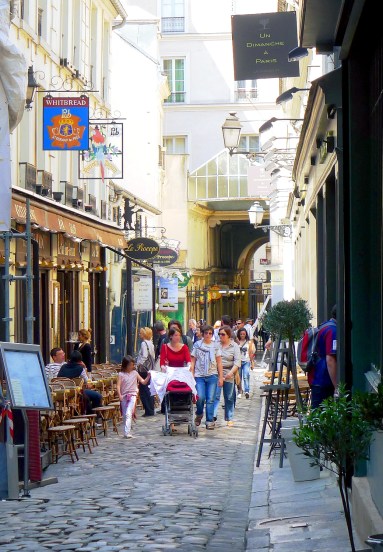
Given the French Revolution was all about rights, taking a walking tour offered by Paris Walks on that topic seemed appropriate.  I misread the time of departure and rushed to Metro Odéon glad to be in my old quartier.  The group was large, the tour guide amusing and well-informed.  It began with the statue of Danton next to the Odéon métro.  Georges Danton is credited with leading the overthrow of the monarchy and establishing the French Republic but his head rolled under the guillitone when he stood against the Reign of Terror.  Next, we walked en masse across Boulevard Saint Germaine to one of the passageways of Paris, Cour du Commerce Saint-André.  We passed the back of Le Procope, the oldest café in Paris, where many a revolutionary scheme was hatched. Benjamin Franklin frequented the café when he was trying to get France to support our own revolution and was seen walking through Paris in a coonskin hat.

P1020086_Paris_VI_Cour_Cour_du_Commerce-Saint-André_reductwk

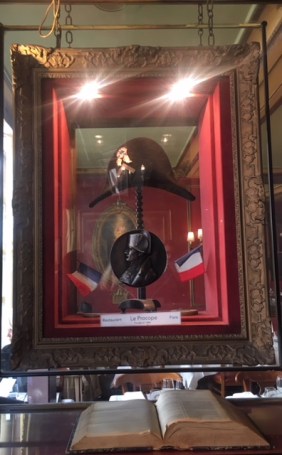
A few steps away was the home of Jean-Paul Marat (Marat de Sade) editor and owner of a revolutionary paper, L’ami du Peuple.  At the end of the passageway, we made a u turn and came to Rue de l’Ancienne Comédie to look inside Le Procope where Napoléon left his hat as collateral while serving as an officer in the French army during the revolution.  Napoléon did enact the Code Napoléon which became the Code Civil des Français.  It declares all “men” equal and lays out rights to which they are entitled.

IMG_3873 2

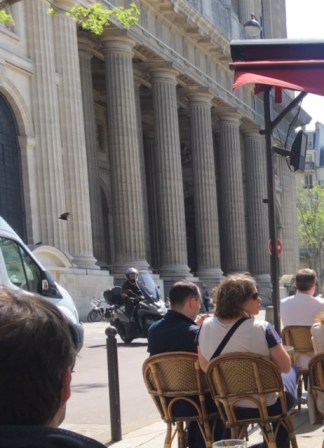
After several hours of wandering within a few blocks of Odéon, we ended up at Saint Sulpice, a perfect end for me given how often I visit.  Over the center door is a sign left from the revolution: “’Le Peuple Français Reconnoit L’Etre Suprême Et L’Immortalité de L’Âme’’ or “The French people recognize the Supreme Being and the immortality of the soul” declaring the basic tenet of what was hoped would be the state religion replacing Roman Catholicisim.

IMG_3664

Tired and hungry, I happened upon a stand on Boulevard Saint Michel selling tartiflette, sausage, and beer.  I had made this dish rich with potatoes, cheese, bacon, and onions.  It could be my dinner.  Small tables and chairs sat next to the stand.  After hours of being part of a crowd, I welcomed the chance to sit alone and enjoy my luscious indulgence. Although there were empty tables, a woman approached me and asked if she could join me.  I pointed out that there were plenty of other places to sit.  But she was determined and sat opposite me.  I wasn’t very gracious, didn’t engage in conversation or make eye contact.  Am I reverting to my French heritage?

tartiflette-127553-1

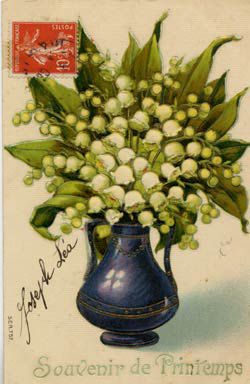
Twenty minutes later, sated, I was on my way.  I passed a man selling lily of the valley bouquets.  Tradition dictates that the sweet smelling tiny flowers be given to a loved one on May 1.  I bought some but the only recipient would be moi.

pcmuguet

I hurried home to catch a few winks before going to the play, Agatha.  Luckily, the theater is just a few blocks from the Irish College.  As soon as I got in my room, I looked up the email with my ticket to check the performance time.  It was at the Théâtre de L’Epée des Bois which I assumed was the theater down the street since the movie theater on Rue Moufettard is called L’Epée de Bois Cinéma.  Wrong I was.  The theater is literally in the woods, in the Bois de Vincennes, not far from where I lived my first time in Paris in Saint Mandé but it would take me over an hour to reach, too far for me to arrive in time.

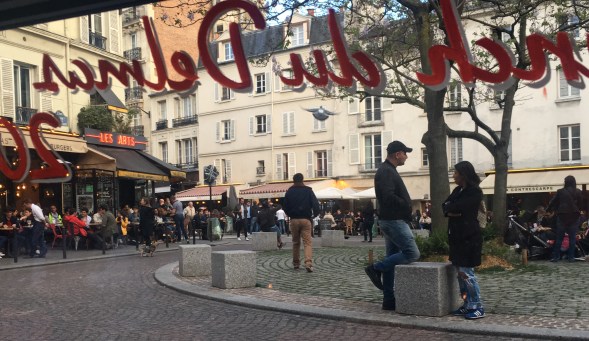
An early night after a drink at Café Delmas contemplating the gatherings on Place de la Contrescarpe.

IMG_3832

Paris Day 29 and 30

Sunday April 29, Monday April 30

A rainy day and the Poet’s last morning, our breakfast club still intact.  Will the collegial atmosphere continue or will it wither away?

IMG_3463
Along the Seine

For several days, I had noticed advertisements in the neighborhood for a flea market on Rue Mouffetard beginning in the early hours of the morning maybe even by 5 a.m.   After breakfast and final good-byes, I decided to explore.  I must have gotten the dates mixed up as I found only a food market.  A small market but interesting as are all the marches de Paris.  I shyly moved up and down the aisles trying to decide where to stop.

Since all I have is a small refrigerator cubby in the kitchen on my floor, I’m limited to what I can purchase.  As I perused the market, I practiced the French I would need to make my transaction.  Bon Jour Monsieur or Madame.  Je voudrais….  C’est combine? Good morning sir or madame.  I would like…. That’s how much?  I decided on a cheesemonger that looked promising, long lines and cheeses designated as award winning, for instance, a morbier touted as the best in France.  Also, a large wheel of comte seemed to be popular among the customers.  In front of me, a woman ordered a saucisson sec maigre.  Really, a French low fat salami?  Finally, it was my turn.  As usual, all my practiced French went out the window.  I was tongued tied but managed, and thank God, remembered to be polite first and foremost.  I began successfully with “Bon Jour Monsieur.  Je voudrais…” but stumbled requesting the saucisson.  Immediately, Monsieur switched to English and, with great charm, educated me on the finer points of choosing.  “Madame, that saucisson is a bit soft, not the best of textures.  But Madame, first you must taste and then choose.” He continued to entertain me and the other customers with his practiced chit chat and gallantry towards the poor Américaine

I walked away with low fat sauccison and the gold medal morbier.  He was right about the sauccison and the morbier, a gift from the gustatory Gods.

IMG_3842

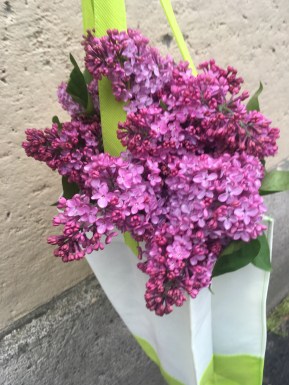
On my way out of the market, a young boy was selling bunches of lilacs. A Paris moment-a bouquet of lilacs in my hand and packages of fromage and saucisson.  C’est parfait.

Monday April 30

Another poet leaves today, and another rainy day.  I could see that I needed to plan my last week carefully or I might slip into a nostalgic funk.

IMG_3861
Jardin de Luxembourg

As soon as I got back to my room, cold and wet, from the Alliance Francaise, I researched possible outings in L’Official des Spectacles, a weekly list of events in Paris.  I found two excellent choices, a Marguerite Duras play, Agatha, which explores incestuous feelings between a brother and sister, something Duras experienced first hand at Théâtre de L’Eppe de Bois, tomorrow night, and Miss Nina Simone in Montparnasse, Sunday May 6.

AGATHA
de Marguerite Duras
 
Mise en scène Bertrand Marcos
Un dialogue entre un frère et une sœur. Ils s’aiment, au-delà de l’amour fraternel qui conviendrait, au-delà des frontières de ce qui est possible, de ce qui est permis. Elle lui a demandé de la retrouver dans leur villa d’enfance afin de lui annoncer son irrémédiable décision de partir, loin de lui.
                                           Miss Nina Simone au Théâtre du Lucernaire

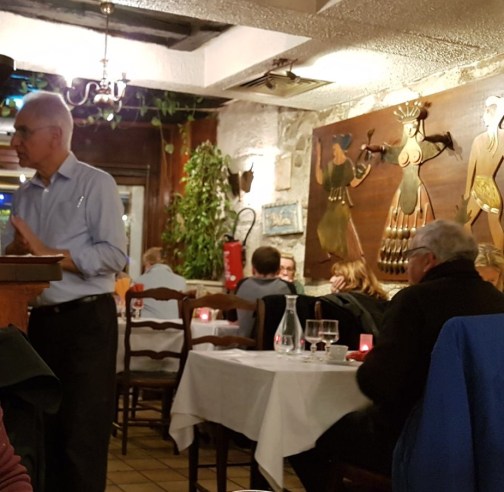
I had planned to have dinner at the Irish College but the grey skies and cold room would make for a dreary meal.  The remaining poet and I went to a Greek restaurant  on Rue Mouffetard.  Warm, cheerful, and comforting Greek food.

6b149e3c-8711-43fe-b4cf-bd7116ab36b8
La Crète

Paris Day 26

Thursday April 26

Only twelve days left before I return to the United States.  I don’t have enough time to explore Sophie Calle or even my own family at the National Archives.  Many shoulds.  I feel pressured to squeeze it all in.  An impossibility.  I must remember to take a photo of the charming street I pass every day on the way to the Alliance Française.   I have only today and two more classes.

IMG_3696

Rue de l’Abbé de l’Epée

Given yesterday’s debacle, I decided to approach Duras by visiting Musée D’Orsay.  As part of The Resistance, she often visited Gare D’Orsay working with the BCRA, Bureau Central de Reseignement et d’Action (Central Office for Intelligence and Action) which coordinated intelligence supplied by French networks.  In her memoir The War, she describes her days at the Gare:

 “…I set myself up there by stealth with forged papers and permits. We managed to collect a lot of information…about movements of prisoners and transfers from one camp to another. Also a good many personal messages.”

and after the arrival of French political deportees,

“Orsay.  Outside the center, wives of prisoners of war congeal in a solid mass.  White barriers separate them from the prisoners.  ‘Do you have any news of so-and-so?’ they shout.  Some stay till three in the morning and, then, come back again at seven.  But there are some who stay right through the night.”

6d822e44ff03aefcbec98716e13e6f17                              Returning Prisoners Arriving at Gare de l’Est 1945
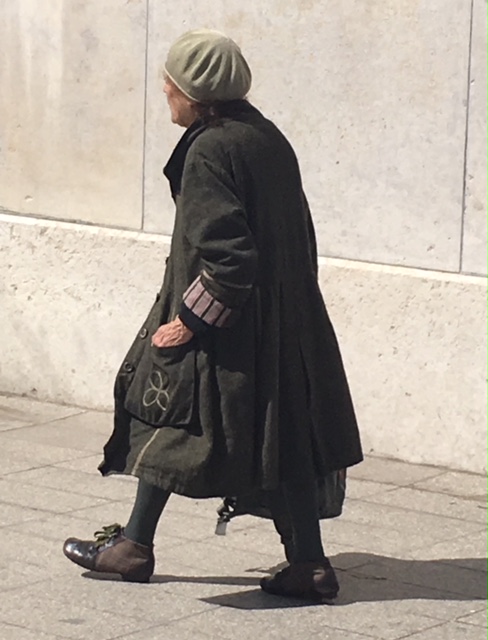
On my way, I passed several sandwich shops: all smelled delicious. I don’t have time for breakfast on the days I go to class, so I was particularly hungry.  While trying to decide which shop to patronize, I passed a woman from a fashion time warp, a thirties coat, 1900’s shoes. Up and down the street she strode.  Maybe this was my Sophie Calle moment.  Sophie Calle, a French multimedia artist, that is, writer, photographer, installation and conceptual artist, followed a man on the streets of Paris and all the way to Venice photographing him without his knowledge.  Later, she had her mother hire a detective to follow and photograph her as she went through her day.

IMG_3709

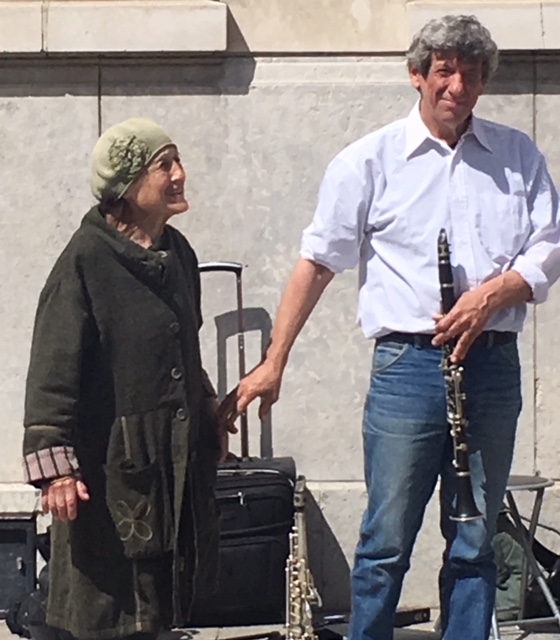
I walked a few hundred feet behind the woman until she entered a drug store.  When she emerged, I couldn’t maintain the stalking.  I’m not made for artistic ruthlessness where another person unknowingly becomes a source of creative endeavor.  Instead, I got in line at a sandwich shop, which would have been at home in Brooklyn: locally sourced ingredients, minimalist design, lots of grains and vegetables.  I took my lunch to the steps of the Musée d’Orsay.  There she was, my thirties’ prey, standing next to a trio busking in front of the museum.  I can’t seem to escape my country: the group played American blues music.  Then, she came alive, dancing in all her magnificence from one song to the next.  When they took a break, the clarinet player raised the dancer’s hand and said to the audience “Merci, Madeline”

IMG_3725                                                                  Madeline

If I wanted to write, I had to get going.  After a long day, Duras describes her walks home from Gare d’Orsay.

“As soon as I leave the embankment (along the seine) and turn into Rue du Bac, the city is far away and the Orsay center vanishes.”

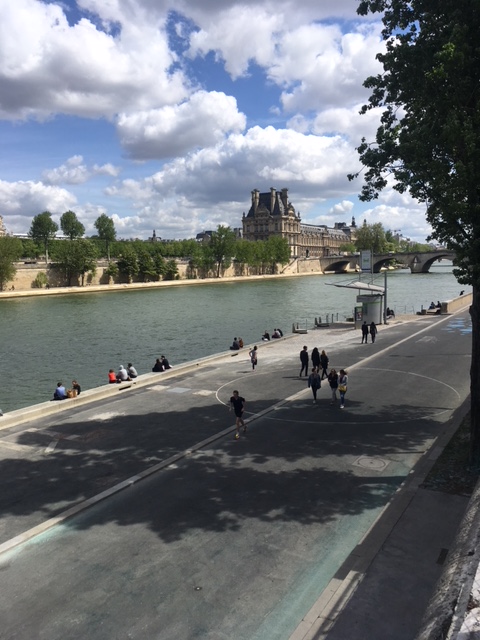
I would do the same.  The sun was shining just as it was for Duras.  The Seine winked blue-green at passers by.  How privileged we are sitting on the steps of the museum, walking along the Seine, having tea in Restaurant du Musée d’Orsay.  In 1945- hunger, fear, despair, loved ones tortured, killed.  But I walk along the Seine undisturbed, unmolested, unafraid.  And just last year, miles away in Calais, a makeshift refugee camp was destroyed.  Even here, the homeless don’t always find shelter.

IMG_3742

Quai Anatole Franc

I enjoyed meandering back to the Irish College and decided to forgo writing.  I made one more Duras stop, the office of her publishers for many years, Gallimard, who collaborated with Vichy in order to publish resistant writers, Jean-Paul Sartre and Camus.  When Patti Smith visited Gallimard, her French publisher, she writes:

“My editor Aurélien opens the door to Albert Camus’s former office.”

Did she know it’s history?  Does it matter?  Can we compromise and be ethical?

Unknown

Gallimard Office, Rue Gaston Gallimard

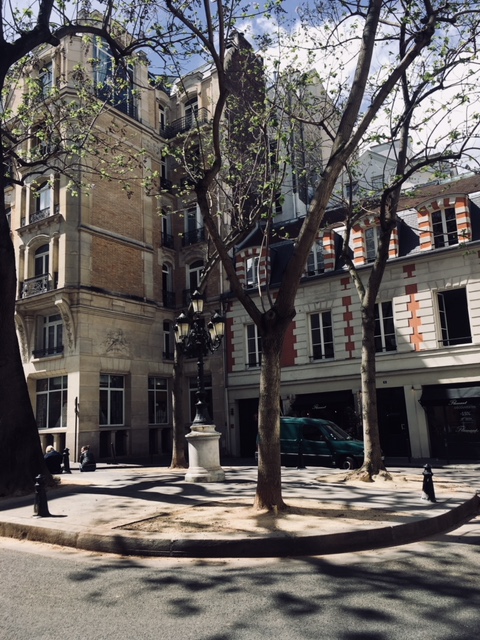
Gallimard is off Rue de l’Université which becomes Rue Jacob and ends at Rue de Seine.  Towards the end of Rue Jacob, I looked right and discovered an empty Place de Furstemberg.  Was I in Paris or Aix-en-Provence where such retreats abound?

IMG_3784                                                    Place du Furstemberg

On Rue Monsieur le Prince, I passed Les 3 Luxembourg Cinema.  I spotted a connection to Agnes Varda. A film entitled Peau d’Ame sur les traces du film de Jacques Demy (Varda’s husband) was playing that night followed by a discussion with the filmmaker, Pierre Oscar Levy.

Two hours later I was seated.  The film is a tongue in check archaeological exploration of the setting of Jacques Demy’s film Peau d’Ame, a musical based on the Charles Perrault fairy tale of the same name, that is, Donkey Skin, about a King who wants to marry his daughter.  Demy used Michel Legrand for the music and Catherine Deneuve as the lead just as he had in The Umbrellas of Cherbourg.

In the film, made over four years, students brushed dirt from artifacts such as pieces of costumes and colored glass as they would on any archealogical dig.  Demy and Varda’s daughter, Rosalie, was interviewed when a ring worn by Deneuve was discovered. The audience occasionally laughed but I couldn’t get the jokes.  Afterwards, the filmmaker and an archaeology professor from the Sorbonne discussed the authenticity of such an endeavor for well over an hour.  Mon Dieu.  I dozed a bit; then the need to get some dinner overroad politeness.  I departed just in time to get a Lebanese sandwich at Au Vieux Cedre near Place de la Contrescarpe.  While I waited, the owner offered me a glass of mint tea. A graceful gesture to the other who, now, doesn’t feel like the other.

Unknown-1                                                                Au Vieux Cadre


Paris Day 25

Wednesday April 25

I planned to explore various locations gleaned from Marguerite Duras’ memoir La Douleur (The Pain) in French or The War in English.  The memoir recalls her experiences during the German occupation and the difficulty adjusting after the liberation of Paris. She and her husband, Robert Antelme, were members of The Resistance.  In June 1944, Robert Antelme, was arrested by the Gestapo at his family home where his sister, Marie-Louise also a member, lived.  Rue Dupin had become a meeting place for their group which included Francois Mitterand.  Eventually Antelme was imprisoned at Dachua.   While he was held in Paris, Duras tried to send packages to him through the Gestapo at its headquarters at 11 Rue des Saussaies.

Csk4E8xWIAQ8xmWGestapo Headquarters, 11 Rue Saussaies

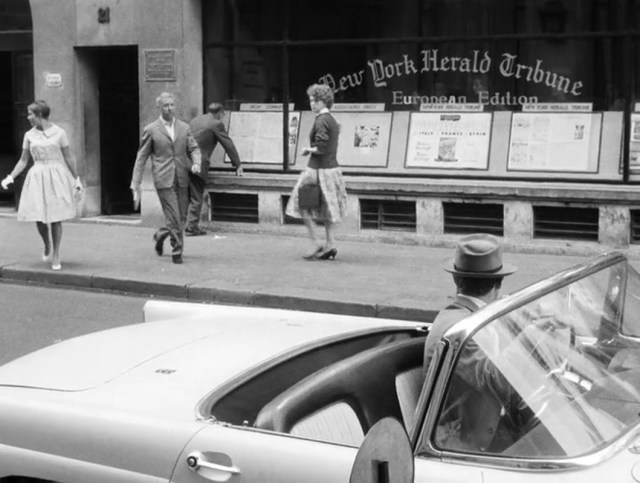
I could get to Rue Saussaies through the Jardin des Tuileries, wander up the Champs Elysees, following my old newspaper route, make a right on Rue de Berri, look for the old Herald Tribune office where I picked up my papers, turn right on Rue Saint Honore, and, a few blocks later, hit Rue Saussaies.  On my way back to the Irish College, I could go by Rue Dupin located in the 6th off Rue de Sevres.

8856460_origParis Herald Tribune Office, Rue de Berri, Still from A Bout de Souffle (Breathless)
It was not to be. The night before, I had spent every Euro I had on dinner.  On Rue de Soufflot, I went to a bank ATM to withdraw some cash.  Denied.  I assumed something was wrong at their end, not mine. I had plenty of funds in my bank account.  After trying two more banks, I realized my bank card ne march pas, didn’t work.

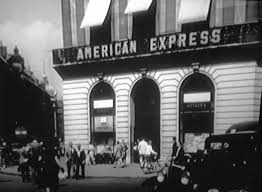
As it was noon in Paris, therefore, six in the morning in the states, I had to return to my room.  After 10 minutes of pacing, I tried the 800 number on the back of my bank card, but it only dealt with lost cards.  I searched for an American Express office hoping that as a card holder, they might help.  None exist.  Not like the days when I could pick up my mail, cash a check, meet a friend there.

UnknownAmerican Express Office, Rue Scribe, Paris

I asked an administrator at the college if they could cash a check for me.  No. He suggested I try a currency exchange office.  Back to Rue Soufflot.  No again.  I went to a few banks.  Absolument pas!  Back to my room.  Two hours later, my bank remained closed.  I called American Express in the states, no go.  I didn’t have the right account to withdraw money.  Finally at 9, I reached my bank.  A digital glitch.  A questionable withdrawal had shown up on my account automatically freezing it.  It could not be unfrozen.  They assured me they had called me at home and sent me a new card.  I reminded them that I wasn’t at home but in Paris with no dough.  Then, they informed me they could not send me money.  I suggested they get on a plane with some moola as I had none, and, therefore, was unable to buy food or even get a cab to the airport.

Five hours later after moving up the chain of command, they advised me to wire money to myself using Western Union.  I hurried to an office on Boulevard Saint Michel as closing time was approaching.  Their computers were down.  Merde.  They directed me to another office further down towards Boulevard Saint-Germain.  Their computers worked.  I spoke to the clerk using English and French: no, I could not wire myself money.  Someone else would have to send it to me.  And so, a family member saved the day.  It had taken only 7 hours to be rescued.  A lesson: always have a secondary source of funds.

I had expected to go to a reading by my daughter’s novelist friend, but the thought of traveling to Montmartre at 8 in the evening overwhelmed me.  I settled for a gyro from Au P’tit Grec on Rue Mouffetard.  I, also, ordered a bottle of retsina but first had to convince one of the customers, a Greek man, that I knew what I was getting myself into, mostly through nodding my head up and down.  As I walked back to my room, I figured out what I could have said to him in French.  It seems I can speak adequate French after the fact.  Should I have tried Ellenika, that is, Greek?

images-1